
Crisis of democracies: threats and challenges in the context of identity emergencies in Latin America
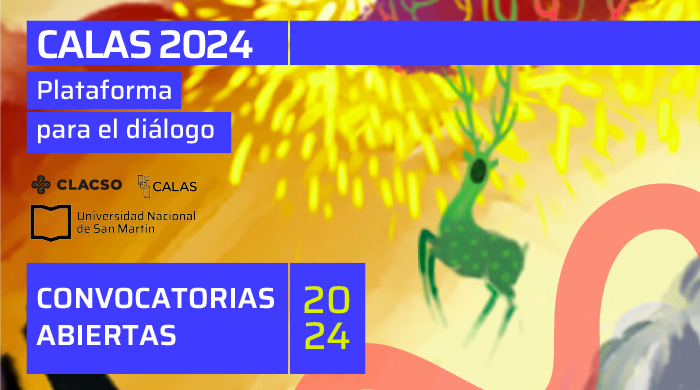
The Center for Advanced Latin American Studies (CALAS, for its acronym in English) invites participation with presentations and debates in the Platform for Dialogue “Crisis of democracies: threats and challenges in the context of identity emergencies in Latin America.” This activity is part of the Knowledge Lab: «Strategic Identities and Crises in Latin America: Processes and Tensions"The fourth CALAS initiative on 'Addressing Crises: Transdisciplinary Perspectives from Latin America'. This time, the Dialogue Platform will be organized jointly with and supported by the Latin American Council of Social Sciences (CLACSO)."
Laboratory 4 explores the notions and interrelationships of identity and crisis in Latin America from an interdisciplinary perspective, drawing on the social sciences, humanities, and art. The Laboratory analyzes how social change—driven by constant crises—is perceived and how this is reflected by different social actors in diverse fields, including politics, economics, cultural and artistic production, media, and social movements. In the region, this social change has been expressed through intense political, economic, and social conflict between hegemonic powers and marginalized identities. Consequently, this laboratory invites reflection on how identities are constructed and reconstructed, who the social and individual actors are that participate in these processes, and how these identities are represented or what forms they take.
This call for proposals is part of the activities of the third research axis of the laboratory “Crisis of Representation and New Identities in Actors of Democratic Public Life.” A central characteristic of the current functioning of contemporary democracies, particularly since the beginning of the 21st century, is the transformation and crisis of the forms of representation that had been established since the mid-20th century.
Thus, various processes shape a landscape of constant change, with recurring crises and multiple impacts on key actors in public life. Among others, we are interested in examining five concurrent processes that are reshaping democratic dynamics in Latin America. First, the shift from representative relationships centered on political parties to those centered on personal leaders. In this way, politics is undergoing a strong push toward personalization, and citizens' trust is now placed in the vague images that leaders construct, primarily through the media and new digital channels. Second, the questioning of political representation based on promises and mandates, which was characteristic of a party-based democracy, and the emergence of "compass" leaders who gain prominence in increasingly unpredictable scenarios. Third, the processes of expanding rights, now expressed not in universalist terms but in particularist and identity-based ones. That is, it is directed at specific groups defined by traits that are assumed to be part of their identity and that, therefore, challenge the classic democratic notion of the general will of a sovereign people. This is expressed, for example, in the increasing judicialization of public life and the particularistic demands often framed in global terms. Fourth, the proliferation of protests and citizen mobilizations that challenge power and exercise a veto over government decisions intensifies the negative aspects of the ways in which popular sovereignty is expressed.
In short, these processes challenge the very idea of representation, the delegation of power, and political leadership, and contribute to a growing dissatisfaction with the usual forms of mediation between civil society and the state. As a result, we see the emergence and consolidation of processes such as the rise of a "new right"—that is, political spaces and figures that combine a radicalized "anti-system" discourse with reactionary or conservative proposals; the emergence of strong political polarizations and antagonisms; and the organization of collective actors grouped in non-partisan structures that, at the same time, do not replicate corporatist forms.
For all these reasons, the notion of crisis is relevant to frame and reflect on the course of contemporary democracy in Latin America, as we witness discontent with the characteristics that had defined it since the mid-twentieth century, and an ongoing mutation that is reformulating, in an unstable process with an uncertain direction, notions and aspects such as identities, citizenship, representation, and rights.
The platform has three areas of focus for analysis:
- State and public policies. State responses to the challenges of political representation.
- Political system, parties and representation. Identity reconfigurations, new political mediations, particularist demands and emerging conflicts.
- Polarization, radicalism, and political antagonisms. Challenges and uncertainties of the current political landscape.
Event and application rules:
The Platform will feature conferences by specialists and will be developed in a Workshop format with debate sessions in which participants and guests are expected to present and discuss their own work.
Location: Campus Miguelete – National University of San Martín (UNSAM), Buenos Aires, Argentina.
Date: November 12 and 13, 2024.
Addressed toThe call is aimed at graduates, researchers, activists, artists, and social leaders involved with the topic, who on the one hand work from diverse disciplines and knowledge, and on the other hand can contribute to theoretical-methodological reflections and/or experiences and ways of doing things from the links to the territories.
Languages: Spanish (preferably), Portuguese, English.
Postulation: complete the application format online with title and summary of the proposal (300 to 400 words) and a brief sheet indicating the professional career, publications and/or relevant activities in the subject.
Deadline for submitting proposals: 02 June, 2024
Academic Committee:
Dr. Lucas Christel (UNSAM), Dr. Claudia Hammerschmidt (Universität Jena), Dr. Jacqueline Behrend (UNSAM), Dr. Claudia Tomadoni (Universität Jena), Pablo Vommaro (CLACSO).
The academic committee will select the submissions based on criteria of excellence. Applicants will be notified of the decision regarding their submissions before July 5, 2024.
CALAS will cover accommodation and food expenses. In addition, there will be a limited budget for travel expenses.
The selection results are now available. If you haven't received them, please contact CALAS by email at the address below.
For more information:
Maria Sibylla Merian Center for Advanced Latin American Studies, tel. +52 33 3819 3000 (ext. 23594 or 23742)
Email: [email protected]
Download the call for applications
Location:
National University of San Martin

