
Crisis of political representation
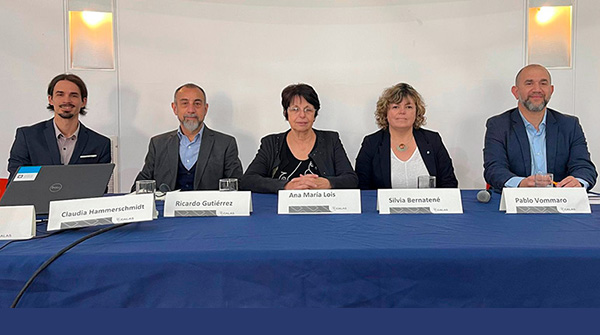

On September 4 and 5, the Miguelete Campus of the National University of San Martín (UNSAM) of Argentina hosted the Dialogue Platform “Crisis of political representation: when God is everywhere but attends in the capitals” organized by the Center for Advanced Latin American Studies (CALAS) in conjunction with and with the support of the Latin American Council of Social Sciences (CLACSO), which was represented by its Academic Secretary, Pablo Vommaro.
Also participating were the Vice-Rector of UNSAM, Ana María Llois ; the Dean of the School of Politics, Ricardo A. Gutiérrez ; the Dean of the School of Humanities, Silvia Bernatené ; as well as Lucas Christel and Claudia Hammerschmidt representing CALAS Southern Cone.
The Dialogue Platform, with the participation of specialists from Argentina, Brazil, Chile, Colombia, Uruguay, Peru, Mexico, Ecuador, and Germany, featured two keynote lectures: the opening lecture by Federico Rossi—a researcher at UNED in Spain and EPyG-UNSAM—on “social movements and democracy”; and the closing lecture by Rebecca Abers—a researcher at the University of Brasilia—on the challenges of political and social participation during the PT governments in Brazil and the post-Bolsonaro challenges.
In addition, there was a discussion on legal mobilization as a political tool in democracy that brought together researchers and social activists, and four thematic panels, which addressed different aspects of the crisis of representation: political systems and demands for representation; the redefinitions of identities and collective constructions; the reconfigurations at the subnational level and the historical processes and future challenges of changes in representation.
This activity was part of the Knowledge Laboratory: “Strategic Identities and Crisis in Latin America. Processes and Tensions”, the fourth CALAS initiative on “Facing Crises: Transdisciplinary Perspectives from Latin America”.

Among the various processes that shape a scenario of permanent mutations, with recurring crises and multiple impacts on the central actors of public life, it is possible to identify the loss of centrality of political parties as structuring public discussions and the advance of audience democracy; the growing prominence of personal leaders and the emergence of "compass" leaders; the increase in claims of particularistic rights to the detriment of universal ones; the multiplication of experiences of protests and citizen mobilizations; the emergence of "anti-system" discourses, polarization and political antagonisms, among others.
In short, these processes challenge the very idea of representation, the delegation of power and political leadership, and contribute to a growing dissatisfaction with the usual forms of mediation between civil society and the State.
However, most of these processes have been - and continue to be - studied primarily on a national scale and with the central state as the measure of all analysis.
Therefore, we understand it is necessary to reflect on the ways in which the aforementioned political phenomena are reconfigured in light of the different local, regional and/or subnational scales and what particularities the multiple facets of the crisis of representation take beyond the strictly national orbit.
In this regard, we invite you to reflect on the following questions: How are new forms of mediation between civil society—expressed in multiple identities—and the state replicated at the local, regional, and/or subnational levels? How do executive powers at these levels typically deal with the various facets of the crisis of representation? To what extent and under what conditions can processes of political conflict escalate from the local level to the national arena? To what extent are local political elites affected by the emergence of new forms of representation? How are political relations between the center and the peripheries in nation-states being reconfigured in this new scenario of political crisis and uncertainty?
The Platform generated discussions, reflections and presentations about these and other questions relevant to the topic.
This activity is part of a broader alliance between CALAS and CLACSO and was organized by the two institutions together with the National University of San Martín, the German Ministry of Science and the Friedrich-Schiller-Universität Jena.
If you would like to receive more information about CLACSO's training programs:
[widget id=”custom_html-57″]
to our email lists.

