
Disability crisis from the Global South
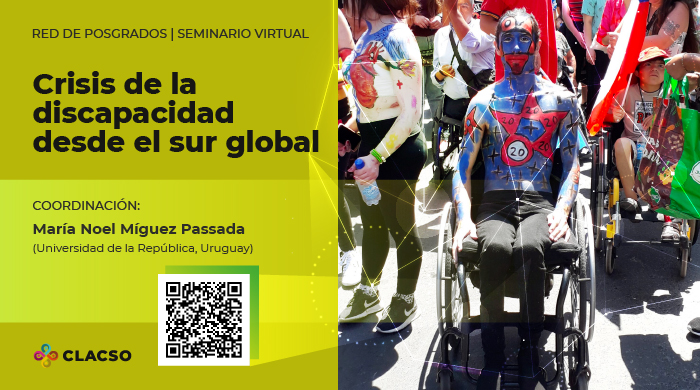
Seminar 2052
Coordination : María Noel Míguez Passada (University of the Republic, Uruguay)
Teaching team: Jhonatthan Maldonado Ramírez (WG Critical Studies in Disability), Yennifer Villa (National Pedagogical University, Bogotá, Colombia), Victor Alexander Yarza de los Ríos (University of Antioquia, Colombia)
Start date : 03/09/2020 | Registration : 20/05/2020 to 02/09/2020
Workload: 12 weeks – 120 hours.
In a historical and social framework of civilizational crisis, of paradoxical macrosocial contexts, of xenophobia, conservatism, racism, violence, disposability, exploitation, crisis, catastrophes and cataclysms on Earth, alternatives, heterotopias and new horizons are also being explored from the Global South.
The issue of disability, far from being untouched by these disputes, oscillates between normalizing neo-eugenic, techno-medical-mechanistic, ableist, and rehabilitative perspectives that condense and expand its crisis, while at the same time critical disability studies are strengthening, resignifying its evolution, repositioning it, reinventing it, and expanding it. Models, practices, institutions, devices, techniques, etc., from the Global North are being revisited from the Global South, weaving dialogues with feminisms, Queer Theory, Crip Theory, the decolonial perspective, ancestral knowledge, critical-popular pedagogies, social movements, and, fundamentally, with and from the embodied bodies of those who inhabit the experience.
From Our America, Abya Yala, or Améfrica, pluriversal and intercultural perspectives open up possibilities that enrich our practices, activism, experiences, and knowledge. We invite you to bring with you your experiences, your journeys, your listening, voices, signs, and touches that allow you to question your beliefs, challenge them, and create opportunities for connection and encounter with others.
- Fractal crises: fluctuations, becomings, countermovements
- Decoloniality and disability. The subject of disability in tension
- Disability and sexuality from a decolonial perspective
- Desiring and Undesired Bodies. Dignified Rage
- Questioning Modern Pedagogy from the Experiences of Gender and Disability in Critical Perspective
- Bodily affectivities: care, disability and interdependence.
- Pooper perspective and affective culture of failure in disability
- Indigenousness and disability: possible intersections
- Indigenous/endogenous/own paradigm in “disability”?: ancestral knowledge and interculturality.
- Knowledge in revolution: alternatives, counter-hegemonies and co-creations
- Abrams, K. (2011). Performing Interdependence: Judith Butler and Sonaura Taylor in the Examined Life. California: Columbia Journal of Gender and Law, 21.2, pp. 72-89.
- Bello, A. (2018). Towards a trans-pedagogy: educational reflections to unsettle, heal and build community. In: Feminist Debate Journal, V.55, pp. 104-128.
- Britzman, D. (2002). Transgressive pedagogy and its strange techniques. In: Mérida, R. (Ed). Transgressive sexualities. An anthology of queer studies. Barcelona: Icaria. pp. 197-228.
- Butler, J. (2014). Precarious life, vulnerability and the ethics of cohabitation. In: Saez Tajafuerce, B. (Ed.). Body, memory and representation. Adriana Cavarero and Judith Butler in dialogue. Barcelona: Icaria.
- Centeno, A.; Morena, R. (2015). Yes, We Fuck. Documentary, Spain.
- Despentes, V. (2012). Corrupt Lieutenants. In: Despentes, V. King Kong Theory. Buenos Aires: Editorial El Asunto. pp. 11-18.
- Flores, V. (2017). Interruptions. Essays on activist poetics: writing, politics, pedagogy. Córdoba: Editorial Asentamiento Fernseh, pp. 25-49.
- Flores, V. (2018). Spores of indiscipline. Disrupted pedagogies and queer methodologies. Santa Fe: Transgressive Pedagogies II, pp. 141-208.
- Fontes, C. (2014). Disabilities in Tapiete and Guaraní children and youth: analysis of community practices and knowledge. Buenos Aires: Argentine Journal of Public Health, 5(19), pp. 26-32.
- GESCO. (2010). Modernity / coloniality / decoloniality: clarifications and replies from an epistemic project on the horizon of the bicentennial. Mexico City: Pacarina del Sur, No.
- Halberstam, J. (2018). The queer art of failure. Barcelona: Egales. pp. 97-131.
- Lineros, A. (2019). Gender discrimination in the LGBTI deaf community. “Life stories or life history”, CAIDSG, Teusaquillo (Bogotá). Bogotá: National Pedagogical University. (mimeo).
- López, M. (2008). Women with disabilities: Myths and realities in couple relationships and motherhood. Madrid: Narceas SA pp. 107-140.
- Maldonado Ramírez, J. (2018) Crip Anthropology. Body, disability, care and interdependence. Mexico: La Cifra Editorial.
- Maldonado Ramírez, J. (2019). From cruel optimism to the power of failure: feeling disability in neoliberal times. (Unpublished text).
- Maldonado Ramírez, J. (2019). The failures of disability: wanting healthy children. Mexico: Nexos. (Dis)abilities. Blog about other bodies and minds.
- Míguez, MN. (2020). Disability and sexuality in Latin America. Towards the construction of sexual accompaniment. Bogotá: Revista Nómadas. (in process of editing special issue 2020).
- Míguez, MN. et al. (2020). Deconstruction of the subject of disability from a decolonial perspective.
- Munévar, D. (2013). Epistemic distances within studies on human disabilities. Bogotá: Revista Universitas Humanística, N°76. pp. 299-323.
- United Nations. (2013). Study on the situation of indigenous persons with disabilities, with special attention to the challenges they face regarding the full enjoyment of human rights and inclusion in development. Washington: UN.
- Peirano, S. (2016). My passion is sovereign. Disabling mechanisms and ideologies in sexuality and functional diversity. Córdoba: National University of Córdoba.
- Pérez, B. and Yarza, A. (Comp.). Subjectivities and disability: explorations, configurations and alterations. La Plata: UNL - Clacso.
- Rivas Velarde, M. (2018). Indigenous Perspectives of Disability. Ohio: Disability Studies Quarterly, Vol 38(4).
- Rojas, S. (2015). Disability from a decolonial perspective: a look at difference. Pernambuco: REALIS Journal, v.5(01).
- Scribano, A. (2007). Mapping interiors. Body, conflict and sensations. Córdoba: Jorge Sarmiento Editor.
- Silva, W. (2015). Life story: son of a minor god. Bogotá: Revista Voto Incluyente - Diversidad, Género y Capacidades Diferenciadas, N°3, pp. 136-142. Bogotá: Universidad Nacional de Colombia.
- Silvestri, L. (2017). Would you choose to get cured if you could? Kamchatka Journal of Cultural Analysis, 10, pp.
- Suzuki, M. (Comp.) (2007). Breaking or silence. A debate on infanticide in indigenous communities in Brazil. Brasilia: Atini – Vozpelavida.
- Yarza de los Ríos, A. (2020). Indigenous narratives on disability in Abya Yala/Afro/Latin America. Medellín: Colección Dɨwẽrsʻsã. (mimeo)
- Yarza de los Ríos, A.; Romualdo Pérez, Z. (2020). “Disability” from and in indigenous peoples in Abya Yala/Afro/Latin America: approaches from Colombia (Êbêra Eyábida world) and Mexico (Ayüük Jääy world). In: Pérez, B. and Yarza, A. (Eds.). Subjectivities and disability: explorations, configurations and alterations. La Plata: UNL - Clacso.
If you have a link with a CLACSO Associated Center:
- Paying in one payment: USD 95 (includes issuance and shipping costs of the digital certificate).
- Paying in one payment: USD 140 (includes issuance and shipping costs of the digital certificate).
- Paying in one payment BEFORE 25/08/2020: USD 150 (includes issuance and shipping costs of the digital certificate).
- Paying in one payment: USD 190 (includes issuance and shipping costs of the digital certificate).
The basic requirements for taking a seminar are:
- Availability of at least 4 hours per week to dedicate to the seminar course.
- Internet access.
- Reasonable handling of communication and computer tools.
- Language proficiency in the language in which the course will be taught. The official languages are Spanish and Portuguese.
If you have a link with a CLACSO Associated Center:
- Paying in one payment: USD 95 (includes issuance and shipping costs of the digital certificate).
- Paying in one payment: USD 140 (includes issuance and shipping costs of the digital certificate).
- Paying in one payment BEFORE 25/08/2020: USD 150 (includes issuance and shipping costs of the digital certificate).
- Paying in one payment: USD 190 (includes issuance and shipping costs of the digital certificate).

