
Covid-19 (I): Social self-preservation
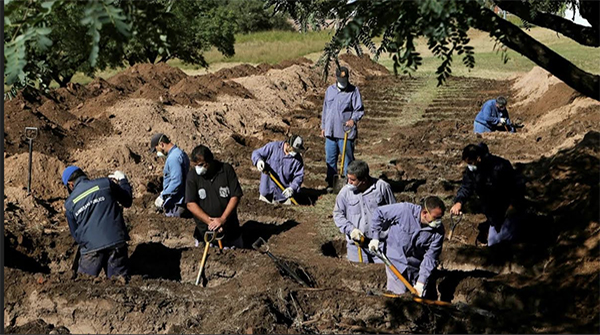
Graves are being prepared at the San Vicente cemetery in the city of Córdoba.
to receive the dead from COVID-19. (Photo: Reuters).
Esteban Torres[1]
In order to advance in explaining the socio-historical process associated with the planetary crisis triggered by Covid-19, I believe it is necessary to address seven aspects of global scope that are interrelated in varying ways: i) the progression of a social self-preservation movement based on the fear of death by contagion; ii) the advent of new protective and aggressive states, a novel legitimacy of exception associated with the actions of the former, and a state discourse of war that reinforces political leadership within the framework of the uncertainty of the current situation; iii) the unfolding of a triple crisis that is progressing simultaneously: a socio-health crisis, an economic crisis, and an ecological crisis; iv) the progress in the formation of a post-Western world society, which involves the shift of the main pole of power from the West to the East, and more specifically from the United States to China; (v) the trend toward a process of social acceleration that impacts the modes of activation of the aforementioned crises, as well as the dynamics of their recomposition; (vi) the creation of real political opportunities for the formulation of a global social change program centered on a new politics of lifethat can advance the realization of three fundamental pacts: a new health pact guided by a public health logic, a new economic pact based on a post-peripheral agenda, and finally a new ecological pact guided by a sustainable development model. Finally, as a last point; vii) the growing demand to reconnect the field of social sciences with the major problems affecting the majority of the world's population, which would require the reconstruction of a unified, methodical, and explanatory social science whose object of study is the processes of global social change.
This study unfolds in seven installments, seven texts, one for each of the points mentioned. In this inaugural text, I address the first point. The reader should bear in mind that, while each text can be read somewhat independently, the full scope of the overall analysis I propose will only be apparent after reading all seven installments.
1- The first global movement of social self-preservation
From the very moment the media began reporting that Covid-19 was wreaking havoc in Southern Europe in early March 2020, the phenomenon magnified, becoming within a few weeks the primary and almost exclusive concern of much of global society. According to surveys, less than a month later, at the end of March, between 70% and 95% of the world's population, depending on the country, admitted to being worried about the consequences of Covid-19. Western countries, particularly Europe, generally agree that this is the worst crisis the world has faced since World War II. For Latin America, this assertion is far from obvious at present, and it also triggers a wider range of interpretations, some of which point to the recognition of the numerous opportunities for political liberation and autonomous economic development that the European wars represented for the region.
The central indicators of the real danger of Covid-19 are linked to its ability to kill human beings from the contagion and, indirectly, to their capacity to destroy national economiesAs of April 20th, at 8:10 AM, a total of 2.416.135 infections and 165.939 deaths had been recorded—almost a million more infections and double the number of deaths compared to nine days prior (JHU, 2020). Just a few days ago, the United States took the lead in both infections and deaths. Another fact that has surprised the world is that seven of the top ten countries in infections and deaths are European (JHU, 2020). The capacity for economic damage, meanwhile, is associated with the destructive power of markets, businesses, and jobs, as well as the decline in the income of the world's population. I will address the figures for the evolution of this mega-economic crisis in the third installment of this study. Currently, discussions regarding which issue is more impactful and urgent to address—the direct mortality rate or the devastating effect on economies—are leaning toward the former. But this equation may soon change.
My work is based on the assumption that the social changes triggered by the spread of Covid-19 are primarily due to the accelerated progression of a planetary movement of social self-preservation Based on the fear of death by contagion, this macro-flow has its epicenter in the middle and upper strata of the affected societies. Based on the available information, I tend to assume that the core sources of this fear are connected to the certainty that the virus is deadly to some degree, and that, for the moment, there are no vaccines to prevent infection nor medications to cure it. This circumstantial realization highlights, as never before, the uselessness of material wealth as a guarantee of preserving human life in a capitalist economic system. To these core fears are added some secondary sources of fear. These are: i) the certainty that this is an extremely contagious virus—more so than its predecessors—that can infect us through any social interaction outside our homes; ii) the certainty that most infections are occurring in a pre-symptomatic state, and therefore during the virus's invisible incubation period in its carriers. And finally, iii) the probability that the social process of contagion could be massively fueled from the lower strata. Therefore, the vast majority of the world's population is terrified because they are aware that the virus kills, that there is no cure available, and because, not knowing at all who could infect them, they realistically assume that anyone could do so.
If mode of contagion The current one allows for the display of a novel power of impact of an individual action on a social group, the logic of social protection, Both in terms of health and the economy, this situation reminds us once again how the state-centered collective becomes the determining factor in preserving life in modern societies. Regarding the mode of contagion, the spread of Covid-19 has managed to magnify, in an unprecedented and somewhat unexpected way, the macro-social effects that the micro-impulses of any individual can generate. Thus, the ongoing global crisis surrounding the pandemic reveals that the acceleration of major social dynamics can depend, simultaneously, increasingly on the decisions of any individual, situated in any stratum of the social structure (contagion), and increasingly on supra-individual entities, such as the state apparatus (protection-aggression) and collective behavior (self-preservation, indifference, and anti-protection).[2]The fact that it concerns any individual, and therefore also, potentially, an individual from a low stratum, is what reinforces the current movement of delegation of coercive power and regulation to protective states[3]The depth of collective fear, and of the self-preservation movement in general, is not only related to the possibility of being killed by a known or unknown individual, but also to the fact that the individual who could kill you might be from a lower socioeconomic stratum. This is generated primarily from the moment local or community transmissions surge. The way the pandemic is spreading indicates that the fate of those at the top is more closely linked than ever before to the fate of those at the bottom, and this magnifies social fear in an unprecedented way.
The self-conservative whirlwind becomes a global and widespread societal movement[4] Because the spread of the pandemic brings with it an unprecedented potential for blurring the lines between social strata and countries. The epidemiological attack makes no distinctions. in the abstract between classes of individuals and classes of nations. However, it must not be forgotten that this movement unfolds from a culture of strata, which is taking shape within the framework of a capitalist consumer society focused on self-realization, based on inequality between classes of individuals and classes of countries (Torres, 2020a; 2020b). Thus, the current movement of social self-preservation permeates and alters all social strata, but it is not producing the annulment of stratified cultures, but rather their momentary reinterpretation.[5]One of the central points of the current symbolic breakdown that the present multidimensional crisis is producing is linked to the evidence – as I indicated – that money helps but does not guarantee that social distancing that preserves individuals from threats to their lives.
Thus, what accompanies the global progression of Covid-19 is a growing societal fear, magnified by the media and cemented by the war rhetoric of protective states.[6]This has been shaping the social behaviors of the vast majority of people on the planet. It is the first time in human history that a wave of collective fear has proliferated, circulated, and fed on itself at such an accelerated pace, on a truly global scale, and at such a pervasive level. However, while the fear of contagion is widespread, the concrete impact of Covid-19 is selective. It is primarily affecting the elderly, and somewhat more so men. And certainly, the spread and effects of the infections are being much more pronounced in the lower strata of society.[7]So far, Covid-19 has had a greater impact on developed countries, but a rapid spread to developing countries is expected. From then on, its peripheral expansion could reverse this uneven distribution of impact between the two global poles.
2- The opposition forces: social apathy and anti-protectionism
The global movement for social self-preservation is opposed by two macro-impulses, until now minority, but equally global: a movement of social indifference and, along with that, a anti-protectionist movementThe movement of social apathy involves all social strata, but it is most pronounced among the lower strata. For the latter, this social impulse is comprised of millions of individuals who are beset by daily survival problems that are as serious as, or even more serious than, the threat of Covid-19. Given this critical situation, they tend to disregard the pandemic and act as if it doesn't exist. This is a type of passive apathy. However, among individuals in middle, upper, and higher strata, the movement of social apathy manifests itself through a propensity to deny or underestimate the individual and social risk associated with the collective spread of the contagion. These individualistic tendencies, which vary in intensity, are expressed in the constant attempt to transgress the rules of isolation, control, and public safety established by protective states and, eventually, by the self-protective communities themselves. Everything here indicates that the higher the social stratum of individuals, the greater the propensity for this active, and in many cases violent, indifference to manifest itself. Many of the coercive measures being implemented by welfare states are aimed at these disaffected strata.
As for the anti-protectionist movement, it has so far taken the form of a minor social opposition, lacking widespread support, and localized exclusively in countries governed by aggressive states (both liberal and socialist). One of the most alarming expressions of this tendency has been the deployment of armed resistance movements in the United States. These movements are generally well-organized and are spreading from various points on the West Coast to the rest of the country. Most are led by businesspeople, sheriffs, and politicians—primarily Republicans—who align themselves from the ground up with President Donald Trump's aggressive liberal policies. Members of these movements violated the quarantines imposed in some states and took to the streets to denounce the actions of protectionist state governments and demand the reopening of the economy ("Opening Our Country") and the defense of individual liberties ("Don't Tread on Me"). Therefore, these are mobilizations that challenge intermediate protective states, such as the governments of Idaho and Michigan, with the active support of the aggressive Trump administration. Another expression of anti-protectionist mobilization involves some leaders of concentrated economic power. A paradigmatic case is that of Ricardo Salinas Pliego, the second richest man in Mexico. This mega-businessman not only prohibited the approximately 70.000 employees working in his companies from complying with the state-imposed isolation measures, but also publicly expressed support for reopening the economy and against self-preservation fear. Like the mobilizations in the United States, this is a demonstration that occurs within the framework of an aggressive state, in this case, an aggressive social state like the one headed by Andrés Manuel López Obrador.
From the outbreak of the global Covid-19 crisis to the present day, the self-preservation movement has remained the dominant macro-impulse worldwide. Without this phenomenon, the liberal and social recreation of the new welfare state as a legitimate and majority form within the global system cannot be understood. The social indifference movement, for its part, has thus far had a far greater social impact than the recent—albeit expanding—anti-protectionist mobilizations. As I indicated, for the moment, these latter movements are only manifesting themselves under aggressive states, such as those of the United States, Brazil, Mexico, and Ecuador. In any case, given the depth of the current situation of structural uncertainty, the balance of power may shift. Everything suggests that the struggle—at the national, regional, and global levels—between these societal movements will largely determine the direction in which the global Covid-19 crisis will evolve.
[1] Co-coordinator of the CLACSO Working Group “Social Theory and Latin American Reality.” Professor of Sociology at the National University of Córdoba (UNC). Researcher at CONICET. The series of articles that the author will present on Covid-19, which begins with this first text, is developed within the framework of cooperation between the CLACSO Social Observatory of Coronavirus “Thinking about the Pandemic” and the “Social E-laborations in Times of Pandemic” initiative of the Faculty of Social Sciences of the National University of Córdoba (UNC), Argentina.
[2] Regarding this differentiation in collective behavior, see below.
[3] The health crisis caused by Covid-19 is defining two general forms of the state: the protective state and the aggressive state. The protective state is the one currently implementing planned anti-virus policies, which the social self-preservation movement believes can combat the threat of Covid-19 to some degree. The aggressive state, on the other hand, is the one that does not adopt an anti-virus policy and which the social self-preservation movement believes minimizes the problem and is unwilling or unable to combat the threat of Covid-19. Furthermore, it is possible to objectively identify at least two types of protective states: the social protective state and the liberal protective state. The former is the state that, when allocating its resources, prioritizes socio-health issues and the economic inclusion of the lower classes. The latter, meanwhile, is the one that prioritizes the general restructuring of the market and generally does not offer supplementary economic protection for the lower and middle classes. Alongside this, it is possible to identify two types of temporary state protection measures, which are relevant to defining the form of state being created in this context: the preventive protective state and the delayed protective state. The first type of state is one that mobilized socio-sanitary protection under a preventive logic, before registering any deaths in its country and with extremely low levels of contagion. The second, on the other hand, focused on protection once the country was already experiencing a more or less advanced socio-sanitary crisis. The vast majority of preventive protective states worldwide are welfare states. In Latin America, the only example of a welfare protective state is Argentina, which also corresponds to a preventive state. An example of a delayed liberal protective state could be Chile. I will analyze the emerging forms of state in Latin America and the world in the second installment (the next one).
[4] Here I distinguish between the global and the general. The former is a reference to spatial scope, which may involve many or few individuals, while the latter is a reference to demographic volume which, unlike the notion of masses, integrates all social strata.
[5]Part of the resistance shown by the upper and upper strata of individuals in their home confinement has to do with the growth of discomfort regarding the de-stratifying and re-classifying interventions of the protective state, and very particularly with those complementary economic interventions of the protective social states aimed at the lower and middle strata.
[6] In the second installment, along with the analysis of emerging state forms and how they connect with a new legitimacy of exception (both in the popular field and in the elitist field), as well as the generalization of the state's use of a discourse of war.
[7] At the moment there are no systematic studies of the evolution of infections and deaths from infection according to class strata.
Bibliography cited
JHU -Johns Hopkins University- (2020). COVID-19 Map. Coronavirus Resource Center. Url: https://coronavirus.jhu.edu/map.html
Torres, E. (2020a). “The inter-capital system: towards an expanded globalization of the capitalist economy.” Encounters Magazine, 18(3), 12-23. https://doi.org/10.15665/encuent.v18i3.2331
Torres, Esteban (2020b). “Social explosions in Latin America: an approach to the global appropriation game”. In: Torres, Esteban; Leite Goncalves, Guilherme (eds). Towards a new sociology of capitalism: a dialogue with Germany. Buenos Aires-Jena: CLACSO-Friedrich Schiller University Jena [Coming soon].
[+] Thinking about the pandemic

If you would like to receive more information about CLACSO's training programs:
[widget id=”custom_html-57″]
to our email lists.

