
Shared responsibility for care
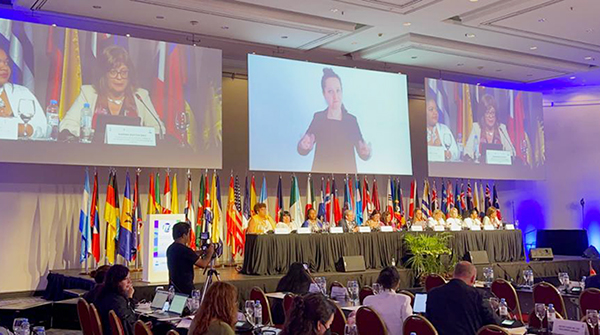

On the last day of the XV Regional Conference on Women in Latin America and the Caribbean, in Buenos Aires, on Friday, November 11, the Roundtable on Shared responsibility for care.
With the moderation of Doris García ParedesThe Minister of the State Secretariat for Women's Affairs of Honduras participated:
Wendy Perez, General Director of the Plurinational Service for Women and Depatriarchalization (SEPMUD) of the Plurinational State of Bolivia.
Ana María Baiardi, Manager of Gender, Inclusion and Diversity of the Corporate Vice Presidency of Strategic Programming of the Development Bank of Latin America (CAF).
Rosario Galarza Meza, Intersectionality Officer of the International Disability Alliance (IDA).
Ruth Díaz Medrano, President of the National Federation of Working Women (FENAMUTRA) of the Dominican Republic.
Naiara Leite, Executive Coordinator of Odara – Instituto da Mulher Negra and member of the Network of Afro-Latin American, Afro-Caribbean and Diaspora Women.
He closed the panel Karina Batthyány, Executive Director of CLACSO, who highlighted the importance of the contributions of those who spoke before her and emphasized regarding care: “We have made progress, without a doubt, but there is still a long way to go.”

“The debate on how to incorporate the complexity of care into a rights-based framework is related to equality of opportunity, treatment, and life trajectories within a context of expanding human rights that leads to a new concept of citizenship. It is important to emphasize this point and understand that it ultimately leads to debates surrounding democracy. Throughout history, the State has transformed itself into a protector against the risks and contingencies that people experience throughout their lives. By adding the notion of care to state programs, an unprecedented approach to new-generation social policies is introduced. This approach includes, of course, the classic pillars of the welfare state (health, social security, and education), but it adds the care of children and the elderly not as an exception when there is no family to assume it, but as a social norm previously unknown.”
After demanding that “public policies be designed to recognize, reduce, and redistribute care work and promote a change in the current gendered division of labor,” among other considerations, she stated: “Among the lessons learned, we can highlight the potential of care policies to positively impact income equality between men and women, the promotion of population change processes, the gendered division of labor, the care deficit at the family level, and the labor market. It has also become clear that, in our countries, social inequalities are closely linked to the unequal provision of family and social care, creating a vicious cycle: those with more resources have greater access to quality care and, in turn, have fewer household members to care for; conversely, those with fewer resources face a series of disadvantages because they cannot afford care, accumulate a heavier burden of domestic work, have difficulty accessing public services, and end up hiring caregivers under informal conditions.”
“The biggest challenge is how to move towards a world in which individuals, and society as a whole, recognize and value the importance of different forms of care, but without reinforcing the idea that only women and girls can and should do this,” added Karina Batthyány, who concluded: “It’s about promoting a new way of making public policy that incorporates gender from the ground up. (…) It implies a new model of relationship between individuals, families, and the State based on the social responsibility for caring for others. As the ECLAC document argues, this is not a time for gradual changes; it is a time for transformative policies. We need comprehensive care systems, fiscal pacts, and labor market policies, and in this context, academia must play a relevant role in challenging the boundaries of knowledge.”
XV Regional Conference on Women in Latin America and the Caribbean
If you would like to receive more information about CLACSO's training programs:
[widget id=”custom_html-57″]
to our email lists.

