
Coronavirus: Gender bias in care
Javier A. Pineda Duque 1
Two things that the coronavirus health crisis has made clear, and which have been central to discussions about development, are: first, the distinction between the ends and means of development; and second, the fallacy of the public-private dichotomy. In the first case, the emergence of development studies as a specific interdisciplinary field of study arose from a critique of reductionist views that prioritized the economic and subordinated other dimensions of development. This discussion gained momentum at the end of the 20th century, based on differentiating between the ends and means of development. The pandemic makes this distinction evident: we cannot subject the rhythm of life to the rhythm of the economy; the economy is only a means and must be subordinated to the ultimate goal of preserving and improving life. This premise called into question the very principles of modernity: the centrality of humankind (as humans—anthropocentrism—and as men—androcentrism) and its superiority over the earth and the non-human, the principle of reason, universalism, and the idea of order and progress.
In the second instance, isolation during the pandemic has made it clear how public and private life are two sides of the same coin. Feminist thought coined the concept of gender precisely to explain how the subordination of women, the feminine, and the feminized domestic sphere were not a product of nature but of culture, power, and social organization. If the current crisis calls into question anthropocentrism, the supposed superiority of humanity over nature also calls into question androcentrism—the superiority of men, the masculine, and the public sphere over the domestic, private, and feminine spheres. If anything has been salvaged to preserve life, it is the centrality of the home and the feminine: care.
Care, in its broadest sense, refers to all the activities carried out in societies for the preservation of human life and nature, which includes our bodies, our individualities, and our environment. This care is exercised individually and collectively, within a complex network for the sustenance of life. In a more specific sense, the privileged place of care—the home—has been highlighted. This is why we speak of the care economy as all the direct and indirect work carried out in households for the care of the most dependent members, which is usually unpaid and has traditionally and predominantly been performed by women. The home has thus been a center of production, consumption, and, now, biopolitical control.
Now that we are all confined to our homes, this gender bias in caregiving is being laid bare. For centuries, many women have been confined to the home, a situation that Betty Friedan partly denounced as "The Discomfort That Has No Name" in her book, *The Feminine Mystique* (1963), perhaps the most influential work in the origins of the second wave of feminism in the 1960s. The coronavirus has brought the feminine—caregiving and domesticity—to the forefront, which to some extent calls into question the male condition. So, we must ask ourselves: what is happening to men during this lockdown?
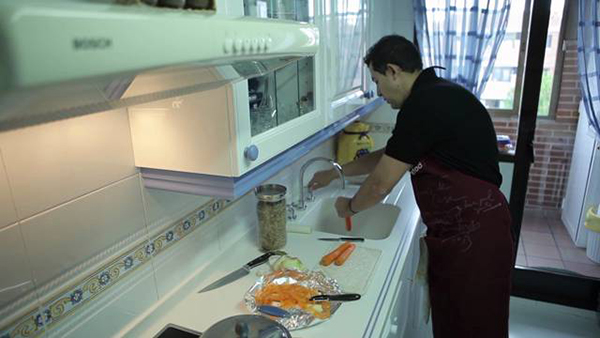
Videos of men being subservient in the kitchen or in domestic life have appeared on social media, often as a form of mockery or humor. These images ridicule caregiving and reinforce gender stereotypes in the home. Furthermore, they reinforce the idea that caregiving activities imply subordination and, therefore, a de-masculinization of men. If caregiving is central to life and one of the ultimate goals of societies, as the current crisis demonstrates, why do they insist on devaluing it?
It has been repeatedly mentioned that women entered the paid workforce while still bearing the brunt of unpaid domestic care work, which imposes barriers on them in the labor market and creates significant dilemmas in family life. Men, for their part, have not done the opposite. At best, we continue to "help" around the house, without acknowledging full responsibility for caregiving. Disputes over time in couples with young children, along with infidelity and male violence, remain among the leading causes of marital breakdown.
The coronavirus gives men a unique opportunity to learn. The isolation caused by the pandemic creates an epistemological opportunity for many men of all kinds, and some privileged women, to experience the otherness of caregiving: once intensively confronted with the time demands of unpaid care work and paid work at home, through this close interaction, we can appreciate the true value of all this direct and indirect care work. It's not simply about accepting the opportunity cost of dedicating time to childcare, cooking, and cleaning, compared to greater productivity in paid work. Rather, this productivity, granted by the market to the latter, is imposed as a product of the devaluation of the former. The fact that it is unpaid does not mean it has no value. We haven't given it that value simply because it has been predominantly female, abundant (five million housewives and seven hundred thousand domestic workers), and, for the most part, unpaid.
After the Care Economy Law was passed in Colombia (Law 1413 of 2010), the National Administrative Department of Statistics (DANE) was able to conduct the Time Use Survey (ENUT) three years later and estimate the value of this work: nearly 20% of GDP; the largest sector of the Colombian economy. Today, in the face of the coronavirus, with commodified jobs returning to the home, such as food preparation, this share could well have doubled. If we want a society that prioritizes life, care must be valued, as must the people who provide it. Only by caring can we develop and understand the ethics of care, understanding and feeling the needs of others, their vulnerability—which can be and is me and our vulnerability—and treating them as we would like to be treated. We men have been self-centered; care implies a shift toward the immediate other and toward collective care.
In several research projects, I have demonstrated how the commodification and socialization of care in recent decades in Colombia—such as elder care, childcare, beauty and appearance care, and healthcare—have perpetuated the devaluation of care work, given that these are predominantly female activities (Pineda, 2019). In the case of healthcare, at the heart of the coronavirus pandemic, this sector is highly feminized (79% are women) and its working conditions are extremely precarious, hindering the development of an ethic of care.
The growing importance of care work on the public policy agenda in Latin America underscores the need to advance its redistribution —between men and women, among society, the state, the market, and families—and its recognition , in order to value this work for improving lives. In other words, moving toward a caring society means acknowledging women's work and its ethical implications, as well as the silence of the privileged, as Joan Tronto (2019) points out.
Highlighted
-Pineda D., Javier A. (2019). Care work: commodification and devaluation. CS Magazine, special issue, 111-136. https://doi.org/10.18046/recs.iEspecial.3218
-Tronto, Joan (2013). Caring Democracy, Markets, Equality, and Justice. New York: NYU Press.
1- Associate Professor, Interdisciplinary Center for Development Studies (Cider), University of the Andes, Bogotá, Colombia. Co-coordinator of the CLACSO Working Group on Care and Gender.
If you would like to receive more information about CLACSO's training programs:
[widget id=”custom_html-57″]
to our email lists.

