
“South-South Cooperation, a way of demonstrating solidarity between peoples”
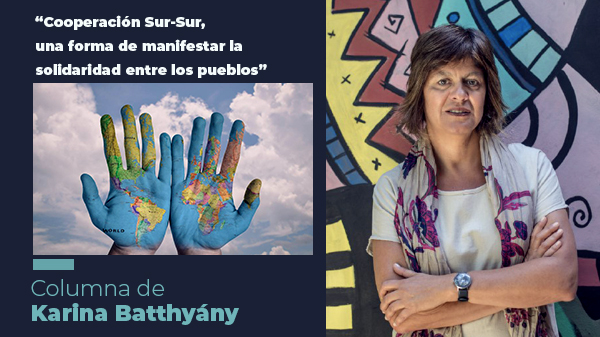
(Transcription of Karina Batthyány's Column)
(In InfoCLACSO – June 23, 2021)
I wanted to talk a little about South-South Cooperation and what we call South-South Programs. What are we talking about when we talk about this cooperation or these South-South Programs? It is, in broad and general terms, technical cooperation between what are called (I don't like the term, but it's the one used) "developing countries," most of which are located in the Global South. Hence the name South-South Cooperation, meaning cooperation between these regions of developing countries. It's a tool used, obviously, by states, but also by international organizations, academia, organizations like CLACSO, of course, civil society, and various sectors in general, to collaborate, share knowledge, share skills, and share initiatives in specific areas of work: very broad areas that can range from agriculture to human rights, from urbanization to public health and climate change. In other words, in all those areas where this collaboration or cooperation is needed. It is therefore a broad framework for collaboration between countries of the south in the political, economic, social, cultural, environmental, and technological fields, which involves at least two (usually more) of these countries located in the south or wrongly called "developing" or developing countries, and which can take different forms: from bilateral, regional, sub-regional, and inter-regional cooperation.
What I want to emphasize today is that this South-South Cooperation is a way of demonstrating something we've already discussed here in the InfoCLACSO columns: solidarity, cooperation, and interdependence among the peoples and countries of the Global South. Its purpose is to contribute to the well-being of the populations of these countries and to the achievement of development goals, many of which are internationally agreed upon, such as the well-known 2030 Agenda for Sustainable Development promoted by the United Nations. This issue, which has always been important, is more crucial than ever in the context of this year-and-a-half-long pandemic. Because, as we discussed in another column, the solutions, the possible ways out of this particular crisis affecting us, cannot be considered individually, either at the level of people or at the level of countries. Therefore, this South-South Cooperation mechanism takes on particular importance. I want to reiterate: what stands out is the solidarity, cooperation, and interdependence of these countries as they strive to empower one another and close the gaps that typically affect countries in the Global South. And also lessons learned, for example, how to overcome crises, specifically the current health crisis in the context of the coronavirus. This instrument is more important than ever today, but let's not forget some past examples involving Latin American countries, such as Cuba's support in the fight against Ebola in West Africa, or Mexico's experience in diversifying corn products to improve the nutrition and health of populations in Africa, particularly in Kenya, or the knowledge of hunger-reduction strategies that Colombia shares with other Mesoamerican countries, and the lessons that Chile shared with Caribbean countries regarding food labeling to prevent obesity. I'm mentioning some of the examples that are usually highlighted in reports, particularly those from the United Nations, on this topic.
It's also worth noting that these countries of the Global South have contributed to more than half of global growth in recent years. And this intra-South or South-South knowledge is higher than ever, representing more than a quarter of world trade; this trade among the Global South is higher than ever and, as I mentioned, represents more than a quarter of all world trade.
What does this have to do with CLACSO? It has a lot to do with it, because CLACSO has a South-South Development and South-South Cooperation Program in the various areas of competence of our Latin American Council of Social Sciences. That is to say, in terms of training, research, scientific evaluation, publications, and communication, like what we are doing now here at InfoCLACSO. We have many examples we could mention, particularly with our colleagues from the African Council of Social Sciences or our colleagues from the Arab Council of Social Sciences. And also, I want to emphasize this, just on Thursday, June 24, we signed a working agreement with the Chinese Academy of Social Sciences to continue advancing this logic of South-South Cooperation, which adds to the trajectory of work and reflection that CLACSO has in what are called, among other things, in a specialization, the epistemologies of the South: the way of analyzing, conceiving, and looking at the world, its problems, reality, and building alternatives from this Global South and within the framework of these cooperation strategies. That's why I wanted to bring this up here on InfoCLACSO today. And of course, I also want to invite everyone to join us, if they wish, for the event we're launching within the framework of this agreement for dialogues on development between China and Latin America and the Caribbean.
Very interesting, Karina… You just included so many things within the framework of South-South Cooperation that I would say it's a way for countries, in this case academics, to position themselves and to look at the world. When we're sometimes so accustomed to the centralist logic of central or more powerful countries that look down on smaller countries in a somewhat pejorative way, this South-South logic offers a different perspective and view of the world…
That's why we talk about epistemologies of the South, which is a way of looking at the world, at reality, and above all, at building alternatives from this place, from the South or the Global South, trying to break with those epistemological and methodological traditions that have often been very present in the field of social sciences with colonialist perspectives in the generation of knowledge and in the analysis of reality. And that's why at CLACSO we are committed to further strengthening this South-South Cooperation. We have always been doing this, but in this year and a half of the pandemic, it has become clearer than ever that this is the path: solidarity, cooperation, and interdependence among the countries of the South in the search for alternatives and in the search for solutions to the post-pandemic era, or whatever we want to call it.
If you would like to receive more information about CLACSO's training programs:
[widget id=”custom_html-57″]
to our email lists.

