
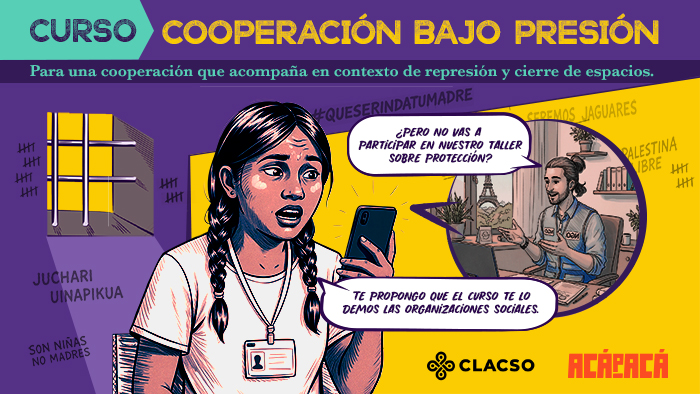
Online course: Cooperation under pressure
EXECUTIVE
Damaris Ruiz and Claudia Caselli (Acápacá)
PROFESSORS
Pablo Vommaro | Damaris Ruiz | Asier Hernando | Mariam Ikermawi | Rosa María Cañete | Rafael Henríquez García | María Cristina Perceval | Ana Silvia Monzón | María Josefa Macz | Luciana Peker | Renata Oliveira | Carlos Bedoya
Start: 14/10/2025
Registration: 14/08/2025 to 13/10/2025
Fewer and fewer countries and communities live in full democracies. Spaces for civil society are shrinking at an alarming rate. We, the social organizations, are on the front lines of this decline, and we are the ones who most need immediate and decisive support. Yet, when we are most needed, international cooperation grinds to a halt: it becomes slow, trapped in its own bureaucracy, paralyzed by risk analyses, institutional fears, and administrative frameworks incapable of adapting. Often, it simply doesn't know—or doesn't want—to respond.
Meanwhile, the world is redirecting resources toward war and armaments, and cooperation is losing strength, ground, and meaning. There is no time to lose: if international solidarity does not react now, it risks being too late.
The erosion of civic space is progressing relentlessly across the globe. Institutional responses are not only insufficient, but often choose to look the other way, normalizing violence, impunity, and neglect. Even within international cooperation itself, hasty withdrawals from critical situations are commonplace, with little or no search for ethical alternatives to remain alongside those who resist.
Faced with this ethical and political void, this course emerges as an urgent, situated, and collective response. It is a proposal that arises from social organizations that, even under repression, choose to uphold life, dignity, and grassroots organizing. Because withdrawal is not an option: the challenge is to accompany, resist, and build hope, even in the most hostile contexts.
This course is aimed at individuals, organizations and institutions linked to international cooperation who seek to act with greater ethical and political coherence in the face of the closing of civic space and the repression of civil society in different regions of the world.
It is specially designed for:
- Donors, philanthropic foundations, and international cooperation agencies that wish to review their frameworks for action in contexts of high conflict.
- International NGOs and transnational networks that support social processes and seek alternatives to forced departures or risky contexts.
- Technical teams, program managers and decision-makers within cooperation institutions who want to strengthen their capacity to respond to political crises and democratic shutdowns.
- Allied organizations, consultants and researchers interested in critical, feminist, anti-racist and decolonial cooperation approaches.
No specific prior experience is required, but a willingness to question conventional models, listen to social organizations, and commit to bolder, more useful, and more sustainable forms of cooperation is essential.
The main objective of this course is to reimagine international cooperation in contexts marked by structural violence, political repression, the criminalization of human rights defenders, and the systematic exclusion of peoples.
It is not just about resisting, but about making cooperation useful, lasting, and accompanied by ethical and political meaning.
With a critical, feminist, anti-racist and decolonial approach, this course proposes to think about and design viable strategies so that international cooperation does not surrender to cruelty, but confronts it with radical solidarity, political imagination and co-responsibility.
This course is not just a learning space, but a political commitment to rethinking and transforming international cooperation in contexts of repression and the closure of civic space. Therefore, its methodology is based on principles of horizontality, co-responsibility, collective production, and ethical care.
Methodological approach
- Critical and situated pedagogy: We start from the real experiences of those who participate, especially from the South, recognizing their knowledge as a legitimate source of knowledge.
- Facilitation rather than teaching: Teachers are not there to "teach" from a position of technical authority, but to to facilitate political, ethical and strategic dialogue from their experiences.
- Mixed spaces: We will combine synchronous (virtual) sessions with asynchronous spaces for reflection, writing, and shared systematization.
- Workshop approach: Permanent interaction, the use of open questions, collective exercises, and co-writing practices will be encouraged.
- Interregional dialogues and dialogues between situated experiences: People from different backgrounds (Nicaragua, Guatemala, El Salvador, etc.) will be invited to share from their lived experience, not from theory.
- Collective mapping of resistances and strategies: Throughout the course, a mapping of learning, tensions, and proposals will be constructed, which will feed into the final systematization.
- Progressive systematization: Each session will leave written or visual inputs (key phrases, proposals, stories), which will be retrieved towards the end.
Session 1: Naming What Hurts: Introductory Webinar
Teachers: Pablo Vommaro, Mariam Ikermawi and Damaris Ruiz (facilitated by Asier Hernando Malax-Echevarria)
This first session opens the course with an introduction that aims to critically frame the central themes that will be developed throughout the program. Drawing on diverse readings and territorial perspectives, the session analyzes global patterns of repression and the rise of authoritarianism, as well as the multiple ways in which collective action is restricted in increasingly closed contexts. The session offers an introductory overview from pluralistic and geopolitically situated perspectives.
Session 2: Cruelty and repression as a global framework
Teacher: Rosa María Cañete
This course delves into the understanding of cruelty and structural repression as systemic phenomena affecting bodies, territories, and organizations, particularly in Latin America and the Caribbean. It analyzes how these patterns shape the closure of civic space, the criminalization of civil society, and the consolidation of authoritarian, racist, and patriarchal systems. Furthermore, it reflects on global repressive strategies and the ethical and political dilemmas that international cooperation faces in these contexts.
Session 3: Ethical cooperation in the face of repressive regimes
Teacher: Rafael Henríquez García and Nicaragua Never Again
This session critically analyzes the role of cooperation in contexts of total closure of civic space, repression, and criminalization. It addresses the ethical dilemmas faced by NGOs in the face of the instrumentalization and normalization of authoritarianism. The real risks to international organizations are examined, and minimum commitments such as political coherence and accompaniment are discussed to sustain cooperation that does not abandon those who resist. Furthermore, the session delves into the experience of a Nicaraguan organization that, despite closure and criminalization, has managed to maintain active ties with international cooperation networks and transnational alliances.
Session 4: Having an impact amidst the siege: political strategies from cooperation
Teachers: María Cristina Perceval
This course focuses on how international cooperation organizations can exert political influence from the Global North without compromising the security of their allies in repressive contexts. Through ethical strategies and context-specific working methods, it explores tools for engaging with authoritarian regimes without resorting to paternalistic or substitution approaches. It fosters critical reflection on possible forms of advocacy from safe environments, enabling action with a short-, medium-, and long-term vision.
Session 5: Resistances that sustain life: defending civic space from the territories
Teachers: Ana Silvia Monzón and María Josefa Macz
This session highlights strategies of territorial resistance against criminalization and state control. It emphasizes local knowledge and organizational practices that sustain community fabric and spaces for collective action without relying on frameworks imposed by international cooperation. Through concrete examples of resistance, the session examines the role of NGOs in these contexts, exploring when to provide support, when to withdraw, and when to remain silent in order to protect.
Session 6: Feminisms in resistance: sustaining life in times of repression
Teachers: Damaris Ruiz and Luciana Peker
This class addresses how feminist movements and organizations respond to repressive contexts through collective, territorial, and ethical strategies. It analyzes the ways in which gender, ethnicity, class, and territory intertwine within repressive systems, and how feminisms sustain life, confront power, and organize resistance. Furthermore, it examines the role of international cooperation in supporting these struggles, avoiding extractive, instrumentalizing, or depoliticized approaches.
Session 7: Futures for a cooperation that does not abandon
Teachers: Renata Oliveira and Carlos Bedoya
This closing session proposes a reflection on the transformative role that international cooperation should assume in the face of rising authoritarianism and the shrinking of civic space. Alternative models of accompaniment based on ethical commitment and care are explored. Drawing on shared learning, participants envision how to build a transformative, committed, non-extractive cooperation that is politically aligned with the struggles for a dignified life. Key lessons are identified, along with pathways for creating a common agenda toward a cooperation that does not abandon its people.

|
Latin America, Caribbean, Africa or Asia |
$190 |
|
Europe, USA, Canada or Oceania |
$220 |
Inquiries: [mail protected]

