
Migration and human mobility: conflicts, policies and rights before, during and after the pandemic
Scholarship aimed at researchers from Central America, the insular Caribbean, Bolivia and Paraguay
Registration closes: December 20, 2021
BACKGROUND
Latin America in general, and the Central American and Caribbean states in particular, face long-standing structural problems that have not only remained unresolved but have been exacerbated by the Covid-19 pandemic. The current situation reveals profound inequalities in migration and human mobility, both within and outside the region, and across the hemisphere and globally.
The intensification of migration flows is a representative phenomenon of this, manifesting in its various forms and displacements: individuals, families, communities, caravans, and mass exoduses of migrants. The demographic composition of these displaced populations shows a more notable presence of families, as well as women, children, adolescents, and young people who migrate with or without their families. This makes an intersectional perspective on these processes essential, as well as a specific approach to dimensions such as gender, age and generation, and sexuality, without losing sight of racial and ethno-national dimensions, given the virulence that expressions of racial and xenophobic discrimination have acquired in some contexts.
Contexts of conflict or political violence, social insecurity, economic, housing, and health crises, risks in disaster environments, and impacts on livelihoods caused by climate change are some of the driving forces behind these processes. In the last decade, we have seen not only a tightening of immigration controls in the United States, but also in South American countries where such policies were not previously the norm. Furthermore, a shift in the region's historical migration pattern is evident, with an increase in intraregional migration flows, requiring attention to South-South flows, in addition to the already established focus on South-North migration.
Multilateral or bilateral cooperation on security and border control, when presented in the face of other existing problems, overlooks analyses of the direct role of states in human rights violations. The punitive approach to migration policies has fueled both illegal activities and corruption involving public and private actors. Furthermore, the impact of border closures due to the pandemic on these punitive security and control policies is an aspect that urgently requires investigation.
In this context, the rights and living conditions of migrants are deteriorating—especially due to the pandemic's impact on the labor market and on access to healthcare—and non-punitive public policies are insufficient or scarce. Likewise, migrants continue to organize and resist through various collectives and movements, even during times of pandemic-related mobility restrictions.
It is from these analyses that CLACSO opens the research call “Migrations and human mobility: conflicts, policies and rights before, during and after the pandemic”, as a way to contribute to the challenges that require not only academic reflection, but also the production of approaches that deepen a greater articulation between academia and the public and social management of migrations, promoting the protagonism of migrants.
CONTEST RULES
Applicants must be researchers with accredited ties to CLACSO Member Centers, which they will demonstrate with a sworn statement. If awarded the scholarship, they must submit a letter of support signed by the highest authority of the center.
- Submissions by collective authors of up to four (4) members will be accepted.
- The formation of the teams must respect gender parity (at least 50% women) and must select one of the members as responsible for the registration of the project.
- Each team must be made up of trained researchers, that is, those who hold a master's degree, doctorate or equivalent and have a proven academic track record and/or researchers in training, that is, those who have a degree or are currently pursuing master's or doctoral studies.
- Each researcher or research team may only participate with one proposal in this call.
- If the scholarship is awarded and travel is necessary, the winners will have to cover the costs of medical insurance or similar expenses themselves.
Up to six (6) group scholarships will be awarded.
The amount of each scholarship awarded will consist of:
- $11.000 for each research team.
The proposed research will be carried out over a maximum period of 10 (ten) months. The grants will be paid in installments via bank transfers made to the principal investigator. It is expected that at least 60% of the grant funds will be used for activities related to gathering and processing the information necessary for the research, which must be reported to CLACSO with supporting documentation.
The winners will work with mentors assigned by CLACSO who will monitor their research and results. CLACSO will publish the final products in print and/or digital media, giving them wide publicity and dissemination through the channels it deems appropriate.
The authors will transfer the original publication rights of their works, given that CLACSO adheres to and defends the principles of open science and open access to knowledge, so that the resulting work is easy to find, accessible, interoperable, and reusable. Subsequently, these works may be published in any other medium, always citing the grant received. Grant recipients must inform CLACSO of the subsequent publication of works resulting from the grant work.
- The member centers to which the applicants are linked must not have any outstanding debts in the payment of membership fees corresponding to the year 2021.
- Completed research projects will not be accepted. Proposals may be linked to ongoing research processes, but the final works must be original and unpublished products and developed within the period established by the call for proposals.
- Members of the Steering Committee or officials of the CLACSO Executive Secretariat may not participate.
- Proposals from researchers who are currently recipients of research grants, fellowships, or research projects organized by CLACSO will not be accepted. Applications from researchers who have previously received a CLACSO research grant will be accepted, provided that the recipient has fulfilled all obligations in a timely manner.
- Texts written in four languages commonly used in Latin America and the Caribbean (Spanish, Portuguese, English and French) will be accepted, depending on the country of origin of the proposal.
- In the first stage, the submitted proposals will be reviewed for their formal and administrative aspects to ensure their compliance with the competition rules. Proposals that do not meet the established requirements will be rejected.
- The proposals that pass to the next stage are evaluated by an International Committee made up of experts who will assess the quality and relevance of the proposals submitted under a pseudonym.
- The Call may be declared void or a smaller number of scholarship recipients may be selected, if the proposals submitted do not meet the required quality standards.
- Situations not covered in this document will be resolved by the convening institution.
- The ruling will be final.
- The research projects will develop their work plan between March and December 2022. This plan will be implemented under the facilitation of tutors assigned by CLACSO.
- The final report submitted by the scholarship recipients will be reviewed by the tutors.
- In their final version, the research papers submitted as a result should be between 12.000 and 15.000 words in length (excluding appendices and bibliography), written in Times New Roman 12-point font, single-spaced. This is an approximate guideline, and CLACSO reserves the right to make adjustments or exceptions if deemed necessary.
- The structure of the text will be free, respecting the conventions of presentation of an academic text and the editorial standards of CLACSO.
- In addition, each proposal must submit a Guidelines for Action Document, containing inputs and recommendations for public policies and social intervention on the topics investigated.
- Texts written in the four languages commonly used in Latin America and the Caribbean (Spanish, Portuguese, English and French) will be accepted, depending on the country of origin of the proposal.
It is mandatory that the submission be made through the online registration system provided by CLACSO. Printed submissions and submissions sent by email will not be accepted. It is recommended to access the online system to review the registration form.
- Access the CLACSO website clacso.org.
- Register in the CLACSO Single Registration System (SUIC). The generated username and password will be required each time you wish to access the system to consult, modify, add, or submit information for this or any other CLACSO activity. Applicants submitting joint proposals must designate one of the authors as responsible for registrationThis same person will receive the corresponding monetary award if the proposal is selected by the Jury.
- Identify the proposal by indicating its title and the pseudonym of the applicant(s). Applications with pseudonyms that correspond to the applicant's first and/or last name will not be accepted. Once the corresponding fields are completed, the system will enable the uploading of the following data.
- They must complete the registration form sworn declaration indicating the applicants' affiliation with a Member Center belonging to the CLACSO network. Consult the database of member centers at: clacso.org.ar/clacso/centros_miembros_clacso/inicio.php.
- Complete the form personal and academic data and attach the curriculum vitae in free format; the digital copy of the identity document, passport or ID card; the digital copy of the highest academic degree obtained (or proof of degree in process) and the photograph.
- Once registration is closed, the system will produce an electronic certificate of receipt that will serve as proof.
Registration closes: December 20, 2021 (23:59 PM Argentina time)
Project completion: March-December 2022
Final report submission: December 19, 2022
The results will be published on the CLACSO website. The winners will be contacted by email.
Queries: [email protected]
OPINION – Migration and human mobility: conflicts, policies and rights before, during and after the pandemic
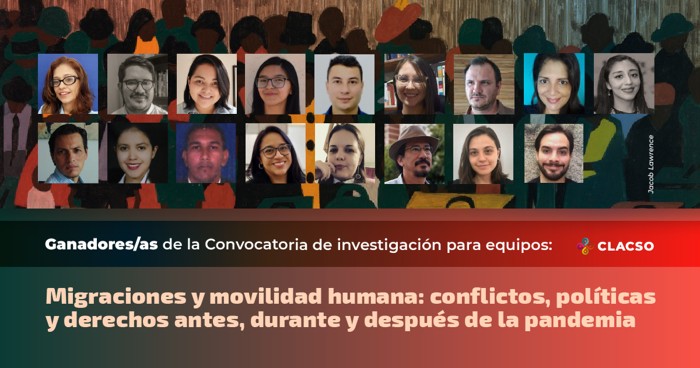
Call for research teams
Latin America in general, and the Central American and Caribbean states in particular, face long-standing structural problems that have not only remained unresolved but have been exacerbated by the Covid-19 pandemic. The intensification of migration flows, in its various forms and displacements, is a prime example. Contexts of conflict or political violence, social insecurity, economic, housing, and health crises, risks in disaster environments, and impacts on livelihoods caused by climate change are some of the driving forces behind these migration processes.
The last decade has seen a tightening of immigration controls not only in the United States, but also in South American countries where such policies were not previously the norm. Based on these analyses, CLACSO launched the research call “Migration and Human Mobility: Conflicts, Policies, and Rights Before, During, and After the Pandemic,” as a way to contribute to the challenges of academic reflection and the development of approaches that foster greater collaboration between academia and the public and social management of migration.
They registered 152 forms and were finally received 29 Complete applications, which after the technical and formal review, were in a position to be qualitatively evaluated by the International Committee to consider the quality, relevance and coherence of the proposals according to the Call.
The evaluation process was carried out by an International Committee composed of 6 Experts from 5 countries: Luis Bonilla (Venezuela), Aimee Gross (Cuba), Juan Iborra (Mexico), Amparo Marroquín (El Salvador), Gabriela Martínez Castillo (Mexico) and María Isabel Messina (Guatemala).
Following the evaluation, which recognized the excellent quality, relevance, and rigor of most of the applications, Six proposals were selected.
The list of winning proposals from the Call for Proposals is as follows:
|
Winning Proposals |
|||
|
Authors |
Member Center |
Country |
Title of the proposal |
|
Guillermo Antonio Navarro Alvarado, Joel Stiven Segura Oviedi and Juliana Gil Ortiz |
Institute of Social Research, Faculty of Social Sciences, University of Costa Rica |
Costa Rica |
Globalization from below: African migration flows in Central America and the Costa Rican migration crisis of 2015-2017 |
|
Loraine Morales Pino and Guillermo Alberto Aguilar olis |
College of the Northern Border – COLEF |
Mexico |
Migration processes in disputed territories. Traces of transit and resistance in Central America between 2019 and 2021. |
|
Camilo Rey, Laura Babilonia Torres, Jairo Alonso Rodriguez Buelvas and Virginia Martinez |
Observatory for Forced Displacement – OPDF – University of Cartagena |
Colombia |
Analysis of the effects of the covid-19 pandemic on the restoration of the social and economic rights of communities displaced by the Colombian armed conflict. |
|
Alfonso Hinojosa, Ruby July Peñaranda Espinoza, Eduardo Enrique Domenech and Valentina Biondini |
Center for Social Research of the Vice Presidency – CIS |
Bolivia |
Migration movements and mobility policies in the South American space: The production of routes, corridors and transit zones in Bolivia |
|
Larissa Jeannette Brioso Díaz, Lidia Menjívar and Fátima Aracely Morales López |
Departments of Social Sciences and Humanities – Central American University |
El Salvador |
Forced migration of trans women: Mental health and protection needs. |
|
Rocío Elizabeth Maldonado Tomás and Rosa Nohemí Gómez Osorio |
Latin American Faculty of Social Sciences, Guatemala – FLACSO |
Guatemala |
The economic and social costs and implications of failed migration for the families of returnees in the municipalities of Barillas (Huehuetenango), Joyabaj (Quiché) and Malacatán (San Marcos), Guatemala |
This ruling is irrevocable and cannot be appealed.
Buenos Aires, March 2, 2022.
If you would like to receive more information about CLACSO's training programs:
[widget id=”custom_html-57″]
to our email lists.

