
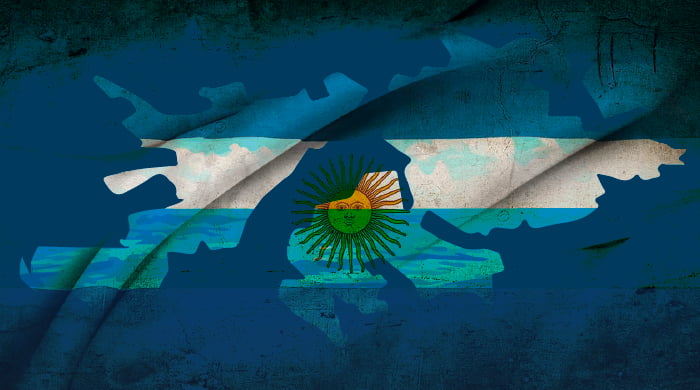
Call for Essays “Malvinas, Antarctica and the South Atlantic: colonialism, sovereignty and development in the 21st century”

ORGANIZING INSTITUTIONS:
- Secretariat of Malvinas, Antarctica and South Atlantic of the Ministry of Foreign Affairs, International Trade and Worship of Argentina.
- Undersecretariat of University Policies, Ministry of Education of Argentina
- Latin American Council of Social Sciences (CLACSO)
- Academic Secretariat of the National University of Tierra del Fuego (UNTDF)
WITH THE SUPPORT OF:
- Faculty of Philosophy and Letters of the University of Buenos Aires (FFyL-UBA)
- Workers' Innovation Center – Metropolitan University for Education and Work (CITRA – UMET)
- Institute of Culture, Society and State (ICSE-UNTDF)
The Secretariat for Malvinas, Antarctica and the South Atlantic of the Ministry of Foreign Affairs, International Trade and Worship of Argentina, the Undersecretariat of University Policies of the Ministry of Education of Argentina, the Latin American Council of Social Sciences (CLACSO) and the National University of Tierra del Fuego (UNTDF) invite you to participate in the Essay Contest “Malvinas, Antarctica and the South Atlantic, colonialism, sovereignty and development in the 21st century”.
The call for proposals seeks to delve deeper into the issue of the Falkland Islands, Antarctica, and the South Atlantic from a Latin American and global perspective. The Falkland Islands Question is recognized by the United Nations as one of the seventeen remaining Non-Self-Governing Territories currently under consideration by the Committee of 24; it is precisely a case subject to decolonization. Antarctica and the South Atlantic are central to understanding sovereignty, cooperation, and development for Argentina, the region, and the coastal states—in Africa and South America—with coastlines on the South Atlantic.
Up to ten (10) original essays on the topic of the call will be selected.
The prizes include the digital publication of all selected works and, for the first 5 works, support for participation in a Seminar to be held at the National University of Tierra del Fuego (UNTDF, Argentina) in which the results and publication will be presented.
This call for submissions follows the Essay Contest “The Malvinas Question: 50 Years After Resolution 2065 (XX),” organized in 2015 jointly by CLACSO, the Secretariat for Matters Relating to the Malvinas Islands, and the Undersecretariat of University Policies of the Ministry of Education of Argentina. That contest promoted discussion and interest in the Malvinas Question in Latin American and Caribbean countries. It sought to encourage academic production by presenting diverse social representations of the Malvinas Question from Latin America and the Caribbean, reflecting on decolonization processes and the importance of the Malvinas Islands for Argentina and the region, and stimulating creativity in written expression related to these topics.
Also relevant is the Malvinas Forum and the Struggles for Sovereignty in Latin America held in November 2018 in the Chamber of Deputies of Argentina, within the framework of the First World Forum of Critical Thinking and the 8th Latin American and Caribbean Conference of Social Sciences of CLACSO and the publication that compiles the interventions of the speakers: “Malvinas, a just regional cause” (Clacso, 2020) 1.
This call for proposals is a continuation of these initiatives and is developed in accordance with the provisions of the Argentine National Constitution and current international regulations.
Transitory Clause One of the Argentine National Constitution establishes: “The Argentine Nation ratifies its legitimate and imprescriptible sovereignty over the Malvinas Islands, South Georgia and the South Sandwich Islands and the corresponding maritime and insular spaces, as they are an integral part of the national territory. The recovery of said territories and the full exercise of sovereignty, respecting the way of life of their inhabitants, and in accordance with the principles of international law, constitute a permanent and inalienable objective of the Argentine people.”
Argentina bases its legitimate claim to the Islands on historical and legal grounds. The Malvinas Question is a special and particular case of colonialism, where part of the territory of an independent state, Argentina, has been forcibly occupied by another state, violating its territorial integrity.
In 1965, the United Nations General Assembly, by an overwhelming majority and without any dissenting votes, adopted Resolution 2065 (XX), endorsing Argentina's position, formally and expressly recognizing the existence of the sovereignty dispute over the Falkland Islands, South Georgia, the South Sandwich Islands and the surrounding maritime areas, which it henceforth called the "Question of the Falkland Islands," urging Argentina and the United Kingdom to find a peaceful solution through bilateral negotiations between the two States.
The Malvinas Question is one of the seventeen cases currently under consideration by the United Nations Special Committee on Decolonization. For Argentina, it is a matter of state policy and an imprescriptible claim, as established by its National Constitution. Since the very beginning of the usurpation in 1833, Argentina has repeatedly received support from Latin America and the Caribbean, beginning with the support of Bolivia and Brazil that year. The international community has repeatedly emphasized the importance of both countries sitting down at the negotiating table to peacefully resolve the dispute. This has been expressed by the United Nations, the Organization of American States (OAS), Ibero-American Summits, South American Summits, the South America-Africa Summit, the South America-Arab Countries Summit, the Group of 77 and China, the South Atlantic Peace and Cooperation Zone (ZPCAS), and the Caribbean Community. Numerous organizations have also expressed their recognition of Argentina's legitimate sovereign rights: the Southern Common Market (Mercosur), the Union of South American Nations (UNASUR), the Rio Group, the Community of Latin American and Caribbean States (CELAC), the Latin American Integration Association (ALADI), the Latin American Energy Organization (OLADE), the Summit of Latin America and the Caribbean for Integration and Development, the Summit of Latin American and Caribbean Unity, the Bolivarian Alliance, the Central American Parliament (PARLACEN), the Mercosur Parliament (PARLASUR), among others.
This initiative is undertaken within the context of the creation of the Secretariat for the Malvinas, Antarctica, and South Atlantic within the Argentine Ministry of Foreign Affairs. By decision of the Executive Branch, the Malvinas Islands Question has once again been elevated to the highest institutional level of the State as a matter of national policy, with the objectives of: 1. bringing the claim before all multilateral organizations and continuing to advocate for respect for and implementation of United Nations General Assembly Resolution 2065 (XX), which requires the United Kingdom to resume bilateral dialogue as a means of resolving the sovereignty dispute; 2. the unrestricted defense of international law and norms that protect natural resources in the South Atlantic; natural resources and biodiversity that are fundamental for the development of research and science, and which represent an excellent opportunity to promote cooperation and integration with the region and with other countries with similar interests; 3. promoting the importance of the Malvinas Cause at the national, regional, and global levels: there is no place in the 21st century for colonial situations.
Regarding Antarctica, Argentina's presence dates back to February 22, 1904: on Laurie Island, in the South Orkney Islands group, a meteorological observatory was inaugurated at the current base of the same name, and Argentina, a bicontinental country, has maintained a permanent and uninterrupted presence there ever since. The preservation of Antarctica, as a territory dedicated to science, is a priority issue in terms of protecting the Antarctic environment and its dependent and associated ecosystems, conserving fisheries resources, and preserving mineral resources. It is a continent dedicated to peace and science through international cooperation, within the framework of the Antarctic Treaty.
1 Publication available at: http://biblioteca.clacso.edu.ar/clacso/se/20200213033904/Malvinas-Una-causa-regional-justa.pdf
Applicant profile
This call for papers is open to researchers, undergraduate and graduate students, and professionals with experience in the relevant fields. Submissions from individuals or groups (up to three authors) related to the theme of this call will be accepted. In the case of group submissions, the designated lead author must be a member of a CLACSO member center.
Recognitions
The prizes for the top five (5) selected essays include:
- Participation in an in-person training seminar on the topic in question, to be held at the National University of Tierra del Fuego in Ushuaia, Argentina. The seminar will take place in March/April 2021, depending on the pandemic situation.
- The publication of the selected works.
Five (5) round-trip economy class air tickets from the city of origin to Tierra del Fuego will be covered, as well as the cost of two nights' accommodation in a hotel selected by the organizers. The organizing institutions do not commit to covering any other expenses beyond those specified above.
It is the responsibility of the winners to have valid personal documentation necessary to carry out the planned trip, as well as personal health and other insurance.
The prize for the total of ten (10) selected essays includes:
- The publication of the selected works.
Selection criteria for winning essays
The evaluation of the presentations will be carried out by an International Academic Committee made up, in equal parts, of representatives from the Secretariat of Malvinas, Antarctica and the South Atlantic, the Undersecretariat of University Policies, the Academic Secretariat of the National University of Tierra del Fuego and CLACSO.
The Committee will initially assess, anonymously, the academic quality of the submitted essays. In a second stage, it will also consider the applicants' academic backgrounds.
The competition may be declared void, or a smaller number of winning essays may be selected, if the submitted works do not meet the required quality standards. Special mentions may also be awarded. Any situations not covered in this document will be resolved by the organizing institutions.
Characteristics of the proposals
- Each researcher may only participate with one proposal in this call.
- Submissions from individuals or groups (up to three authors) related to the theme of this call for papers will be accepted. In the case of group submissions, the person designated as responsible for the submission must be a member of a CLACSO member center.
- The work must be an original and unpublished product of the authors and must not have been previously submitted to any publisher for publication.
- Provisional versions and works that have been published or have received any local, national or international award will not be accepted.
- Members of the Steering Committee or officials of the Latin American Council of Social Sciences (CLACSO) are ineligible to run. Officials from the Secretariat for the Malvinas, Antarctica and the South Atlantic, the Undersecretariat for University Policies, and the National University of Tierra del Fuego are also ineligible.
- Submissions from researchers who are currently scholarship recipients in the framework of research competitions organized by CLACSO will not be accepted.
- Applications will be accepted from researchers who have received a research grant awarded by CLACSO, provided that the beneficiary has fulfilled the obligations duly undertaken in a timely manner.
Essay format
- Essays should be between 20 and 40 pages long, written in Times New Roman font, size 12, single spacing, on letter or A4 size paper.
- The format will be free, respecting the conventions of presentation of an academic text and the editorial standards of CLACSO.
- Essays must be signed with a pseudonym.
- Texts written in Spanish, Portuguese, English, and French will be accepted.
Publication of the winning essays
The final versions of the winning essays will be published in open access by the organizing institutions. The authors will grant the original publication rights to their works, although these may subsequently be published in any other medium, citing the award received. The authors must inform the organizing institutions of any subsequent publication of their work.
It is an essential requirement that the submission be made through the online registration system provided by CLACSO.
Printed or emailed submissions will not be accepted. Applications that do not comply with the established guidelines will be technically rejected.
It is recommended to access the online system to learn about the registration format.
- Visit the CLACSO website, www.clacso.org, to access the registration system. Register in the CLACSO Single Registration System (SUIC). Each time an applicant wishes to access the system to consult, modify, add, or submit information for this or any other CLACSO activity, they must log in with their personal username and password. Applicants submitting essays authored collectively must designate one of the authors as responsible for the registration.
- Identify the essay by indicating its title and the pseudonym of the applicant(s). Submissions with pseudonyms that correspond to the applicant's name and/or surname will not be accepted.
- Complete the personal and academic data form and attach the curriculum vitae in free format; the digital copy of the passport, the digital copy of the highest academic degree obtained (or proof of degree in process), and a color photograph of each applicant.
- Attach the essay respecting the characteristics established in this call.
- To finalize your application, click the CLOSE REGISTRATION button. The system will generate an electronic certificate that will serve as proof of successful submission. The system will only consider applications that have been successfully submitted.
REGISTRATION CLOSES: August 10, 2020, 24:00 PM (Buenos Aires, Argentina)
The results will be published on the websites of the organizing institutions.
The ruling will be final and irrevocable.
All applicants will be contacted by email.
Inquiries: [mail protected]
We do not accept inquiries by phone or mail.
New closing date: August 10
Inquiries: [email protected]
If you would like to receive more information about CLACSO's training programs:
[widget id=”custom_html-57″]
to our email lists.

Results
The Latin American Council of Social Sciences (CLACSO) announces the results of the Call for essays “Malvinas, Antarctica and South Atlantic: colonialism, sovereignty and development in the 21st century”, organized jointly with the Secretariat of Malvinas, Antarctica and South Atlantic of the Ministry of Foreign Affairs, International Trade and Worship of Argentina, the Undersecretariat of University Policies of the Ministry of Education of Argentina and the Academic Secretariat of the National University of Tierra del Fuego (UNTDF).
Fifty-seven applications were received . After technical review, 56 of them were deemed eligible for evaluation by the International Committee. The Committee considered the quality, relevance, coherence, and currency of the essays in accordance with the call for submissions.
The evaluation assessed the high quality of the submitted essays, as well as their rigor and intellectual contribution to the issue addressed in the call for papers. Given the quality and excellence of most of the submissions, it was decided to increase the number of winning essays to twelve (12) for inclusion in the digital publication.
The evaluation process was carried out by an International Committee composed of twelve (12) expert evaluators from three (3) countries : Esteban Rodríguez (Argentina), Facundo Rodríguez (Argentina), Federico Lorenz (Argentina), Gabriel Merino (Argentina), José Luis Fernández Valoni (Argentina), Karin Otero (Argentina), Leandro Morgenfeld (Argentina), Mariana Aparicio (Mexico), Mónica Esmeralda Bruckmann Maynetto (Brazil), Osvaldo Mársico (Argentina), Patricia Vara (Argentina) and Uriel Erlich (Argentina).
The Call was supported by the Faculty of Philosophy and Letters of the University of Buenos Aires (FFyL-UBA), the Center for Innovation of Workers – Metropolitan University for Education and Work (CITRA – UMET) and the Institute of Culture, Society and State (ICSE-UNTDF).
According to the evaluation carried out, the list of the 5 (five) winning essays that will be awarded with their digital publication, as well as with support for participation in a training seminar on the subject matter to be held at the National University of Tierra del Fuego during 2021, is presented below:
| Researchers | Country | Essay title |
| Lucía Wolaniuk | Argentina | New challenges towards redefining Antarctic policy in the 21st century: regional cooperation on the Ushuaia-Punta Arenas axis as a development opportunity |
| Ivaldo Gonçalves de Lima | Brazil | Decolonizing Imaginacao geopolitics: The Geostrategic Potential of the South Atlantic Revisited |
| Agustina Belen Felizia | Argentina | Returning to the Falklands with the South Atlantic as the axis for national development |
| Camila Eva Bonetti | Argentina | The Falklands and Brexit: A new opportunity for Argentina? |
| Rene Quisbert | Bolivia | An ally in the far north against colonialism: The historic Bolivian-Argentine bond for the defense and recovery of the Falkland Islands |
Below is the list of the other 7 (seven) winning essays , which will be awarded with their digital publication in the collective book:
| Researchers | Country | Essay title |
| Juan Sebastián Schulz | Argentina | Colonialism in the Falkland Islands: A Geopolitical Analysis of an Ongoing Phenomenon |
| María Laura Civale | Argentina | Antarctica: A South American Perspective |
| Marcos Guillermo Fernandez Peña | Argentina | The manipulation of the principle of self-determination of peoples as a neocolonial strategy of Great Britain: the Falklands case and the Diego Garcia case. |
| Santiago Guardone | Argentina | Environmental management in the Falkland Islands, South Georgia and the South Sandwich Islands |
| Juan Augusto Rattenbach | Argentina | Falklands/Malvinas: The cost of British colonialism in the South Atlantic (1995-2018) |
| Rogerio do Nascimento Carvalho | Brazil | Southern Atlantic, Malvinas and Antarctica: the fight against the presence of extraregional actors. |
| Victor Hugo Juarez Chacon | Venezuela | British militarization of the South Atlantic and its influence on the diplomatic actions of the Union of South American Nations |
This ruling is irrevocable and cannot be appealed.
Buenos Aires, October 20, 2020

