
Critical thinking to confront the single narrative
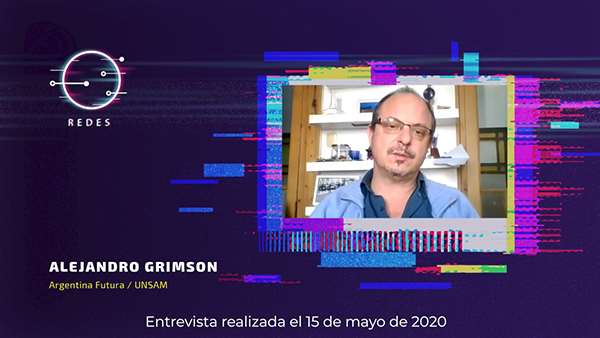
Alejandro Grimson, PhD in Anthropology from the University of Brasilia, professor at the Institute of Higher Social Studies of the National University of San Martín (UNSAM), researcher at Conicet and advisor to Argentine President Alberto Fernández, directs the program “Argentina Futura”, which has just presented “The future after Covid-19”, a digital book where nearly 30 intellectuals reflect on the pandemic.
In this regard, in a dialogue with CLACSO.TV, Grimson explained that “we made the decision to invite a dozen cultural figures and public intellectuals to tell us how they think the future might be and how they would like it to be after Covid. And what emerges there are multiple dimensions. First, the possibility of breaking down a barrier and opening the horizons to cultural, social, and political imagination in order to look ahead to a more egalitarian society, with a greater state presence, with less inequality, and, based on that, on building an idea of the future, to be able to understand why we are taking the measures that are being taken in the present.”
Interview by Gustavo Lema – May 15, 2020
Alejandro Grimson reviewed the history of neoliberalism, which, in his view, “continues to this day with some anomalies. There were some South American countries that introduced the interruption, as we know, fundamentally in the 21st century; for many years there were some other cases, but basically if you look at the world as a whole, there really is an enormous triumph of a model based on financial accumulation, the mobility of capital.”
He then argued that “the issue of quarantine as the best preventative measure against the coronavirus situation means that the mandate to society is 'stay home,' so you have to stay home, maintaining a huge distance from the rest of the world. There's another element of this globalization process that remains more present than ever, perhaps, which is what other authors have called 'consciousness of contemporaneity.' What does that mean? It means we are aware that we are contemporaries. We know what happened in China, we know what happened in Europe, what is happening in the United States, so we know that this isn't a pandemic specific to this part of the world, like some diseases that are unique to our region and have a different pace of research, but rather a global pandemic that impacts not only health but also, obviously, the economy. There is already a global economic crisis that is enormous, and I think there will be disputes over the narrative surrounding the pandemic. But the book shows that within these disputes there is a possibility closely linked to all the work of Latin American critical thought, of CLACSO, of all its researchers, centers, and so on, which is that we have the possibility to turn the crisis into an opportunity. An opportunity that those narratives produced for decades from Latin America, from critical thought, which were often inaudible, much less so obviously in our own countries in the contexts in which there was a break with neoliberalism, but, in general terms, in the era of the single discourse and in other subsequent moments such as those being experienced today in other Latin American countries, the discourses generated from spaces like CLACSO are being made invisible.”
The book “The Future After Covid-19” was contributed by, among others, Dora Barrancos, Beatriz Sarlo, Horacio González, Ricardo Forster, Atilio Borón, Gabriela Cabezón Cámara, Rita Segato, Julián Rebón, Maristella Svampa and Jorge Alemán.
If you would like to receive more information about CLACSO's training programs:
[widget id=”custom_html-57″]
to our email lists.

