
Agreement between CLACSO and CALAS
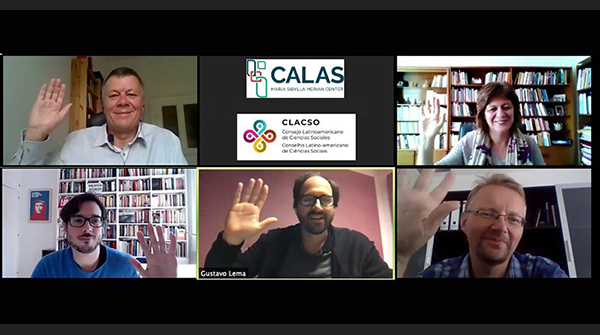

On Wednesday, June 10, a framework agreement was signed between the Latin American Council of Social Sciences (CLACSO) and the María Sibylla Merian Center for Advanced Latin American Studies in the Humanities and Social Sciences (CALAS), based in Guadalajara, Mexico. In a virtual meeting, due to the mandatory lockdown caused by the pandemic, the agreement was signed by Karina Batthyány, Executive Secretary of CLACSO, and Hans-Jürgen Burchardt, a member of the CALAS Board of Directors. Also participating were Nicolás Arata and Gustavo Lema from CLACSO, and Jochen Kemner from CALAS.
The purpose of this association is to jointly promote the coordination of academic events, the organization of scholarship programs for study and research, the design of training proposals, the co-editing of open access publications, among other activities, in the development of an academic program for the period 2020-2025.
Hans-Jürgen Burchardt praised the role of the two institutions in their work of disseminating the social sciences and humanities. He noted that “We in Europe, and also in the United States, often have the idea that when we think of Latin America, we think of crises and that we have to investigate those crises. Our idea is completely different. We don't want to investigate Latin America, but rather with Latin America, because we also want joint responses, a transfer of ideas from Latin America to Europe, to Germany, which would help us precisely to find joint solutions to the human and global crisis. And it seems to me that the best partnership, the best opportunity to do that and enter into a very broad debate in both the social sciences and the humanities, is CLACSO; we have long admired the work that CLACSO does throughout the region, and I think we can align ourselves very well and achieve good collaborative work.”
In turn, Karina Batthyány highlighted that “For CLACSO, this agreement is of great importance because it means collaborating with universities in Germany and universities in Latin America, which, incidentally, are centers that are part of our Latin American Council, on a highly relevant issue: addressing crises. And if it was relevant some time ago, today it acquires particular significance within the context of all the problems we are experiencing. Furthermore, it aligns with a shared approach to working in the social sciences and humanities. The idea of producing knowledge, but also of generating impact, is something that greatly concerns CLACSO: that knowledge effectively serves social transformation with the idea of working together, that is, with a transdisciplinary and transregional approach of genuine cooperation between CALAS and our Council. For us, it truly opens an opportunity to strengthen these ties and to work on the programs we have under development, on disseminating knowledge through publications, on research, on exchanges, on equal terms, and with that spirit of building transdisciplinarity and transregionality among researchers from our region and researchers from Europe, and from Germany in particular.”
He then added that this work agreement “It already has concrete actions underway, because we have already made progress in terms of joint publications that allow us to publicize the results that CALAS has with its programs, as well as training activities that we are exchanging and discussing, particularly on a topic that CLACSO has been working on and that we consider very relevant, which is that of elites, the whole issue of inequalities, state capture, and challenges to democracy. And hopefully we will continue along this path by strengthening scholarships and the exchange of students and professors from Latin America to Europe and from Europe to Latin America.”
Jochen Kemner, in turn, assured “The important thing is to put this collaboration agreement into practice, to truly create joint programs that also leverage the strengths of both centers. We share many ideas and concerns, but we have different structures. At CALAS, we have our own scholarships, publications, and events, and I believe these can complement CLACSO's work very well. CALAS offers scholarships for medium-term stays, four to six months, for established researchers, providing them with the time not only to conduct research but also to read, reflect, and write texts that we later publish in our collection and that are also published in CLACSO's virtual library.”
Finally, Nicolás Arata, Director of Training and Editorial Production at CLACSO, highlighted the value of CALAS's open access library. “It’s growing, it’s developing, it has some truly remarkable titles, with significant academic value, in terms of their innovative content and the perspective they offer. When our colleagues at CALAS presented us with this opportunity, we immediately thought about initiating this first joint activity because we saw great value in terms of the contributions this collection makes—and will surely make—to understanding some specific problems in the social sciences in the region. So, this first step also allowed us to begin developing a broader, more ambitious work plan, where there are areas in which CALAS and CLACSO will complement each other very well, and others where the task is to cooperate. I believe the CALAS-CLACSO open access library is also a very good concrete example of how we can take steps in that direction.”
CALAS is a center for advanced studies established in March 2017 by four Latin American universities and four German universities (Bielefeld, Kassel, Hanover, and Jena), at the initiative of the German Federal Ministry of Education and Research (BMBF). Its main campus is located at the University of Guadalajara, Mexico. CALAS has three regional campuses in Quito (FLACSO-Ecuador), San José (University of Costa Rica), and Buenos Aires (National University of San Martín). It also hosts visiting professorships at the University of Havana (Cuba) and the Federal University of Minas Gerais (Brazil). As a Center for Advanced Studies, CALAS aims to address highly relevant topics in the Social Sciences and Humanities through its research program, "Confronting Crises" in and from Latin America, applying historical, exemplary, scientific, and systematic approaches in a transdisciplinary and transregional dialogue.
If you would like to receive more information about CLACSO's training programs:
[widget id=”custom_html-57″]
to our email lists.

