
CLACSO Agreement / Secretariat of Childhood, Adolescence and Family of Argentina
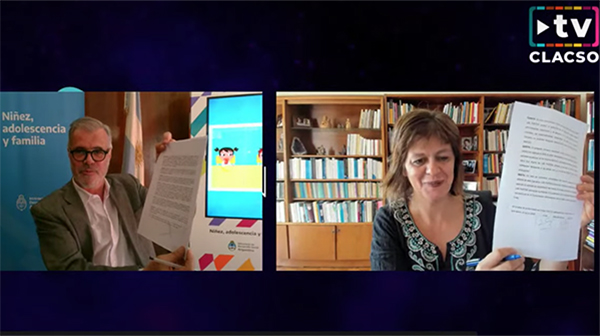
On Friday, October 9, an important agreement was signed between the Argentine Secretariat for Children, Adolescents, and Families (SENAF) and the Latin American Council of Social Sciences (CLACSO). Participants in the virtual ceremony included Gabriel Lerner, National Secretary of SENAF; Karina Batthyány, Executive Secretary of CLACSO; Pablo Vommaro, Director of Research at CLACSO; and Eliana Pereyra, representing the Chief of Staff of SENAF.
The Agreement, in its main aspects, aims to establish the foundations for inter-institutional cooperation to develop, promote, encourage, and implement research, publication, and training activities within the respective areas of competence of both parties, in order to promote concrete actions for the benefit of society. Likewise, this Framework Agreement will focus on actions aimed at improving the conditions of children and adolescents, based on equality, equity, and the recognition of their rights.
Presented by Gustavo Lema
During the launch event, Gabriel Lerner recalled that at SENAF “we have a tradition of policy development with a great deal of interaction with academia, universities, and research centers, because we understand that to sustain policies with evidence to support them, interaction between political bodies and the centers of university and research knowledge is essential… This agreement will enrich the work of the Secretariat, a framework agreement that will allow us to consider concrete initiatives around which research, publications, and staff training can be developed.”
Karina Batthyány also agreed, stating that “ what we signed today is very important as a first step towards a strategy of collaboration and joint work between the Secretariat, CLACSO, and the centers that comprise CLACSO, to promote research, training, and the dissemination of activities. Clearly, the issues within the Secretariat's purview related to childhood, adolescence, and family are absolutely crucial both within CLACSO and as substantive topics in the Social Sciences and Humanities today.”
According to Pablo Vommaro, “CLACSO strongly seeks to link research with public policy that has social impact. Therefore, I believe that the space of public policy—recognizing that there is also knowledge and wisdom—, the space of research itself—dialoguing, building bridges, and making mutual acknowledgments—, and the space of social movements, territorial organizations, and collectives, are three spaces that exist within CLACSO. And I also know—which is why we are promoting this—that SENAF also works closely with social movements and that there is a strong interest in connecting with academia and universities.”
Finally, Eliana Pereyra anticipated that this framework agreement “will allow for other specific agreements to work on everything related to research and to coordinate actions for children and adolescents in this difficult context of the pandemic that we are all experiencing. Thinking about rights and the inequalities that exist in access to rights for children and adolescents is something we must address, and this framework agreement can help us work to obtain more information and data about what is happening.”

