
Against Our America
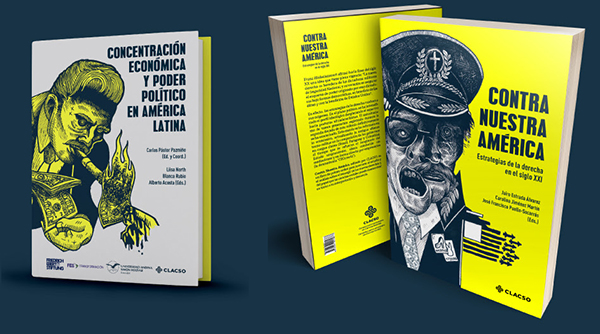
New-generation authoritarianism and economic concentration have intensified in the region and the world. State capture, processes of land and capital concentration, xenophobic outbreaks, techno-military alliances, the tightening of economic plans, and cuts to public spending are some of the dimensions analyzed in "Against Our America" and "Economic Concentration," two fundamental collective works for addressing and interpreting the new faces of the right wing in Latin America and the Caribbean.
Against Our America: Right-Wing Strategies in the 21st Century
“The changing political landscape and its electoral expressions, the deepening of the economic crisis and the deterioration of living conditions, as well as the widespread impoverishment and indebtedness of large sectors of the population, are some of the symptoms of a unique situation in which right-wing forces have been deploying a comprehensive strategy to recover or strengthen their positions in the region,” argue the book's editors Jairo Estrada Álvarez, Carolina Jiménez Martín and José Francisco Puello-Socarrás.
They add that “analyzing the recent trajectories of the right wing does not mean addressing a strictly circumstantial phenomenon. It is better to explore a long-term event that, with its ebbs and flows, has been developing at least since the 1980s and in parallel with the so-called 'democratization' processes following the civic-military dictatorships in the subcontinent. In this sense, we emphasize that recent electoral episodes and political profiles, both at the level of individual and organizational leadership, as well as the political and public policy programs (economic and social) they embody, while maintaining historical continuity, also express new modes of political articulation and novel modalities in hegemonic (re)construction.”
DOWNLOAD THE BOOK
http://biblioteca.clacso.edu.ar/clacso/se/20200320011351/Contra-Nuestra-America.pdf
Economic concentration and political power in Latin America
Editors: Liisa North, Blanca Rubio, Alberto Acosta and Carlos Pástor Pazmiño.
The latter, who also coordinated the work, explains that “the concentration and hoarding of productive resources are historical features of the accumulation processes in our America. What is new is the intensification that has taken place in recent decades, driven by the new right wing and even by governments considered 'progressive.' This explains and accentuates the distributive inequality. It is not only about income and business assets, among which land and water stand out; markets and technologies are also highly concentrated, to mention just a few strategic examples. It is no coincidence that the region has the most unequal land distribution on the planet.”
Pástor Pazmiño adds that “the authors are Latin American intellectuals with distinguished careers, and the articles they contribute have diverse origins: some were prepared specifically for this volume (Francisco Durand; Thomas Chiasson-LeBel; Ramón Fogel, Sara Costa and Sintya Valdez; Cristóbal Kay; Alberto Riella and Paola Mascheroni; Raúl Prada Alcoreza; Raúl Zibechi, Roberto López Cauzor); others were recently published in books and academic journals from various countries in the region (Sandra Polo Buitrago; Diego Sánchez-Ancochea; Alberto Acosta and John Cajas; Enrique Leff; Ashish Kothari, Alberto Acosta, Federico Demaria, Arturo Escobar and Ariel Salleh), while two others are translations of chapters from Dominant Elites in Latin America: From Neo-Liberalism to the 'Pink Tide', a book published in 2018 by Palgrave Macmillan, and which are based on doctoral dissertations (Carlos Velásquez Carrillo and Simon Granovsky-Larsen).
DOWNLOAD THE BOOK
http://biblioteca.clacso.edu.ar/clacso/se/20200319051943/Concentracion-economica.pdf
If you would like to receive more information about CLACSO's training programs:
[widget id=”custom_html-57″]
to our email lists.

