
Construction and processing of quantitative data
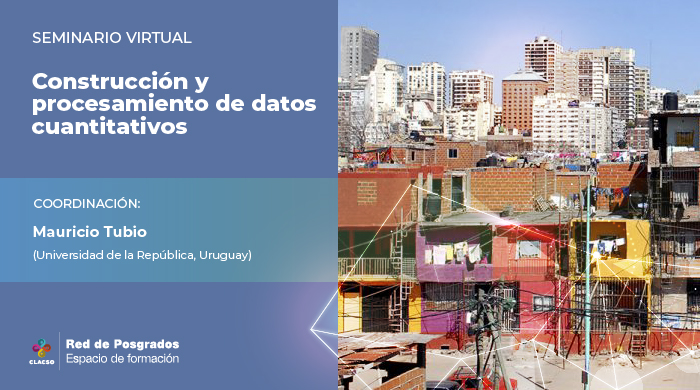
Seminar 2223
Chair: CLACSO
Coordination: Mauricio Tubío (University of the Republic, Uruguay)
Teaching team: Mauricio Tubío, Pablo Hein and Juan Romero (University of the Republic, Uruguay)
Start: 28/07/2022 | Registration: 23/06/2022 to 27/07/2022
The central objective of this course is to train graduates in the Social Sciences and other disciplines in the use of quantitative measurement instruments applicable to various academic and professional fields in our continent. The course will focus on presenting the challenges and procedures to be followed when conducting quantitative measurements of social reality using survey research techniques. The first part of the course is dedicated to presenting the concepts of measurement, operationalization, and indicator construction. The second part presents the theoretical and methodological considerations of survey research, its different modalities, and the methods for developing and administering measurement instruments. Finally, the concept of statistical sampling will be addressed, presenting the most commonly used sample types for conducting surveys and introducing methods for calculating sample size and sample extraction.
The collection of primary, quantitative data requires specific conditions and decisions for its application, as well as the selection of appropriate techniques. In our continent, there is a rich and varied experience in the development of social surveys, both in academic settings and within social organizations and applied studies. The purpose of this seminar is to present the central concepts of this technique from a practical perspective and to provide an overview of the current development of new survey methods in social research. The seminar aims to familiarize students with the strengths, potential, and limitations of different types of surveys for generating knowledge in the social sciences. In this sense, the course seeks to contribute to improving the ability to apply these techniques and to provide conceptual and methodological tools for the critical evaluation of academic production based on the construction and use of quantitative data.
The objective of this course is for students to develop a basic set of methodological and statistical knowledge and skills to solve research problems involving the collection of primary quantitative data related to behaviors, opinions, and attitudes. To this end, the first module addresses the challenges of measurement in the social sciences and the empirical operationalization of concepts for constructing observable indicators. The second module presents the survey research technique, its characteristics, types, and procedures for conducting data collection. The third module introduces the statistical assumptions of probability, sampling, and practical tools necessary for determining sample size and selection in social survey research.
- Operationalization in the Social Sciences
- The logic of variables
- Survey research
- Survey of general uses and types
- Design of measuring instruments
- Scales for measuring attitudes and testing the form
- Field work
- Sampling
- Size determination and extraction
- Results communication strategy
- Alvira, MF. The survey: an overview. Publisher: Center for Sociological Research, 2011. Collection: Methodological Notebooks
- Baranger, D. Data construction and analysis. Introduction to the use of quantitative techniques in social research. Posadas, Argentina 2009.
- Berenger, D. with collaboration from Fernanda Niño. (2009) Construction and analysis of data: introduction to the use of quantitative techniques in social research. 3rd ed.-Misiones, Argentina.
- Blanco, C. Survey and Statistics: Quantitative Research Methods in Social Sciences and Communication. 1st ed. - Córdoba: Brujas, 2011.
- Cea D Ancona, Ma. Angeles. (2001) Quantitative Methodology: Strategies and Techniques of Social Research. (3rd edition) Editorial Síntesis, Spain. CHAPTER 5: The Selection of Units of
- Cea D´Ancona, MA CHAPTER 1: HISTORICAL COORDINATES OF SOCIAL RESEARCH: THEORY AND EMPIRICAL RESEARCH In Quantitative Methodology Research Strategy and Techniques EDITORIAL SÍNTESIS, SA Madrid 1998
- Cea D´Ancona, MA CHAPTER 4: THE OPERATIONALIZATION OF CONCEPTS In Quantitative Methodology Research Strategy and Techniques EDITORIAL SÍNTESIS, SA Madrid 1998
- Cea D'Ancona. MA Survey Methods. Theory and Practice. Editorial Síntesis, Madrid 2005. Pages 289 to 387.
- Cochran, W. (1996). Sampling Techniques. Continental Publishing Company; Mexico; 513 p. Chapter 1: Introduction, pp-28 – pp31.
- Cohen, N. [et al.]. Research Methodology, What For?: Data Production and Designs /– 1st ed. – Autonomous City of Buenos Aires: Teseo 2019. Pages 15 to 3
- Ferrando, Francisco Ricardo Alvira Martín, Luis Enrique Alonso Benito, Modesto Escobar Mercado, 2016, ISBN 978-84-9104-111-5, pp. 202-236
- García Ferrando (2002) Survey, in García Ferrando, M; Ibañez, J; Alvira, F. The Analysis of Social Reality: Research Methods and Techniques, Alianza Universidad, Madrid. Chapter 5, pp. 169 to 199.
- García Ferrando, M. (1989) 3rd edition. Alianza Editorial, Spain. Sociostatistics: Introduction to Statistics in Sociology. Chapter 4.3. General Aspects of Sampling in Sociological Research. Pp. 132-154.
- González Blasco, P. MEASURING IN THE SOCIAL SCIENCES. In García Ferrando, M., Ibáñez, J., and Alvira, F. The Analysis of Social Reality: Research Methods and Techniques. Alianza Editorial, 1998. Pp. 209-235. Val Cid, C. Measurement: Validity and Reliability. In The Analysis of Social Reality: Research Methods and Techniques / edited by Manuel García
- Hernández Sampieri, R. et al. Chapter 1 Definitions of quantitative and qualitative approaches, their similarities and differences In Research Methodology Sixth Edition McGRAW-HILL / INTERAMERICANA EDITORES, SA DE CV Mexico 2014 pp. 1 to 20
- Hernández Sampieri, R. et al. Chapter 9 Quantitative Data Collection In Research Methodology Sixth Edition McGRAW-HILL / INTERAMERICANA EDITORES, SA DE CV Mexico 2014 pp. 196 to 216
- Kerlinger, F. Behavioral Research. Chapter 3 Constructs, Variables, and Definitions. Pages 30-47. McGraw-Hill, Second Edition, Mexico, 1988.5
- Kerlinger, F. and Lee, H. (2002). Behavioral Research. 4th Edition. Chapter 8: Sampling and Randomization. pp. 147–157. McGraw Hill Publishing.
- López-Roldán, P.; Fachelli, S. (2015), Chapter 11.3 "The survey", in P. López[1]Roldán and S. Fachelli, Methodology of Quantitative Social Research, Autonomous University of Barcelona
- Mandujano Bustamente, F. (1998). Sampling theory: particularities of sample design in studies of social behavior. In: Electronic Journal of Applied Methodology. Vol. 3 nº 1, pp. 1-15.
- Martínez Bencardino, Ciro. (2012). Statistics and Sampling. 13th ed. -- Bogotá: Ecoe Ediciones, 900 p. – (Exact Sciences. Mathematics). ISBN 978-958-648-702-3. Chapter 7: Sampling Designs.
- Noelle, E. Surveys in Mass Society. Alianza Editorial, Madrid 1970 Pages 37 to 64 - 187 to 229
- Otzen, Tamara, & Manterola, Carlos. (2017). Sampling Techniques on a Study Population. International Journal of Morphology, 35(1), 227-232
- Vidal Díaz de Rada. (2012). Papers: journal of sociology, ISSN 0210-2862, ISSN[1]e2013-9004, Vol. 97, No. 1, 193-223.
- Vidal Díaz de Rada. Fieldwork Manual for Surveys (Face-to-face and Telephone). Madrid: Center for Sociological Research, 2015 (Methodological Notebooks; 36). Pages 115 – 170.
- Wainerman, C. (co-ed.). Measurement Scales in Social Sciences. Nueva Visión Publishers, Buenos Aires, 1976, pp. 199-289. Baranger, D. Data Construction and Analysis. Introduction to the Use of Quantitative Techniques in Social Research. Posadas, Argentina, 2009. Chapters 84-90. Scales
|
|
Discount for one payment until 15/07 |
In one payment after 15/07 |
|
CM Plenos |
$75 |
$150 |
|
CM Associates |
$95 |
$190 |
|
No link |
$95 |
$190 |
FAQ
The basic requirements for taking a seminar are:
- Availability of at least 4 hours per week to dedicate to the seminar course.
- Internet access.
- Reasonable handling of communication and computer tools.
- Language proficiency in the language in which the course will be taught. The official languages are Spanish and Portuguese.
|
|
Discount for one payment until 15/07 |
In one payment after 15/07 |
|
CM Plenos |
$75 |
$150 |
|
CM Associates |
$95 |
$190 |
|
No link |
$95 |
$190 |

