
Conservation and ancestrality: an intercultural perspective on the management of territories
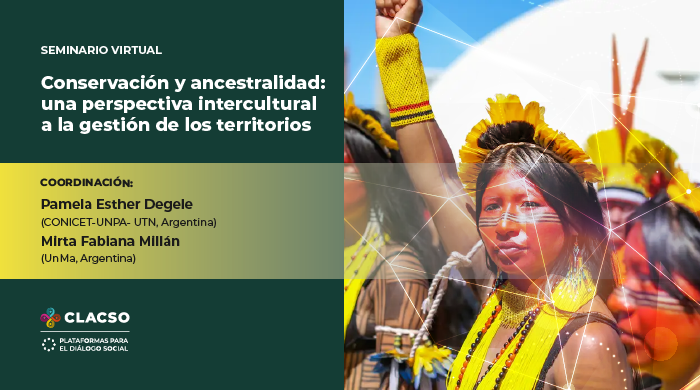
Seminar 2419
Coordination: Pamela Esther Degele (CONICET – UNPA – UTB, Argentina); Mirta Fabiana Millán (UnMa, Argentina)
Start date : 10/10/2024 | Registration : 20/05/2024 to 09/10/2024
Workload: 12 weeks – 90 hours.
The exploitation, transformation, and degradation of nature, evident in phenomena such as biodiversity loss and climate change, is one of the most pressing issues of the contemporary world. In Latin America, characterized by a proliferating cultural and natural diversity, as well as by an aggressive historical process of extractivism, economic inequality, and racism, this issue takes on paramount importance. Indigenous Peoples and local communities across the continent, in particular, express a clear stance of preservation, planning, and stewardship from innovative and alternative perspectives to hegemonic norms. This stance is directly linked to halting violence in their territories, as well as to the simultaneous protection of human rights and the rights of nature. Therefore, it is urgent to generate knowledge from an intercultural perspective that allows for the inclusion of these silenced voices in current debates and public policies, contributing to a greater justice—a clear failure of the current international conservation paradigm. The course, therefore, aims to provide theoretical tools from the perspective of interculturality to promote a comprehensive epistemic analysis of the conservation and management of territories, enabling the development of future academic productions and/or critical professional exercises that account for this diverse reality.
The widespread and growing problem of the exploitation, transformation, and degradation of nature in Latin America is closely linked to a historical pattern in the region of the subjugation of human and cultural rights, within a context of dominant economic and political interests that differ from the common good. These interests determine conditions of extractivism and territorial injustices in the region. These processes are evident in the various resistance movements that have emerged in recent decades, with a growing protagonism of Indigenous and peasant populations, and women, who present a counter-hegemonic stance, expressing the need to break with dominant Western cultural patterns (and their consequences, such as extractivism), and embracing an emancipatory praxis. As an alternative, the "good living" approach is emerging strongly in Latin America, an alternative territorial and lifestyle model rooted in an Andean Indigenous worldview, and therefore non-Western and non-capitalist. This approach, far from being a finished, theoretical and homogeneous proposal, acquires great value because it is built from the encounter of experiences and knowledge of peoples who have inhabited the continent for millennia, and who have also been long silenced and violated.
One of the most significant innovations of this approach is its break with the anthropocentric worldview, understanding the human and the non-human in relational terms, as a “political community.” Thus, from these ancestral worldviews, nature is a relational concept that underpins the cultural and territorial identity and autonomy of populations. Furthermore, it transcends the idea of its domination and instrumentalization, transforming it into a “subject of rights.” This shift in perspective is considered key to promoting improved care and protection of natural and cultural diversity in the region. Therefore, this course aims to advance toward an intercultural interpretation of nature management and conservation, in contrast to the hegemonic biological discourse that seeks to be depoliticized and that serves the currently strained model of sustainable development. It is widely acknowledged that the current international conservation paradigm, through its primary instrument of protected natural areas, faces numerous difficulties in achieving its objectives. For example, the tendency to ignore traditional uses and conceptions of the territory where conservation is planned has generated situations of displacement and imposition, creating conflicts and situations of injustice that force a rethinking of the model.
The course provides elements for reflection from the perspective of post-development, considering that to achieve a sustainable and just territory it is necessary to transcend towards a plural intercultural rationality, which simultaneously respects the rights of nature and local cultures as well as recognizes the link between the body, biodiversity, territory, gender, spirituality, self-determination and the identity reproduction of peoples; in practical terms, that gives priority to these aspects in territorial management and conservation, which until now have been scarcely recognized and subjugated to economic interests, generating numerous social and environmental problems.
General objective:
- To provide an analytical and investigative perspective on interculturality as an emerging paradigm in Latin America in relation to the management and conservation of territories.
Specific objectives:
-To provide theoretical tools to benefit knowledge and academic/professional contribution in conservation and territorial management with alternative epistemological approaches.
-To provide participants with useful bibliography from intercultural perspectives and new conservation paradigms. -To collectively reflect on the importance of the intercultural perspective in relation to international and national conservation policies of the last 10 years.
-To publicize, discuss and learn about different specific cases in the Latin American context and in particular in Argentina.
- The perspective of interculturality in Latin America
- The current international paradigm of conservation
- Ancestral perspectives on territory, nature, and conservation
- Territorial justice and human rights in conservation
- Socio-environmental conflicts, indigenous peoples and territories in relation to the States
- Participatory mechanisms for territorial management
- Interculturality in public conservation policies
- Exchanges of experiences and case studies
- Briones, C. 2005. Formations of otherness: Global contexts, national and provincial processes. In Argentine Cartographies. Indigenous policies and provincial formations of otherness, Editorial Antropogagia, Buenos Aires, Chapter One, Pp 11-43.
- Dussel, E. 2000. The coloniality of knowledge: Eurocentrism and social sciences. Latin American perspectives. CLACSO.
- Horn, P. et al. 2021. Contested Territories: Interdisciplinary Dialogues on Conflict, Resistance and Alternatives. Lessons from Latin America. Contested Territories Working Paper Series 1, 1-43.
- Tubino, F. and Flores, A. 2020. Critical interculturality as a policy of recognition. Pontifical University of Peru, Lima. Briones, CN 2009. Cultural diversity and interculturality: what are we talking about?; Prometeo, 35-58.
- Diaz, P. 2003. Interculturality in debate. Theoretical and political appropriations for a challenging education. Visiting Resource Professor Papers LLILAS, The University of Texas at Austin.
- Degele, PE, Pedregal, B., 2022. North–South dialogue on territorial policies and discourses: insights for the future of nature conservation. Land 11, 994. https://doi. org/10.3390/land11070994.
- Swyngedouw, E. 2011. Nature does not exist! Sustainability as a symptom of depoliticized planning. Urban, 1, 41–46
- Oviedo, G. 2008. Protected areas, development and culture. Green Letters 2, 2-4.
- Millan, M; Chaparro, MG; Mariano, M. 2019. Intercultural dialogues on ancestral territories in the province of Buenos Aires, Argentina; Latin American Faculty of Social Sciences Ecuador; Icons. Social Sciences Journal; 63; 161-184.
- Ñanculef Huaiquinao, J. (2016). Tayiñ Mapuche Kimün Mapuche Epistemology - Wisdom and Knowledge. Santiago, Chile: University of Chile.
- Alfonso Cárdenas, LD and Martínez Soriano, AF 2020. Spiral Pedagogy: Beings, Knowledges and Territories in Re-existence. Educational Practices, Pedagogy and Interculturality. V International Congress of Ethnography and Education.
- Svampa, M. The frontiers of neo-extractivism in Latin America: socio-environmental conflicts, eco-territorial turn and new dependencies. Bielefeld: Bielefeld University.
- Gudynas, E. 2021. Water Justice: Exploring the varieties of Justice and the Rights of Nature. In: Water Justice: A View from Latin America (37-56). Alicia Guzmán León, ed. Bartolomé de las Casas Center, Cusco.
- Brei, A. 2013. Rights & Nature: Approaching Environmental Issues by Way of Human Rights. Journal of Agricultural and Environmental Ethics, 26, 393-408.
- Miguel Leone. 2013. Indigenous Peoples and Democracy. Formation of New Political Subjects. Argentina, 1983-2013. X Conference on Sociology. Faculty of Social Sciences, University of Buenos Aires, Buenos Aires.
- Quijano, A. 2005. «The “indigenous movement”, democracy and pending issues in Latin America», Polis, 10. Lanata, JL 2014. Genocidal practices and state violence in transdisciplinary perspectives. - 1st ed. – San Carlos de Bariloche : IIDyPCa-CONICET.
- Borrini-Feyerabend, G., Dudley, N., Jaeger, T., Lassen, B., Pathak Broome, N., Phillips, A., and Sandwith, T. 2014. Governance of protected areas: from understanding to action. Gland, Switzerland: IUCN. Vladimir Zambrano, C. (2001). Plural territories, sociopolitical change and cultural governance. Boletim Goiano de Geografia, 21(1), 9-50.
- Massiris, A. 2005. Conceptual and methodological foundations of territorial planning. Tunja, Colombia: Uptc
- Ruiz Velez, RR and Espinales Laaz, JA 2023. Public Natural Heritage from the perspective of human rights in the Ecuadorian context.
- Aylwin, J. and Cuadra, X. 2011. The challenges of conservation in indigenous territories in Chile. Citizen Observatory, Chile. Ulloa, A. 2010. CONCEPTUAL, POLITICAL AND TERRITORIAL RECONFIGURATIONS IN THE DEMANDS FOR AUTONOMY OF INDIGENOUS PEOPLES IN COLOMBIA. Tabula Rasa 13 73-9.
-Luis Cayón, «Discovering nature. Natural law and indigenous territorial organization in the Colombian Amazon», Anuário Antropológico [Online], v.35 n.1 | 2010
- Degele, P. and Millán, M. 2023. The conflict over Cerro Largo (Argentina): reinterpreting the territory, its dispute and conservation from the ancestral Mapuche worldview. Diálogo Andino 69, 198-209.
- Trentini, F. (2012). Political ecology and conservation: the case of the “co-management” of the Nahuel Huapi National Park and the Mapuche people. Pilquen Journal, 14(15), 1-11.
- Anaya, FC and Espírito-Santo, MM (2018). Protected areas and territorial exclusion of traditional communities: analyzing the social impacts of environmental
compensation strategies in Brazil. Ecology and Society 23(1), 8.
|
Discount for one payment until 03/10 |
In one payment after 03/10 |
|
|
CM Plenos |
$85 |
$150 |
|
CM Associates |
$85 |
$150 |
|
No link |
$105 |
$190 |
FAQ
The basic requirements for taking a seminar are:
- Availability of at least 4 hours per week to dedicate to the seminar course.
- Internet access.
- Reasonable handling of communication and computer tools.
- Language proficiency in the language in which the course will be taught. The official languages are Spanish and Portuguese.
The seminars last 12 weeks, plus the completion of a final project. A total of 90 hours of dedication will be credited.
A course consists of twelve classes, each accompanied by required reading bibliography, supplementary bibliography, discussion forums and training activities proposed by the teaching team, partial deliveries and a final project.
The course is online and asynchronous. Some instructors may propose synchronous activities. In those cases, the time and date will be agreed upon beforehand between the teaching team and the students to ensure everyone's participation.
To pass the seminar, you must participate in at least 80% of the discussion forums and activities proposed by the teachers, have completed the scheduled partial deliveries, and pass the final work.
|
Discount for one payment until 03/10 |
In one payment after 03/10 |
|
|
CM Plenos |
$85 |
$150 |
|
CM Associates |
$85 |
$150 |
|
No link |
$105 |
$190 |
The possible payment methods are credit card, bank transfer and bank deposit.
Inquiries: [email protected]

