
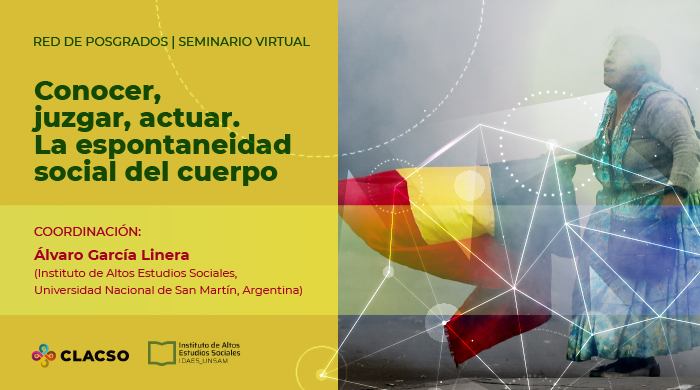
To know, to judge, to act. The social spontaneity of the body
Seminar 2057
Coordination : Álvaro García Linera (Institute of Advanced Social Studies, National University of San Martín, Argentina)
Start date : 15/09/2020 | Registration : 20/05/2020 to 14/09/2020
Workload: 12 weeks – 90 hours.
Society, as a collection of relationships and events, presupposes not only individuals capable of performing certain actions physically, but also of collectively signifying, representing, naming, and imagining those practices. In all cases, it is the body, and different sets of bodies, that act, think, believe, fight, become angry, tolerate, impose themselves, and resist, giving rise to the continuum of social relations. Society tends to be represented as a complicated and strange entity that exists independently of individuals, when in reality it consists of regular, and of course complex, ways in which bodies, real people, interact. Therefore, studying the body as the site of social bonds allows us to restore the fragility and contingency of daily social relations, but also the weighty anchors in which the histories of past social relations are deposited in the various memories of the body, and in its probable courses of action. What will be done, then, is to problematize some of the important studies on the body as a social relation, to articulate certain aspects addressed by different authors, to find logical ways in which these contributions complement each other, and to arrive at a proposal for grammaticalizing the social acts of the body and collective behaviors. The guiding thread of the entire course will be to provide elements regarding the conditions of possibility for social change.
1-Political Economy of the Body. The Living and Naked Carnality of Exploitation (Marx).
- Value as a bodily abstraction.
- Perpetual bodily dispossession.
- The body as a social relationship.
- Surplus value as bodily alienation.
- The capitalist construction of the body. The factory.
2-Society as a Web of Power for the Subjection of Bodies (Foucault).
- Docile bodies. Power beyond the State
- The body as a narrative of power
- Panopticism, Disciplining and Biopolitics.
3-Techniques and body gloss (Mauss, Birthwishtell, Goffman, Elias)
- Social hierarchies and body movements.
- The grammar of the body.
- Knowing and informing without speaking. The interaction of bodies.
- Civilization made flesh.
4-Social Order (domination) made Body (Bourdieu).
- Body hexis and mental schemes.
- Class body. Class gesture.
- To carry social order within one's body.
- Embodied race and ethnicity.
- Can the dominated emancipate themselves?
5-The Social Grammars of the Body. Common Sense (Gramsci)
- Common sense as a shared way of being, acting, imagining, and naming the world
- Moral Order
- logical order
- Instrumental Precepts
- Procedural Precepts
- Intentional precepts.
- Social languages: grammar of speech; body grammar; grammar of mental schemas.
- Hegemonic forms of short and long duration.
6-Why is it so difficult, although not impossible, to change the world?
- Austin, A., How to Do Things with Words; Lecture 1 and 2, Editorial Paidós, Spain, 2016.
- Birwhistell, R., The Language of Body Expression; Chapters I to 3, Editorial Gustavo Gili, Spain, 1979.
- Bourdieu, P., The practical sense, chapter 5, 6, Editorial Taurus, Spain, 1991.
- Bourdieu, P., Distinction: A Social Critique of the Judgement of Taste; Chapter 7, Taurus Editions, Spain, 1998.
- Bourdieu, P., Pascalian Meditations; Chapter 4, Anagrama Publishing House, Spain, 1999.
- Durkheim, The Elementary Forms of Religious Life; introduction, Editorial Akal, Spain 1982.
- Elias, N., The Civilizing Process; Chapter Two, Fondo de Cultura Económica Publishing House, Mexico, 1989.
- Feher, M., Tazi, N., Fragments for a History of the Human Body; pages 129-199, volume 2, Editorial Taurus, Spain, 1991.
- Foucault, M., Genealogy of Racism; fifth lesson, and summary of the course, Editorial Altamira, Spain, 1998.
- Foucault, M., Microphysics of Power; point 6 power-body Editorial Siglo XXI, Argentina, 2019.
- Foucault, M., Discipline and Punish: The Birth of the Prison; Chapter: Discipline, Editorial Siglo XXI, Mexico, 2012.
- Goffman, E., Frame Analysis. The frames of experience; sections 1 to 8, Editorial Centro de Investigaciones Sociológicas, Madrid, 2006.
- Goffman, E., Public Relations, chapters 1 and 2, Alianza Editorial, Madrid, 1978.
- Gramsci, A., Prison Notebooks, 6 volumes; Notebooks 5 and 29, ERA Editions, Mexico, 1981-2000.
- Lemieux, C., Grammars of social action; chapter 4, Editorial Siglo XXI, Argentina, 2017.
- Marx, K., Capital, Critique of Political Economy, Volume 1; Chapter 1; Editorial Siglo XXI, Mexico, 1981.
- Marx, K., Grundrisse: Foundations of the Critique of Political Economy 1857-1858, Volume II; Section “Machinery and Living Labor”, Editorial Siglo XXI Mexico, 1978.
- Marx, K., Manuscripts 1861-1863; “Exchange with Labor. The Labor Process” in Marx, K., Community, Nationalisms and Capital, Vice-Presidency of the Plurinational State of Bolivia, La Paz, 2018.
- Marx, K., Manuscript on Friedrich List, 1845, in Marx, Community, Nationalisms and Capital, Vice-Presidency of the Plurinational State of Bolivia, La Paz, 2018.
- Mauss, M., “Techniques and body movements”, in Sociology and Anthropology, Tecnos Publishing House, Spain, 1991.
- Nun, J., Common sense and politics; chapter 1, Fondo de Cultura Económica Publishing House, Argentina, 2015.
- Searle, J., Creating the Social World; chapters 4 and 5, Editorial Paidós, Spain, 1014.
- Tellez, E., Martinez, R., Pigmentocracies. Color, ethnicity and race in Latin America; chapters 1 and 6, Fondo de Cultura Económica Publishing House, Mexico, 2019.
- Wittgenstein, L., About Certainty, Editorial Gedisa, Barcelona, 2009.
If you have a link with a CLACSO Associated Center:
- Paying in one payment: USD 95 (includes issuance and shipping costs of the digital certificate).
- Paying in one payment: USD 140 (includes issuance and shipping costs of the digital certificate).
- Paying in one payment BEFORE 25/08/2020: USD 150 (includes issuance and shipping costs of the digital certificate).
- Paying in one payment: USD 190 (includes issuance and shipping costs of the digital certificate).
The basic requirements for taking a seminar are:
- Availability of at least 4 hours per week to dedicate to the seminar course.
- Internet access.
- Reasonable handling of communication and computer tools.
- Language proficiency in the language in which the course will be taught. The official languages are Spanish and Portuguese.
If you have a link with a CLACSO Associated Center:
- Paying in one payment: USD 95 (includes issuance and shipping costs of the digital certificate).
- Paying in one payment: USD 140 (includes issuance and shipping costs of the digital certificate).
- Paying in one payment BEFORE 25/08/2020: USD 150 (includes issuance and shipping costs of the digital certificate).
- Paying in one payment: USD 190 (includes issuance and shipping costs of the digital certificate).

