
Congress on racism and structural inequalities
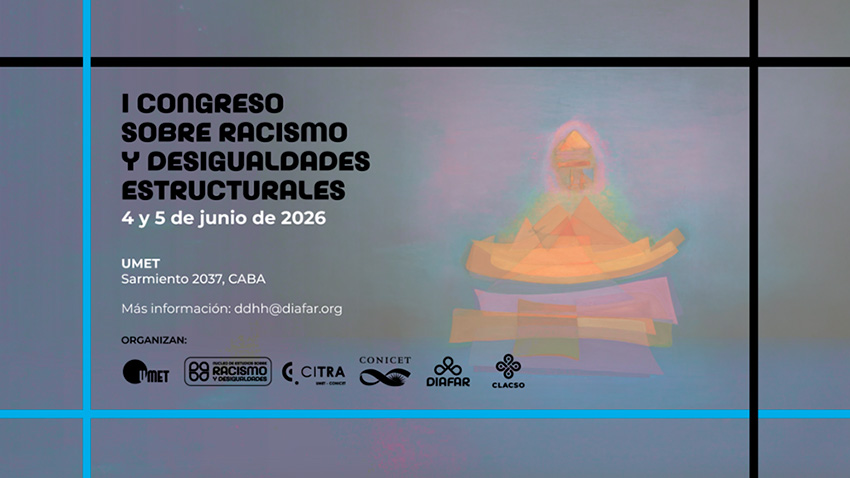
On June 4th and 5th, the “ First Congress on Racism and Structural Inequalities ” will be held at the Metropolitan University for Education and Labor (UMET). This initiative is organized by the Center for Studies on Racism and Inequalities at UMET, with the support of CLACSO and CITRA. Over two days, researchers, activists, and leading figures from various Latin American and Caribbean countries will discuss one of the region's most persistent problems: the ways in which racism continues to structure inequalities in access to rights, political representation, education, justice, work, and daily life.
The Congress brings together more than sixty presentations from Argentina, Brazil, Colombia, Cuba, Chile, Mexico, Venezuela, Guatemala, Peru, and Ecuador, among other countries. Throughout the various panels, topics such as institutional racism, state violence, migration, Black feminisms, public health, memory, education, cultural production, and experiences of Afro-descendant and Indigenous political organizing will be addressed.
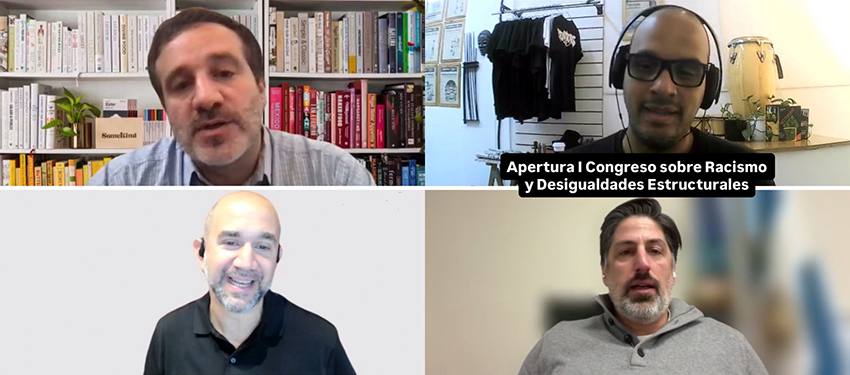
The opening remarks are delivered by Nicolás Trotta , National Deputy and President of the UMET Academic Council; Pablo Vommaro , Executive Director of CLACSO; Fernando López , Secretary of Research and Development at UMET; and Federico Pita , Director of the Center for Studies on Racism and Inequalities and coordinator of the CLACSO Working Group "Anti-racism and Afro-descendants in the Global South".
UMET: Sarmiento 2037, Autonomous City of Buenos Aires
In his remarks, Pablo Vommaro stated that “at CLACSO we know that the Latin American and Caribbean social sciences, humanities, and arts have a long tradition of critical thought committed to understanding and transforming multidimensional social inequalities. But we also know that racial inequalities have long been insufficiently addressed in both academic circles and public policy. Therefore, now more than ever, it is essential to strengthen an agenda of research, reflection, and action that contributes to making visible and transforming the multiple forms that structural racism takes in our societies.”
The historic moment we are living through reached a turning point on March 25, when the UN General Assembly adopted a landmark resolution declaring the transatlantic slave trade and racialized slavery the most serious crime against humanity. The initiative received 123 votes in favor and was opposed only by Argentina, the United States, and Israel.
The resolution, which seeks to have nations assume historical responsibility for exploitative regimes, has 3 key points that are strongly linked to this Congress:
Non-prescriptibility: The text reaffirms that crimes related to this trafficking do not have a statute of limitations and are violations of international law.
Restorative justice: It establishes the international debate on reparations, including formal apologies, compensation, rehabilitation and return of cultural property.
Gender recognition: Denounces the sexual violence and forced reproduction to which enslaved women were subjected.
The resolution was promoted by Ghana and supported by the African Union and the Caribbean Community (CARICOM).
This Congress invites us precisely to consider racism not as an individual or circumstantial problem, but as a historical and structural dimension that permeates social, economic, cultural, and political relations. It calls upon us to understand how racial inequalities intertwine with other forms of exclusion and how they persistently affect the living conditions, access to rights, and opportunities of millions of Afro-descendant, Black, and Afro-diasporic people in Latin America and the Caribbean.
In this context, I want to especially highlight the work being done by the CLACSO Working Group “Antiracism and Afro-descendants in the Global South ,” a space that seeks to consolidate a critical perspective capable of linking knowledge production, public advocacy, and dialogue with social movements. The Working Group is based on a fundamental conviction: it is impossible to conceive of democracy, equality, and social justice without placing the fight against racism at the center and without recognizing Afro-descendant populations as fundamental political, historical, and epistemic subjects for building more just societies.
I also want to mention the Virtual Seminar “Historical Reparations and Intertwined Inequalities: Towards Reparative Justice and Afro-Reparations ,” which we at CLACSO are promoting as a space for training, debate, and collective construction. The seminar seeks to contribute to an increasingly necessary discussion in our region: how to think about historical reparations not only as compensatory mechanisms, but as processes of profound transformation oriented towards racial justice, the democratization of our societies, and the recognition of the historical struggles of Afro-descendant and Afro-diasporic peoples.
We also find ourselves in a particularly challenging regional and global context. We are witnessing the rise of hate speech, racist expressions, renewed forms of exclusion, and political projects that seek to deny or minimize existing inequalities. In this context, spaces like this Congress acquire strategic importance. Because producing critical knowledge, strengthening dialogue between academia and social movements, and building collective agendas are fundamental tasks for strengthening and revitalizing democracy and expanding rights.
“At CLACSO, we reaffirm our commitment to building a cross-cutting anti-racist agenda that helps challenge the historical hierarchies that still persist in our institutions, our knowledge systems, and our societies. It is not enough to simply declare ourselves against racism; the challenge is to actively build anti-racist practices, policies, and institutions,” he concluded.
This is an interdisciplinary space for researchers, activists and artists, aimed at strengthening critical analysis on inequalities, focusing on Afro-descendant experiences in Latin America and the Caribbean and their contributions to social justice, culture and human rights.
The holding of this first Congress also reflects the consolidation of a field of study that has gained visibility in recent years in Argentina and Latin America. In the face of discourses that deny or minimize the existence of racism, the event offers a space to produce knowledge, exchange experiences, and strengthen academic and political networks committed to transforming the historical inequalities that continue to shape our societies.
Areas of focus:
• Racism, public policies and collective action
• Inequality and racialization from a historical perspective
• Black and popular feminisms in the Americas and the Caribbean
• Visual, literary, and performative narratives
Open call for:
• Research presentations (ongoing or completed)
• Experiences of activism or cultural practices
• Artistic and audiovisual proposals
Organized by: UMET through its Center for Studies on Racism and Inequalities – CLACSO – DIAFAR (African Diaspora of Argentina) – CONICET and the Center for Innovation of Workers (CITRA). The meeting has the participation and support of the CLACSO Working Group "Anti-racism and Afro-descendants in the Global South".

