
"With tax reform, extreme poverty could be eradicated in the region."
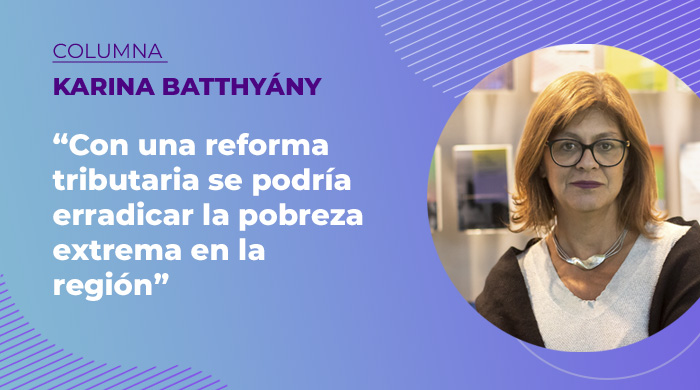
Transcript of Karina Batthyány's column
in InfoCLACSO – July 17, 2024
Today we're going to talk about a very significant report from Oxfam, with whom we work closely on various issues throughout Latin America and the Caribbean. The report, titled “EconoNuestra,” addresses structural inequalities in our region, highlighting how these inequalities were exacerbated during the Covid-19 pandemic and intersected with other crises. It clearly outlines the need to discuss a new social and economic pact for our region, one that prioritizes equity and sustainability—something we've been working on through our Platforms for Social Dialogue program.
What problems does Oxfam raise or identify in this report? The first is the polarization of wealth. It focuses on two main elements: one of them is extreme inequality, which is illustrated with a wide range of statistics. For example, the wealthiest 1% of the population holds almost 55 times more wealth than the poorest half of the population.
On the other hand, this polarization is also linked to the concentration of wealth. In line with the previous data, it is shown that in 2022 the wealthiest 1% owned almost 44 out of every 100 dollars of total wealth, while the poorest half owned only eight cents out of every 100 dollars. This illustrates how wealth reaches different sectors of the population, hence the term wealth polarization.
The second major area addressed in this report is tax systems, which it describes as inefficient and unfair. It demonstrates that Latin American tax systems collect little revenue and in a highly unjust manner. For example, half of the revenue comes from direct consumption taxes (VAT), which disproportionately affect lower-income households. The fewer resources people have, the greater the proportion they spend on everyday necessities. Consequently, a larger share of their income is impacted by direct consumption taxes such as VAT.
But the question also arises of how this benefits the wealthy, that is, how these tax policies tend to favor those with the greatest resources. For example, given that effective personal income tax rates in Latin America and the Caribbean are, on average, the lowest in the world and have decreased significantly since the 80s, this is where a difference can be made—not through consumption taxes, but by taxing other types of income, such as personal income or income from high earners.
A third point mentioned is the climate crisis and the demographic transition, and their impacts. Regarding the climate crisis, it is shown how Latin America and the Caribbean is one of the regions most affected by this phenomenon, despite being one of the lowest contributors to global warming. While not the largest contributors to this problem, we are among the regions most affected by the climate changes and crises that have unfortunately become commonplace in our time.
Regarding the demographic transition, it is explained that we previously viewed it as an exception in Latin America and the Caribbean, for example in countries like Uruguay or Cuba that already had an advanced demographic transition. When we speak of an advanced demographic transition, we are referring to a predominantly aging population. By 2045, the population of the entire Latin American and Caribbean region will be predominantly aging, entering this advanced demographic transition with enormous economic and social implications in many areas, including social security and care.
These are essentially the core themes addressed in this report, but what's interesting is that, after a thorough analysis, it also offers concrete proposals. The first proposal concerns public policies to reduce inequalities, focusing on intersectional inequalities. This involves developing public policies that reduce inequalities affecting young people, rural populations, Afro-descendants, and Indigenous people, while also, of course, addressing the gender dimension in a substantive way.
Among these policies, the importance of investment in public services is highlighted, which is one of our region's greatest shortcomings. While we see complaints in Europe about the decline of public services, in Latin America and the Caribbean we still have a significant lack of universal access to basic public services. We are talking, quite simply, about increasing investment in areas such as health, education, and other universal public services.
Furthermore, proposals are made regarding climate justice, working with the idea of just transitions, that is, promoting a transition towards sustainable and environmentally friendly economic models. When we talk about a just transition, it refers to how these regions, which are not the main contributors to the climate crisis, are being most significantly affected by it. The idea of implementing environmental regulations that attempt to limit negative socio-environmental impacts and ensure a fair distribution of economic benefits within the framework of this climate justice is also outlined.
The report then dedicates a chapter to tax reforms, one of the core issues analyzed in the study. Two proposals are presented: first, taxes on large fortunes, that is, on the net worth of the ultra-wealthy, to generate additional funds for public policies, for example. Second, it addresses how to eliminate tax evasion by strengthening anti-evasion measures to ensure that everyone contributes fairly.
There is a fourth set of proposals linked to shared responsibility in care work. It's important to remember the significance of this issue, among other factors, due to demographic transitions toward aging societies. This set of proposals raises the need for universal care systems that guarantee the right to care, establishing shared responsibility among the State, the private sector, families, and households.
These proposals establish a roadmap that several institutions at the regional level have undoubtedly been working on, and this report allows us to revisit, systematize, organize, and also promote and coordinate these proposals to move forward. Furthermore, Oxfam estimates the potential impact of these reforms, particularly that a progressive tax reform could generate an additional $264 billion annually. These funds, for example, could be used to eradicate extreme poverty in Latin America and the Caribbean, establish national care systems, and implement various climate actions, effectively doubling current public spending to address the climate crisis.
In conclusion, this Report underscores the importance and urgent need to transform economic and fiscal systems in Latin America to reduce inequality. It also underscores the urgency of promoting climate justice and guaranteeing the rights of all people in our region across various social and economic spheres. Furthermore, it proposes concrete steps to build or advance toward more just, democratic, and sustainable societies.
It is also important to mention that the report raises the need for coordinated international action, with appropriate coordination in all the areas mentioned, but especially in the field of tax policies. Of course, the political commitment of governments is essential to adopt and implement these proposed measures, and undoubtedly others that will also be part of the discussion.
In short, this report is a very important tool for public debate and political action, to try to promote the significant change that we all want for our Latin American and Caribbean region.
– The report, the proposals, and the analysis are very interesting. What other contributions can academia make to thinking about research logic, but also about collaborative work between civil society, academia, and public policymakers?
– There are many things that can be done, but I'll tell you what we do at CLACSO. We promote social dialogue around these kinds of reports and proposals that revisit central debates for the region, such as tax reform, the concept of basic income, and the development of care systems. What we want is to connect this academic knowledge, which emerges from the Oxfam report and many others, with those working in the field of public policy, but also, and fundamentally, with what we call civil society, which is really the social movements and organizations. This is absolutely essential to advance this social transformation and for Latin America to move toward the urgent overcoming of inequalities.
If you would like to receive more information about CLACSO's training programs:
[widget id=”custom_html-57″]
to our email lists.

