
What kind of economy will we have after the coronavirus pandemic?
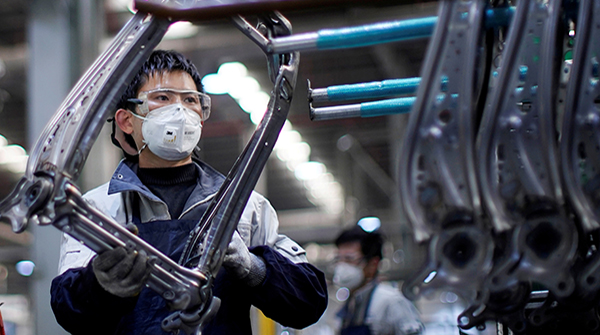
FILE PHOTO: An employee wearing a face mask works on a car seat assembly line at Yanfeng Adient factory in Shanghai, China, as the country is hit by an outbreak of a novel coronavirus, February 24, 2020. REUTERS/Aly Song/File Photo
We must take advantage of this unprecedented situation of shared vulnerability to collectively build an economy that cares, protects, and saves lives.
Gerard Pisarello[1]
The worsening COVID-19 crisis is starkly revealing that there is no single way to resolve the dilemma between lockdowns and maintaining economic activity. However, one thing is becoming clear: the responsibility and determination with which this crisis is faced will determine the lives of countless people, as well as the possibility of emerging from this pandemic with very different ways of relating to one another than those that brought us to this point.
Emergency deniers
Those who deny the severity of the virus, like Bolsonaro and Trump, are the most reluctant to accept lockdowns as a way to curb contagion and prevent overwhelming healthcare systems. To justify this, they are appealing precisely to the need to "save the economy." However, it doesn't seem that their concern is the economic situation of the majority. Bolsonaro has had no qualms about calling for an end to quarantine, arguing that Brazilians shouldn't fear infection because they are people "who dive into a sewer and nothing happens to them." A collection of Trump quotes along the same lines can be found. And the consequences are plain to see. In just a few days, deaths in Brazil are skyrocketing, and the United States has become the country with the most infected people in the world—around 81.000—which is especially worrying considering that in its privatized healthcare system, COVID-19 treatment can cost around $35.000.
The false dichotomy between economy and life
At the other extreme are those who have vehemently argued that the only way to confront the virus is through a total lockdown and an equally severe suspension of economic activity. This is a drastic approach, which has even been framed as a radical dilemma: "Either the economy or life!" This formulation may be useful for drawing attention to the severity of the pandemic, but it has proven unrealistic as a guide for public action. Firstly, because protecting life cannot be considered in isolation from the economy—that is, from the production, distribution, and consumption of the goods and resources that make life possible. And secondly, because a prolonged interruption of the economy, without a prior social safety net, would also face significant obstacles.
That's precisely why most countries advocating for intensive isolation measures are proposing to redirect rather than completely halt the economy. They are prioritizing production related to the socio-health emergency. In almost all of them, in fact, the first step has been to close bars, gyms, clothing stores, and similar sectors. But conversely, they have boosted the production of masks, ventilators, rapid tests, and personal protective equipment for healthcare and cleaning professionals.
In some cases, this has led to initiatives for nationalization or public control of private sectors that neoliberalism considered anathema until very recently. In Spain, the health emergency revealed to many that there was an article of the Constitution, Article 128, which subordinates wealth, "whatever its ownership," to the general interest, and which has significant potential for application. In Ireland, in fact, the Christian Democratic Prime Minister Leo Varadkar has already temporarily nationalized 2000 hospital beds, nine laboratories, and thousands of employees to incorporate them into the state health system to fight COVID-19.
To distinguish what is essential from what is not.
Some countries, such as Italy, New Zealand, and now Spain, are going a step further and detailing which activities should temporarily close and which should continue. Italy has drafted a decree limiting the temporary operation of the economy to specific sectors. However, this is far from implying a sudden shutdown or a widespread paralysis of the production system. The decree approved by Giuseppe Conte's government maintains as essential… some 80 sectors of the economy! This includes strategic and auxiliary industries, without which the healthcare system itself would be jeopardized: chemicals, pharmaceuticals, aluminum, rubber, the food sector, optics, waste collection and treatment companies, repair of basic industries, water and gas distribution, and many more.
This shows that, in all these countries, what is really being imposed is a fundamental balance: being able to send a significant number of workers home to contain the contagion, but without abandoning the performance of essential, strategic activities, without which the triple health, social and economic emergency would worsen even further.
Reorient the economy to protect life
In a context like this, there is no perfect solution. But the challenge is clear: to maximize isolation during quarantine while laying the foundations for an economy geared towards protecting life sustainably over time. This requires addressing current emergencies, but also keeping a focus on the productive, commercial, and energy ecosystem of the future.
It is here, as in the 2008 crash, that we see once again that the economy needed to confront these pandemics cannot be the capitalist economy that has brought us to this point: one that creates precarious work, destroys public services, is speculative, and is predatory in its impact on nature. Therefore, it is no longer a matter, as Nicolas Sarkozy so loudly and hypocritically proclaimed a decade ago, of "refounding capitalism." Rather, it is about listening to what movements like feminism and environmentalism are proposing and taking advantage of the crisis to lay the foundations for a different economy: one that is more cooperative, prioritizes the public and the commons, and addresses the urgent need to reverse global warming, social inequality, and the proliferation of weapons of mass destruction.
Caring for people in lockdown and those who work outside
In the immediate term, this requires protecting both those confined to their homes and those who must work outside. However important lockdowns are to prevent the healthcare system from becoming overwhelmed, it is difficult to force everyone to self-isolate when the starting point is a structural social inequality in which not everyone is in an equal position to do so. One only needs to look at large countries like India or Mexico, but also cities like Lesbos and others in Europe, to grasp the scale of the tragedy.
If you have decent housing and a secure income, a long lockdown can be difficult but manageable. If you live in overcrowded conditions or are unemployed, confinement can mean exposing your loved ones to other illnesses, being unable to pay rent, or simply not being able to feed your children. That's why it's urgent to strengthen home care services—something cities like Barcelona, Cádiz, Valencia, and Bilbao are already dedicating enormous resources to—or to introduce emergency basic income schemes, like the one the opposition just secured from Bolsonaro in Brazil. And that's also why it's urgent to set clear limits on layoffs, as the PSOE-UP government is proposing, or to suspend mortgage and rent payments for vulnerable families and businesses, something that requires confronting the banks and large landlords.
And the same applies to the economy that continues to function outside of homes. A healthy economy, committed to supporting those in lockdown, cannot leave its small and medium-sized businesses, cooperatives, the cultural sector, nursing homes, and, of course, those performing essential social and healthcare work, unprotected. It's pointless to applaud cleaners, doctors, nurses, supermarket cashiers, or caregivers for the elderly if their labor rights, work schedules, and health are not then protected with the same determination.
The fundamental question: who pays for this?
Of course, this comes at a cost, and the obligation of public authorities—all of them—is to ensure that the usual suspects don't bear the brunt of it. In Europe, the Union itself is risking its credibility and survival on this issue. It is telling that—unlike what happened with the Greek crisis—Portugal, Spain, and Italy are now jointly questioning the petty resistance of the Netherlands and Germany to issuing coronabonds and facilitating financing for Southern European countries that isn't subject to the whims of speculators and vulture funds. It is also telling that a growing segment of the population is beginning to ask why their governments aren't applying stricter fiscal measures to the wealthy and the wealthy landowners who were bailed out countless times and haven't repaid that effort to society.
Obviously, whether the crisis serves to further prop up the casino economy that has taken hold in recent decades also depends on the organizational capacity of citizens and those who live by their labor. This is not easy in a context of isolation, but the challenge is unavoidable: to organize, to create spaces for mutual support, to connect beyond physical borders, so that the aspirations that resonate from balconies today can find their way despite the pandemic. The fight against COVID-19 cannot be conceived as a war effort. What is needed is not to kill anyone or militarize daily life, but to take advantage of this unprecedented situation of shared vulnerability to collectively build an economy that cares, protects, and saves lives.
[1] Professor of constitutional law, republican, and activist for the Comuns, Barcelona. Article originally published in eldiario.es.
If you would like to receive more information about CLACSO's training programs:
[widget id=”custom_html-57″]
to our email lists.

