
"With Cuba's new Family Code, we took a leap forward in terms of social inclusion."
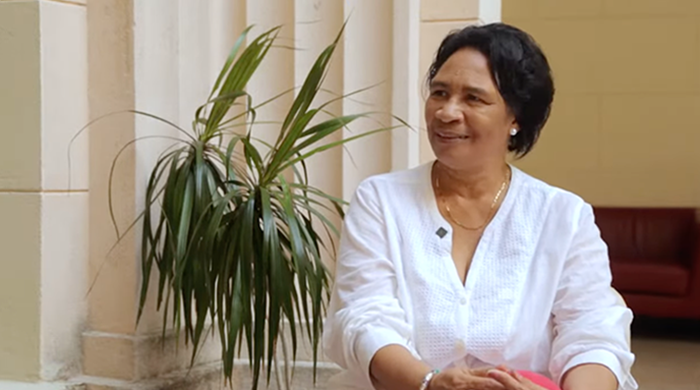
Within the framework of the Forum “Contemporary challenges in caregiving: Demographic and political dynamicsThe conference, organized from April 25 to 27 in Havana, Cuba, by CLACSO, UNICEF, the Cuban Ministry of Labor and Social Welfare, the United Nations Population Fund, OXFAM, UN Women, the Friedrich Erbert Foundation and the CLACSO Caribbean Region Centers, spoke with CLACSO.tv Miriam Nicado, Rector of the University of Havana.
– The issue of care is a vital one, not only for Cuba but for Latin America and the entire world. We must continue to research it, seek greater consensus, and find better ways to ensure that those who need care have all the necessary resources to guarantee their lives and their future. We are at an extraordinary moment because, in the case of Cuba, public policies are being restructured. Therefore, the Care Policies event filled a gap, providing a space to discuss how to address this issue in the country.
– You are the first woman to hold the position of rector at the University of Havana in Latin America and the Caribbean, where the glass ceiling for women remains a problem in accessing positions of power. What does it mean to be rector of this emblematic university?
– It is an extraordinary challenge to lead the University of Havana. This university is not only old, but also prestigious. Prominent figures in the nation's politics have passed through its halls. The Father of the Nation, Carlos Manuel de Céspedes, studied here; Fidel Castro graduated from here; and it is the university where the Federation of University Students of Cuba was founded.
Furthermore, it's a Cuban people's university. So, it's a huge commitment to all the students, to its entire history, but also to all women. Because I believe that one cannot let down Cuban and Latin American women in a position like rector. I feel very honored by this responsibility and at the same time ready to give my all for it.
– Regarding the changes to the New Family Code, which has been the subject of a very broad, important, and momentous debate, how did you experience them and what significance do they have for the struggles of diverse groups?
– The Family Code was a momentous event for us, because it sparked a nationwide debate about the direction the code was taking. We made an extraordinary leap forward in terms of social inclusion. The fact that it allowed for couples to be of any kind, as people wished, was something many people had hoped for.
Furthermore, the Code clearly establishes the need to care for older adults differently than we have done previously. The role of women in society is also clearly defined, as is the role of the family as the fundamental unit for life and personal growth. We are very pleased with this new regulation. We can serve as a model for other societies where certain, more entrenched laws still persist. However, it also presents a cultural challenge, because not everyone yet fully understands the changes in this Code.
Interviewed by Gustavo Lema.
If you would like to receive more information about CLACSO's training programs:
[widget id=”custom_html-57″]
to our email lists.

