
Current state and visions for the future of agroecology
Andes Region of the McKnight Foundation
On July 6, the Sixteenth Annual Meeting of the Collaborative Crop Research Program Community of Practice Andes Region of the McKnight Foundation was inaugurated, which lasted until July 16, 2020.
This meeting is held every year with representatives from all agroecology programs in this region, including CLACSO.
The main objectives of this Community of Practice were:
1. To generate a space for exchange and inter-learning among the members of the CdP Andes.
2. Share research results, with a view to identifying synergies between projects.
3. Reflect, learn and identify opportunities on more global topics such as: the implications and challenges of the pandemic for projects and share innovative strategies that they are implementing; the current state and visions for the future of Agroecology in the region; global opportunities to transform food systems; and on Diversity, Equity and Inclusion (DEI).
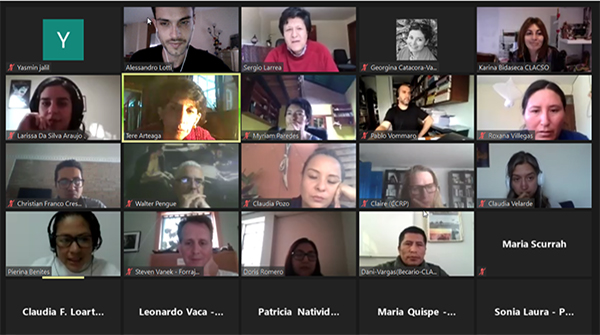
CLACSO participated in this space by presenting the “Research and training program in Andean agroecological systems and organized a seminar on July 10, in which the 15 scholarship recipients and tutors of the Program participated, coordinated by Karina Bidaseca.
The Agroecology Research and Training Program, a joint initiative of the McKnight Foundation and CLACSO, aims to promote knowledge, training, and participatory research on family farming practices by integrating agroecological principles into agricultural and systems management in the high mountains of Ecuador, Peru, and Bolivia (above 2.500 meters above sea level), working with small-scale farmers. Our academic network consists of 17 institutions and 8 countries on two continents: Latin America and the Caribbean, and Europe:
- Cochabamba University – AGRUCO, Latin American Faculty of Social Sciences, Ecuador – FLACSO, Graduate Institute Geneva, International Potato Center (CIP), Postgraduate Program in Human Rights and Citizenship – PPGDH-UnB, Postgraduate Unit – UPG/UNMSM, Autonomous University of Madrid, University of León, University of the Basque Country, University of Louvain, Higher University of San Andrés, Higher University of San Simón, National Agrarian University La Molina, National University of General Sarmiento (UNGS), National University of Engineering, National University of Engineering, National Higher University of San Marcos, Polytechnic University of Madrid.
In space “Session on the agroecological fellows of CLACSO"We delved deeper into the multiple impacts that the various actions carried out throughout the project have generated."
A reflective analysis was presented considering the point of view of scholarship recipients, tutors and directors on the impact and incidence of research scholarships in postgraduate Higher Education and in the communities of belonging and on the knowledge acquired to influence the fields of knowledge of agroecology in social organizations, public policies and reference institutions.
The CLACSO presentation was given by Karina Bidaseca and included the participation of Roxana Villegas, a scholarship recipient from the 2nd cohort.
In the second part, scholarship recipients and tutors from the program participated.
We share with you some of the testimonials from the participants:
Scholar: Leonardo Vaca: For us as scholarship recipients, it is very enriching to be able to meet with people from very different backgrounds, to broaden our view of agroecology towards a systematic approach.
Tutor: Alejandra Arce: Since I come from Grupo Yanapai and CIP (CGIAR), these are distinct institutional spaces with some overlap and areas of interest in development research that connect with the work of Gavi (soils and landscapes), Dani (local perception of risks from extreme events), Sandra (food literacy), and Doris (in situ conservation of oca). All are fascinating and relevant topics with knowledge gaps. I wouldn't speak of evidenced impact to date, but rather of "cross-pollination."
Intern: Claudia LoarteOver time, the community will solidify, but getting to know each other, exchanging knowledge, and receiving ongoing support are crucial during thesis work. Likewise, the support of the CLACSO tutors helps us align concepts on academic studies and allows us to observe progress and reactions in neighboring and similar countries. THANK YOU from PERU!!!
intern Claudia Pozo: My name is Claudia, and I'm from Bolivia. I joined the second cohort of the program. We've had some very important moments that are helping us learn. Personally, I find it a learning experience every day because agroecology has so many areas to explore. In my case, I'm working on research into multidimensional poverty from an Andean perspective, and listening to my colleagues and all the experts helps me continue this work. We're currently experiencing some setbacks due to the pandemic, and what we really need to focus on is adapting our field strategies and developing interdisciplinary support so we can continue our work.
Intern: Claudia Valverde: The community of practice has been very important for my training and for my research, because of the dialogue of knowledge and the exchanges with colleagues and tutors. All the shared spaces have been very enriching.
Intern: Gavi Alavi: The community of practice has supported me in expanding my studies, focusing on the biophysical aspects, towards the more social side. Likewise, they have emphasized the importance of obtaining reliable information from interviewees, in our case, the farmers.
Intern: Sandra Baldeón: I believe that the scholarship, in addition to providing us with theoretical and technical elements that strengthen our knowledge, allows us to experience agroecology firsthand, enabling us to understand it better and conduct more comprehensive research. The learning and practice community since the scholarship's inception has been incredibly enriching, from the exchange of experiences among fellows to the invaluable support and ongoing guidance provided by the entire CLACSO team, including directors and co-directors. This triangulation of knowledge and stakeholders generates rich and diverse contributions that allow us to constantly broaden our academic and scientific understanding of agroecological practices.
intern: Patricia Natividad: The training in Environmental Analysis (EA) and research methodologies with Carlos and Ernesto has been invaluable, especially having it at the beginning of the fellowship, as it allowed us to acquire knowledge that we could apply throughout the fellowship. We also benefited from their guidance at various times. I believe that a first step in building community was the joint working group proposal we presented at ALAS 2019 in Lima. I think a very positive aspect of the fellowship is the opportunity to dedicate time and resources to training in EA and field research (with advisors).
To learn more about the program and the research projects being developed, visit this StoryMap: https://ccrp.maps.arcgis.com/apps/MapJournal/index.html?appid=463f523a5112414fa3e38d522b8fd616
If you would like to receive more information about CLACSO's training programs:
[widget id=”custom_html-57″]
to our email lists.

