
How to stop the war?
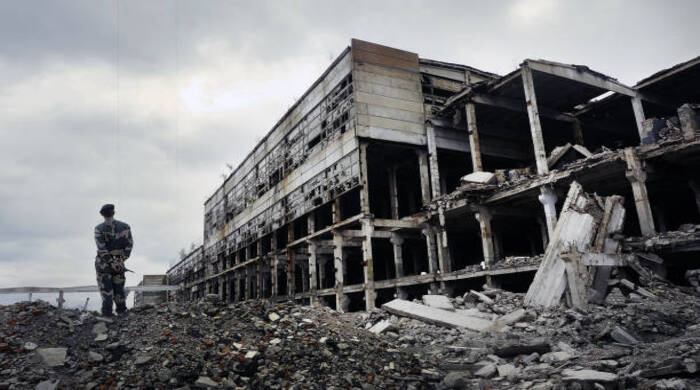
Soldier in military uniform stands on the ruins of the destroyed house. Hot spots on the planet. The concept of the fight against terrorism.
Esteban Torres 1
The spectacle of cross-accusations between NATO, Russia, and Ukraine and the destruction of
Ukrainian cities filmed in real time shifted the focus of the debate away from the big
Purposes that fuel war. Esteban Torres analyzes how the central actors in this
conflicts are becoming war economies and, therefore, it is difficult to expect a
An expansionary policy of peace is impossible if the economic course is not changed. Can the EU influence the
A peaceful resolution to the conflict, or is it already too late?
At this point, who remembers that the pandemic isn't over yet? For at least 20 days now, we've been bombarded with a deluge of information and images, the media epicenter of which is an intense argumentative battle over the legitimacy of the actions of each of the protagonists involved in the war. What has shaped the discursive narrative of the armed conflict is an old exercise in assuming and assigning responsibility, in which the central aim is to convince the respective national societies of who threw the first stone, who remains the main aggressor in a flow of escalating interstate violence, and therefore who has the right to self-defense. Is it Zelensky's western Ukraine? NATO? Russia? The United States?
Within the context of this unscrupulous communications barrage, characterized by high levels of irrational censorship typical of 21st-century political and military conflicts, what seems to emerge as a common certainty is the existence of clearly defined primary and secondary actors: at the center of the theater of operations, Russia and the United States; as subsidiary actors, Ukraine and Europe; and in the background, with potentially decisive influence, the People's Republic of China. Generally speaking, we could assume that this understanding of the power dynamics is shared by all directly involved parties, as well as by the majority of news consumers worldwide.
The frenetic pace of the current spectacle of accusations flying back and forth and the destruction of Ukrainian cities, filmed in real time, has minimized discussion of the overarching goals fueling the war and limiting the possibility of a peaceful resolution to the conflict. As has been the case at least since the Gulf War in 1990, the spectacularization of the military adventure, based on a minute-by-minute reporting model, diminishes interest in its analytical assessment. Only by attempting to decipher the structural causes underlying the global conflict can we shed light on the phenomenon of contemporary Russian warmongering, currently in relation to Ukraine, but surely extending beyond it, as well as NATO's novel economic aggression, its indirect military involvement, and its clear intransigence—at least for the moment—regarding the Russian claim.
Once it is established that the central actors in this drama are the old adversaries of the 20th century, Russia and the United States, the key fact of this military adventure lies in recognizing that, for the first time since the collapse of the USSR in 1991, two war economies are openly confronting each other in a global public conflict. One is consolidated, the American economy, and the other is in the process of recovery and growing state control since Putin's arrival at the Kremlin in 1999. Max Weber classified countries into two types: those with a war economy and those that develop from a peace economy. For the German sociologist, war economies are those that depend on the military industry for their national growth, while peace economies, on the contrary, are those that do not have such an industry, or whose influence as a source of national income and employment is negligible. Thus, in this new wartime situation, rather than a lively confrontation between an American capitalism in the process of imperial retreat, and an oligarchic Russian capitalism, with a statist or socialist past - and with a living nationalist ancestor - what we observe in all its starkness is a new chapter in the growing competition between the two main war economies of world society.
The United States is the world's leading arms producer and exporter, with Russia as its closest competitor. The current North Atlantic conflict involves a business worth well over $100 billion annually. To this must be added the 10% to 15% of revenue generated by the illicit arms trade. Between 2016 and 2020, the United States increased its share of the global arms market to 37%, 5% higher than in the 2011-100.000 period, supplying weapons to 96 countries. Russia, for its part, currently holds a market share of around 20%, having lost 2% compared to the 2011-15 period, but boasts a client base of over 15 countries.
Furthermore, as we shall see, the characteristics of the military industries of both countries are strikingly similar. In short, this framework of coincidences signifies two things: first, that wars are increasingly necessary for the health of the national economies of both powers, without which their internal levels of social welfare and national strength would weaken; and second, that the main problem currently preventing the establishment of a relatively peaceful world order is the growing militarization of the national economies of core countries, centered on the major arms-producing powers. Of course, it should not be forgotten that the United States and Russia also occupy first and second place, respectively, in the production and export of oil and gas worldwide.
Therefore, first and foremost, the conflict in Ukraine is a new war for the maximization of future profits in the three markets mentioned. The nature of this expansive, conflictive, and globalized economic evolution blurs the civilizational rivalry between West and East.
1. The war economies of Russia and the United States
The fact that oil and gas currently generate more revenue for the United States and Russia than arms sales does not mean that the military market does not decisively shape the structure of their respective economies. As we have seen, both are war economies. Unlike the hydrocarbon market, the military industry is inexhaustible, knowledge-intensive, and based on cutting-edge technologies, which guarantees high barriers to entry and a highly profitable business in the long term. It is also a crucial industry for the expansion of states.
From 1992 to 2020, the Russian government allocated between 3.07% and 4.87% of its GDP to military spending, with the exception of 1998 (2.78%) and 2016 (5.43%). In absolute terms, the amounts invested did not vary significantly since 2011. In 2020, Russia allocated approximately USD 67 million to its military sector; in 2011, it was USD 54 million, and in 2013, it reached its peak, allocating around USD 72 million for this purpose. However, the revenue generated by the arms industry dwarfs these figures.
According to official figures, Russia exported $54.000 billion worth of arms in 2019, representing 15% of its total exports. The Russian military industry is estimated to generate between 2,5 and 3 million jobs in the country, roughly 4% of total formal employment.
Regarding the United States, we see that from 1991, the year of the USSR's dissolution, the percentage of GDP allocated to military spending decreased slightly, fluctuating from then until today between 3.09% and 4.97%. Thus, we find that both economies have a very similar percentage of investment. However, unlike Russia, the volume of money invested by the US government has only increased.
It has practically tripled in the last 30 years, rising from $226 million to $760 million in 2021. Democrat Biden had no qualms about increasing the last annual military budget approved under Trump's presidency by 5%, bringing it to $684 million. Thus, we see that Russia allocates only 8% of the funds injected by the US government. This is an abysmal difference with no clear parallels in the global market. In terms of job creation, the situation in both countries is strikingly similar. The US Department of Defense reports that in 2021 it employed 720.000 civilian employees and 2,2 million military personnel, to which we should add some 3,5 million indirect and induced jobs associated with the aerospace and defense industry. This totals approximately 6,5 million people, representing around 4% of total national employment. That is, the same percentage of jobs in the sector as the Russian economy. The rest of the world is far from these figures.
European economies, with the exception of France and, to a lesser extent, England, are built as peace economies. The same is true of Latin American economic systems, which are simply consumers of weaponry, especially heavy weaponry. The pacified state of the economies of both regions, which represents a disadvantage in the current global power games, constitutes a clear structural advantage when attempting to sustain a general pacification dynamic. A country that buys weapons and may eventually use them, but has a peace economy, can choose to demilitarize at any time, based on a favorable shift in circumstances, while a country with an arms industry that is a determining factor in its GDP is unable to transition to a peace economy in the medium term. Throughout history, no peripheral economy has managed to become a war economy. And this has generally occurred not because of the primacy of a culture of peace or a widespread democratic culture, but simply because the great world powers in each period of history have exerted pressure to reduce other countries to the role of consumers, not producers, of sophisticated weapons. But let us leave aside for now the age-old problem of the global division of labor.
2. Economies of peace and the transition to coexistence
The only way to stop the belligerent progression of world society is to initiate a difficult reconversion of current war economies into peace economies based on a convivial transition agreed upon by the central states of the world.
The commitment to world peace, the NO to war, so that it is not merely a cry of impotence from the people or a call for humanism in a violent world, must generate a movement in favor of the pacification of economies. The current demand of the people must become a NO to war economies and a resounding YES to peace economies. But the pacification of each national economy is not a decision that a state can make without the agreement of others. The increase in a state's military budget leads to an increase in the budgets of its rivals. And this occurs for reasons of national security and, in the case of war economies, for reasons of commercial competition. A law of war is that armed conflicts between countries tend to generate greater rearmament in neighboring countries. This intensifies in cases where war economies are directly or indirectly involved. Currently, this neighborhood is increasingly globalized. And we must not lose sight of the fact that the rearmament of countries, both in their roles as producers and consumers, expands the market for the purchase and sale of weapons, and therefore makes it more attractive to the interstate system as a whole.
The most militaristic personal inclination would have failed in the social-democratic Sweden of the 80s, just as individual leadership with the strongest democratic aspirations on the international stage has been ostracized in the United States since the end of World War II. An expansive policy of peace, much less a lasting one, cannot be expected from a war economy. It is for this very reason that Europe, as a relatively peaceful economic bloc, must fully recognize that the best course of action it can take at this dramatic moment is to commit itself by all means to the promotion of world peace, rejecting the completely irrational temptation to jump on the bandwagon of a new arms race in which it will be a mere supporting player.
Despite its secondary role in the current war, Europe is the only leading regional society objectively positioned to guide political negotiations toward a peaceful transition that paves the way for an economy offering greater structural guarantees of peace for the world. And the way Latin America can contribute to world peace is by maintaining its impartiality in an increasingly multipolar world, resisting all pressure to actively enter an armed conflict from which it will only suffer losses.
1 Co-coordinator of the CLACSO Working Group “Social Theory and Latin American Reality”.
This article was originally published in Revista Anfibia:
https://www.revistaanfibia.com/como-parar-la-guerra/
If you would like to receive more information about CLACSO's training programs:
[widget id=”custom_html-57″]
to our email lists.

