
How do we disseminate the data we have produced in an individual or group research project?
Besides disseminating a summary of the data as part of the text of a thesis, article, book, or report, what do we do to disseminate the complete dataset we have produced in an individual or group research project? Does it remain on our computer or on the institution's computer?
Today we can deposit these datasets—including code, spreadsheets, and databases—in digital repositories so they can be accessed by other researchers interested in the topic. Universities and other research centers have institutional or thematic digital repositories [1] , and there are also specific repositories for research data [2].
By depositing our research data in open access repositories, we will be complying with national and institutional policies that require open access to results of research funded with public funds.
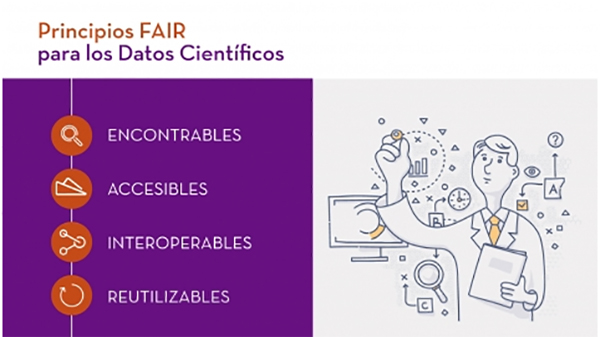
When preparing research data for open access dissemination in a repository, it is advisable to follow the FAIR principles ( Findable, Accessible, Interoperable, Reproducible ). [3]
The FAIR Principles are a set of guiding principles for making research data easy to find, accessible, interoperable, and reusable ( Wilkinson et al., 2016 ). Research libraries provide support for managing, describing, and publishing research data in accordance with these principles.
In order for a research dataset to comply with the FAIR Principles, it is important to ask the following questions formulated by CSIC [4].
- Does the dataset have a persistent identifier (handle, DOI)?
- Is there documentation/metadata that allows the data to be properly understood?
- Is the metadata accessible?
- Has a usage license been applied to the dataset? Is it a standard license? Does it impose any restrictions? Does it explicitly allow reuse?
- Are the dataset files in open formats or in widely supported proprietary formats?
- Is the dataset/metadata encoded according to any global standard?
- Is the dataset linked to other datasets or other research results? How?
There are several free online tools that provide information and assess the degree of compliance with the FAIR Principles, for example:
FAIR Principles: Good practices for open research data:
https://unavdadun.wordpress.com/2018/11/13/principios-fair/
How to make your data FAIR:
https://www.openaire.eu/how-to-make-your-data-fai
Self-assessment tool – Australian Research Data Commons' FAIR data self assessment tool:
https://ardc.edu.au/resources/working-with-data/fair-data/fair-self-assessment-tool/
ICPSR Guide to Social Science Data Preparation and Archiving:
https://www.icpsr.umich.edu/icpsrweb/content/deposit/guide/index.html
See also:
http://biblioteca.clacso.edu.ar/accesoabierto/
[1]https://v2.sherpa.ac.uk/view/repository_by_country/019.html
[2]http://service.re3data.org/search
[3]https://datos.gob.es/es/noticia/principios-fair-buenas-practicas-para-la-gestion-y-administracion-de-datos-cientificoshttps://unavdadun.wordpress.com/2018/11/13/principios-fair/
[4]http://digital.csic.es/dc/politicas/adhesion-principios-fair.jsp
If you would like to receive more information about CLACSO's training programs:
[widget id=”custom_html-57″]
to our email lists.

