
“Colombia is a country designed from a neoliberal perspective.”
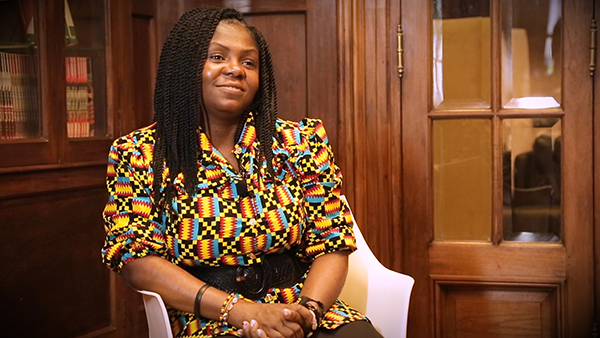
Francia Márquez Mina
The Afro-Colombian social leader and feminist, Francia Márquez Mina, A pre-candidate for president in her country's 2022 elections and recognized for her advocacy for her native Cauca region, she visited Buenos Aires. There, among other activities, the 2018 Goldman Environmental Prize winner visited the headquarters of the CLACSO Executive Secretariat.
Interviewed by Gustavo Lema
In that context, he participated in the InfoCLACSO on Wednesday, November 3, where he described the historical and current situation of Colombia and also spoke about the uprooted and excluded from their land, the Afro-descendants of the continent, the environment, and narrated his own life working as a teenager in the mines.
Francia Márquez Mina was one of the participants in the 1st National Meeting of Organizations of the Afro-Argentine Community convened by the National Institute against Discrimination, Xenophobia and Racism (INADI) together with the Province of Entre Ríos and its Secretariat of Culture.
A warm embrace, thank you so much for the invitation, and thank you to the CLACSO newsletter for having us here. We are here to share, to weave resistance as historically oppressed peoples, violated by the logic of the politics of death. We are here to connect, to share experiences and actions that will allow us to continue on this path.
-On that note, I'd first like to address the current situation in Colombia so you can give us some insight into what's happening there. We were very close to the events of June and July of this year, with the significant street protests against the violence, but also the assassinations of leaders and activists amid the persecution. This is also part of a broader Latin America and Caribbean context, with its own mix of positive and negative aspects: we see a revolutionary and mobilized Chile with its constitutional reforms, but we also see a Brazil entrenched in the logic of the far right. Where does Colombia stand in this situation?
I believe we are now at a point where the people can no longer endure this; the people want changes in terms of justice, equality, and equity—changes that eradicate the logic of colonial, racial, and patriarchal structures that have damaged not only humanity, not only our lives as human beings, but have destroyed the very heart of the nation: the womb. The social uprising we just experienced in Colombia, in which I participated because I stood with the young people on the front lines demanding their rights and raising their voices, is a testament to this historical weariness. Because what's happening in Colombia today isn't new; this has been going on our whole lives: we've witnessed the politics of death, our families have had to deal with death, dispossession, displacement, hunger, and misery, because we've had a petty political leadership that seized control of the nation-state, which it founded with these logics and structures of historical oppression, and which now continue to permeate the system, because it's a state that has been run by the same 40 families that have governed us our entire lives, and the majority of us don't live in dignity. We live in fear, anguish, anxiety, and constant dread, both in the countryside and in the city, amidst uncertainty. And there's a youth that can't take it anymore, and these moments have happened time and again. In the 90s, there was also a social explosion of young people who said, "This has to change," and they changed the Constitution through a process involving a seventh ballot, and it was the youth who gave birth to the change. I believe we face the same challenge: to bring about change in our country, and of course, a change in the logic of Colombia, a country deeply shaped by neoliberalism, extractivism, racism, and patriarchy. Transforming that through a vision and a policy centered on protecting life, guaranteeing justice, and taking on the challenge of ending the war so we can live in peace without fear—that is the challenge for Colombia. But this will, of course, have repercussions throughout Latin America, across the entire region.
-In that sense, I'm left with some phrases I read, that you've said at some points, regarding the relationship between violence in Colombia and the development of an economic model, and how the relationship between the two is almost one of necessity… What is that relationship like, and why is it so difficult to dismantle one in order to dismantle the other?
-Well, indeed, I believe that the armed conflict—and I, as a Black woman of color, would have to begin by saying that this violence began with colonization and slavery. And this violence has permeated society, of course, later changing its forms, then partisan violence, the Liberal Party, the Conservative Party, and then the guerrillas emerged due to territorial dispossession. But violence in Colombia has always stemmed from the pettiness of the political leadership, who think of themselves as elite, who still believe they are of noble birth, and who exclude the majority of society. And this historical exclusion is reflected in the concentration of land ownership; we are the country in this region with the most unequal access to land: exclusion, displacement—every day we witness communities being displaced from their ancestral territories. So, under the logic of bringing “development” to the communities, I have never seen development in my community: there is no drinking water, no basic sanitation, children have no access to education, we have no internet connectivity. So what kind of development are they talking about? We have huge dams, massive mining projects, the entire sugar and palm oil industries, and the port is still in Buenaventura, a Pacific region. We have the port through which 70% of the country's economy flows. Buenaventura doesn't have potable water, it's militarized, and even under militarization, there are "chop houses" where they chop people up like onions. But who are these people being chopped up like onions? They're Black people, peasants, impoverished people, racialized people. They're women heads of households who lose their children every day, who are murdered. So, that's the logic of this deadly economic model that hasn't allowed us to live in dignity, that has concentrated wealth, that has put the State in the hands of a few, that has permeated institutional corruption, that allows children to die of hunger in territories like La Guajira, for example, where we have Cerrejón, the largest coal mining company in Latin America, and next to Cerrejón is the project that's sold as the country's development. Boys and girls are dying of malnutrition, hunger, and thirst.
-On that path, I would love it if we could travel, even if only through your memories and experiences from your childhood. What was that childhood like? I understand that when you finished primary school, if you wanted to continue studying, there was only one path left. And that path was to work in the mine…
"Well, we grew up in ancestral territory. And when I say ancestral, I mean that my grandparents and great-grandparents were there. It was only 170 years ago that slavery was legally abolished in Colombia. So my great-grandmother was an enslaved woman, and I grew up in that territory where the traces of slavery are still there. In this region of the country, which is southwestern Colombia, like Cauca, especially northern Cauca, the physical structures of the slave plantations are still there. People were forced to work in mining and agriculture. When it was announced that slavery would be abolished, the landowners who had enslaved people opposed freeing our people. The State had to compensate them, but it never compensated our people for slavery, and that's not only in Colombia but also in Argentina and throughout Latin America—that is, in all the places in the world where slavery, especially of the Black and Afro-descendant population, was imposed." So, our people had to liberate themselves in their own way, acquiring the land through suffering and bloodshed. We were taught that the land is not a gift, that it cost our elders suffering, imprisonment, death, and hard work. From a very young age, we are taught to value the land as a space for life. That's where I learned to mine because it's the only option… Mining enslaved us, but it also served the Black people in that territory, given the abandonment by the state, just like traditional farming, as a means of subsistence, a form of community organization, a way to remain as a people and as families. So, mining also helped us sustain ourselves, and people in my community still live off ancestral mining practices. Now it's a territory with many resources, because the State has granted that territory to multinational companies, to foreigners. In 2009, for example, when I became involved as an activist, I had to confront, along with the community, the third largest mining company in the world. Suddenly, the State said: you have rights, but we as Black people 'don't have rights.' You don't have the right to be consulted because you're not a Black community. They denied us, they erased us, but that's been happening all our lives. I wrote my thesis on Prior Consultation and Structural Racism, and I found historical archives from Luis López de Mesa from the 20th century, where they were talking about the degeneration of the race. And they said that in Colombia, after achieving independence—forgetting that independence was achieved with Black people, with Indigenous people, with impoverished people—the way we 'achieved' independence, the mixing with Black and Indigenous people degraded the race. That's why we haven't been able to advance in progress…
-A new Nazism, more like Nazi speeches…
They still use it now… If you listen to Vargas Lleras, a Colombian politician and heir to that colonial caste, he says: Prior Consultation, a fundamental right recognized in the 91 Constitution based on ILO Convention 169, is an obstacle to development. In other words, the same 20th-century thinking. Now, the heir to that caste, those who conceived that racist, patriarchal, and exclusionary nation-building project, is raising the same issue, not just about bodies, of course, but about the rights of those racialized bodies. That's the logic we grew up with; I grew up in that territory, but I also learned resistance. I learned that we weren't enslaved people; we were free beings who were enslaved. When I acknowledge that, I ask myself: Would my son ask who enslaved us and why? And that leads us to think today about clearly focusing the debate on a project that puts life at the center, which we are committed to discussing as a historical reparation for the Afro-descendant population not only in Colombia but also in Latin America, which amounts to almost 200 million people.
-On that mine road, you spent your pregnancy working in the mine…
-That's right. Patriarchy has its effect, and racism affects you too. Because as a child, when you hear that discourse—which I only understood when I wrote my thesis about needing a white person to improve the race—well, I believed it, because television sold it to me… At 16, I was pregnant by a mixed-race white man who only saw me as a sexual object. He got me pregnant and that was it, he left. So, I had to assume motherhood and fatherhood at 16 while I was still in high school, and that's the life of many women in Colombia. My mother has had to be the head of her household. I think that in 50% of families in Colombia, they are made up only of women, of mothers who have to assume the responsibility of supporting their children, of providing for them, because men don't assume that responsibility. So, when I got pregnant, I had to drop out of school. For me, it was a torment, because every day I dreamt that my uniform hadn't dried, that the teacher wouldn't let me into class. I had that nightmare for over two years, the nightmare of having to drop out of school because of a pregnancy, but I never gave up on studying. I always said: I want to study, to get ahead. I always thought about becoming a professional, knowing that it's like a dream for our people. For young people, thinking about going to university is a utopia, a dream, not a reality. When I told my younger siblings I wanted to study, they asked me where I was going to study, how much it cost, and they laughed. "You barely get there and they close the doors on you..." And they did close them on me many times, but I kept going back and pushing to study. That's how I became a lawyer and had my first child. I had to work in the mine throughout my pregnancy: for example, today I went to the mine and gave birth to him in the early hours of the next morning. And that's how it is for all of us women… My mother has no fingerprints left on her hands. I realized that when I won the Goldman Environmental Prize, when I went to get her a passport and she almost couldn't travel with me. How many mothers in Colombia, here in Argentina, in Latin America, have lost their fingerprints working in private homes, doing whatever it takes to raise their children?
If you would like to receive more information about CLACSO's training programs:
[widget id=”custom_html-57″]
to our email lists.

