
Colombia in flames: the end of neoliberalism will be violent
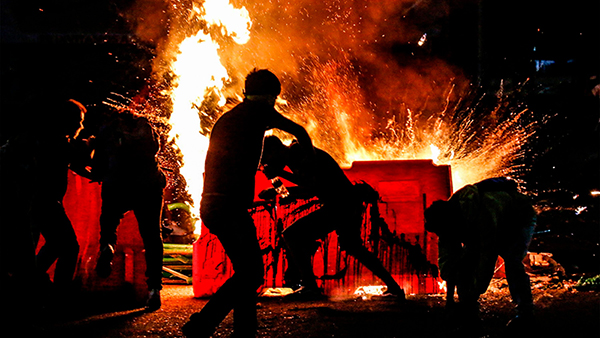
Demonstrators set a barricade on fire during a protest against police brutality in Cucuta, on the Colombian border with Venezuela, on September 10, 2020. – At least 10 people were killed and hundreds wounded after rioting broke out in the Colombian capital Bogota during protests over the death of a man repeatedly tasered by police, authorities said. (Photo by Schneyder MENDOZA / AFP)

Boaventura de Sousa Santos
Colombia is in flames. It is currently one of the countries with the highest number of COVID-19 deaths, ranking fourth in the region after the United States, Brazil, and Mexico. To date, only 3.5% of its population has been fully vaccinated, and it is among the countries that refuse to support the release of vaccine patents. In 2020, 42,5% of its population lived in monetary poverty, and 15,1% in extreme monetary poverty. Adding to these stark but telling figures, since the signing of the 2016 peace agreement, between 700 and 1.100 human rights defenders have been murdered (figures vary between NGOs and government institutions). The areas that were formerly controlled by the FARC-EP are now disputed by various illegal armed groups, which not only seek economic interests (drug trafficking, illegal mining) but also bring with them a horrific and bloody interest in controlling the civilian population, seriously affecting the social fabric, resulting in this being only the tip of the iceberg of the new panorama that the country is going through.
It is in this context, and after almost three years under a right-wing government opposed to the peace agreement, that, amidst a pandemic that has killed thousands, the working people have taken to the streets to raise their voices against a proposed tax reform. This reform, according to the government, sought to raise 23 trillion pesos (approximately US$6.3 billion) to improve public finances and fund social assistance programs. While it is true that the country needs to improve its tax system, this reform proposed increasing the number of people declaring and paying income tax, with the endorsement, vision, and conceptual framework of the International Monetary Fund (IMF).
The idea of having more people pay taxes and finance government spending doesn't sound far-fetched in theory; in fact, it would suggest that high-income earners would pay the most taxes, considering the principles of... progressivity, equity and tax efficiency enshrined in the Political Constitution of Colombia. However, according to World Bank data, Colombia is one of the most unequal countries in Latin America (the Gini index is 51,3), reflecting an inadequate and regressive fiscal policy that enables a high concentration of income and wealth, resulting in lower development, given that income and wealth remain in the hands of a very small percentage of the population. The proposed reform would add to the country's long and complex tax system, which does not reflect a truly progressive policy and is full of tax benefits aimed at those with the highest incomes.
We could say that since 2016, the working people have flooded the streets and squares of Colombia demanding the defense of peace and the fulfillment of the agreements, the protection of social leaders and solidarity with those who have been murdered, as well as the rejection of proposed modifications to pension, labor, and tax systems. Thus, in the last five years, Colombia has seen its streets filled with young people, women, Indigenous people, Afro-Colombians, teachers, pensioners, and students who have generated unprecedented events, such as one of the largest demonstrations in the country since the 1970s, which took place on November 21, 2019 (21N). Thanks to this popular empowerment, and despite the COVID-19 pandemic, Colombia marched again from September 9th to 21st, 2020, to protest against police brutality, the government's mismanagement of the economic and social crisis caused by the pandemic, and to raise their voices saying "enough" to the massacres in the country, which continued unabated despite lockdown measures. Of particular note is the Minga of Southwestern Colombia, which took place in October 2020 and was led by Indigenous organizations. Its slogans and courage resonated deeply, and it successfully mobilized a large segment of society around its demands as it traveled across the country, garnering the support of millions who warmly welcomed them in every city along their journey to the capital.
Under this scenario, the people decided, starting on April 28 (28A) 2021, to march against the tax reform and the indifferent government. The repression by the police forces is brutal. Citizen discontent has been subjected to stigmatization and repression by the security forces, leading various human rights organizations to register, between April 28 and May 05, a total of 1708 cases of police violence, 381 victims of physical violence by the police, 31 deaths (under investigation), 1180 arbitrary arrests of protesters, 239 violent interventions by the security forces, 31 victims of eye injuries, 110 cases of police gunfire, and 10 victims of sexual violence by the security forces. Similarly, the Ombudsman's Office (the figure of the ombudsman In Colombia) it was noted that 87 complaints were registered for alleged disappearances during the National Strike protests of April 28.
What began as strong opposition to an unpopular reform and a finance minister who didn't know the value of a dozen eggs (and, in general, the entire basic food basket), has escalated to the point of not only achieving the withdrawal of the reform in Congress and the minister's resignation, but also prompting President Iván Duque Márquez to propose a dialogue with various sectors of civil society. This dialogue, however, seems to be limited to the country's elites, conducted from above, and never from below. Social organizations know from experience that nothing good can be expected from this government, but, as always, they are not refusing dialogue. The first victory of the citizen movement in the streets—the withdrawal of the reform—did not come peacefully or without cost. In addition to the aforementioned figures collected by the country's NGOs, President Duque announced the militarization of the country before yielding to the public outcry. Since May 01st, social media and the streets of Colombia have witnessed the horror of a military deployment typical of a dictatorial state of emergency, with police firing on peaceful, unarmed protesters. This has perhaps been the most violently repressive response during the pandemic worldwide.
Particularly in Cali, the protests were especially intense due to the mobilization of Indigenous organizations following the brutal assassination of Sandra Liliana Peña, a 35-year-old Indigenous governor who advocated for the recovery of traditional knowledge and rejected the presence of all armed groups in her territory. This city, the second largest Black urban center in South America, is rife with contradictions and struggles, and has witnessed the most abhorrent repression of its people. The situation is such that, in the middle of a peaceful gathering broadcast live on social media, riot police were seen dispersing the demonstration, resulting in the death of a young man in front of more than 1.000 viewers watching online. From Siloé, a slum (favela) in Cali, it was also reported that internet service was unavailable in the area on the night of May 04th.
The weak response to police violence by Colombian institutions (both administrative and judicial) has allowed armed civilians to threaten (and sometimes shoot) protesters, labeling them “vandals” and “terrorists.” In Cali, students circulated the following “dialogue”: “We have 25.000 weapons,” shouted a man dressed in white from his expensive SUV parked in front of the University of Valle (Univalle). “We have one of the best libraries in the country,” replied a student. In Pereira, the mayor promoted a “common front” that included members of private security, the army, and the police to “restore order and public safety,” resulting in a young man being shot eight times and now in critical condition in a city hospital.
Where is Colombia headed?
This question is important for Colombia, but beyond Colombia, I seem to see in recent events in Colombia the embryo of much of what will happen on the continent and in the world in the coming decades. Of course, each country has its own specificities, but what is happening in Colombia seems to herald the worst-case scenario I identified in my recent book on the post-pandemic period (The Future Begins Now: From Pandemic to Utopia. Madrid: Akal, 2021). This scenario consists of denying the severity of the pandemic, prioritizing the economy over protecting lives, and the ideological and political obsession with returning to normal, even though normal is hell for the vast majority of the population. The consequences of the pandemic cannot be magically halted by the ideology of conservative governments; the post-pandemic social and economic crisis will be extremely serious, especially because it will compound the crises that existed before the pandemic. This will make it much more severe. Emergency aid policies, however inadequate, combined with the economic weakening caused by the pandemic, will lead to enormous state debt, and the worsening debt will be an additional reason for more and more austerity. Conservative governments know no other way to deal with peaceful protests by the working people against social injustice than through repressive violence. This is how they will respond, and the message will include the increasing militarization of daily life. This implies the use of lethal force that was designed for external enemies. The already evident erosion of democracy will deepen even further. To what extent will the remaining democratic foundations collapse, giving rise to new dictatorial regimes?
This scenario is not unrealistic speculation. A recent IMF report makes the same prediction. The authors, Philip Barrett and Sophia Chen, state that pandemics can have two types of effects on social unrest: a mitigating effect, suppressing the possibility of riots by interfering with social activities, and a counter-effect, increasing the likelihood of social unrest and consequently generating riots or protests as the pandemic subsides. What they fail to mention is that the protests will be motivated by the very policies that the IMF and financial agencies promote worldwide. Such is the hypocrisy of the world we live in that the IMF ignores or conceals the consequences of its guidelines. The Colombian people deserve and need all international solidarity. I am not sure if they will receive it openly from the international agencies that claim to promote human rights, despite these rights being so gravely violated in Colombia. Let's imagine for a moment that what is happening in Colombia were occurring in Caracas, Russia, or any other part of the world declared unfriendly to the US. Surely the OAS, the UN High Commissioner for Human Rights, and the US government would already be on the ground denouncing the abuses and proposing sanctions against the offending governments. Why the mildness in the statements issued to date? It's obvious to everyone that Colombia is the US's best ally in Latin America, having offered to host seven US military bases on its territory (a situation that fortunately didn't happen thanks to the intervention of the Constitutional Court). International relations are currently experiencing their most scandalous moment of hypocrisy and bias: only enemies of US interests commit human rights violations. This isn't new, but now it's more shocking. Multilateral agencies surrender to this hypocrisy and bias without any shame. Colombians, however, can expect the solidarity of all democrats worldwide. Hope lies in their courage and in our solidarity. Neoliberalism doesn't die without killing, but the more it kills, the more it dies. What is happening in Colombia is not a Colombian problem; it is our problem, the problem of democrats around the world.
At the moment, the protests in Colombia show no signs of ending, and although only a week has passed since they began, we must insist on overcoming the fear that pervades the country's streets and on clinging to the hope of a promising, fairer, and more peaceful future for a nation that sought to end a conflict of more than 50 years through an agreement that is now languishing under the clutches of [unspecified threat]. abyssal capitalism.
1 Social repercussions of PandemicsIMF Working Paper. 2021.
If you would like to receive more information about CLACSO's training programs:
[widget id=”custom_html-57″]
to our email lists.

