
"#CLACSO2025 is a key space for building future alternatives in our region"
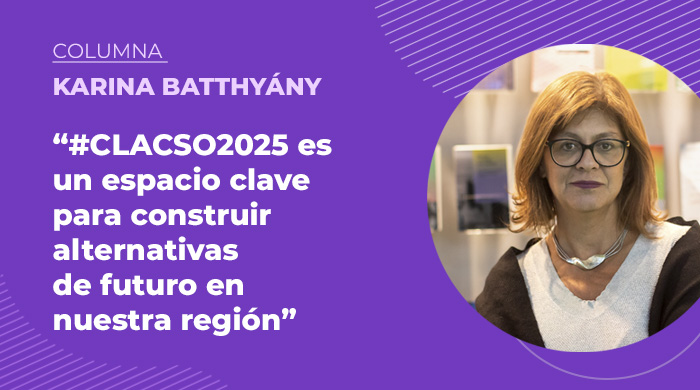
Transcript of Karina Batthyány's column
in InfoCLACSO – May 7, 2025
We are one month away from the start of CLACSO's most important Assembly, a political and academic institutional forum held every three years. There, the main areas of work for the next three years will be discussed, as well as the achievements of the 2022-2025 period, in a Latin America and the Caribbean that is navigating critical moments, crossroads, and major dilemmas.
At the next Ordinary General Assembly, which will take place on June 7 and 8, 2025 in Bogotá, Colombia, the thematic areas defined in #CLACSO2025 will be discussed and, in addition, the election of the person who will be leading our network for the period 2025-2028 will take place.
Prior to that, on May 14th we will have the second debate between Pablo Vommaro, Isabel Piper, and Alhena Caicedo Fernández, who are vying for Executive Director at #CLACSO2025. On June 7th and 8th, we will be holding our Assembly session, and starting on the 9th, we will inaugurate the X Latin American and Caribbean Conference of Social Sciences, “Horizons and Transformations for Equality: Democracies, Resistance, Communities, Rights, and Peace,” at the National University of Colombia and the Agora Bogotá.
– Within the framework of the peace process and the current presidency that is making a difference in the region, what is the importance of holding this conference in Bogotá, Colombia?
– When we made the decision, together with our Member Centers, to propose Colombia as a possible venue for our #CLACSO2025 Conference, one of the determining factors was its political process with the arrival for the first time of a progressive government and the challenges that this implied in 2022.
We chose Colombia within a framework of issues that are crucial for the entire region, such as democracy, peace, and human rights, which take on a very particular character in that country. It was also discussed that 2025 would mark the centenary of Orlando Fals Borda, a Colombian Latin American and Caribbean intellectual who has influenced all of us who have pursued training in the social sciences and whose thought remains undeniably relevant today.
– We know there are many activities: panels, forums and presentation sessions… When will the materials be available on the CLACSO website?
– We can share some details and say that the program under construction will be available soon. I ask for everyone's patience, because we're talking about a huge number of academic activities, since we received more than 4.000 submissions, in addition to the more than 40 forums we'll be holding, as well as hundreds of panels and workshops.
As if all that weren't enough, we'll have a Social Sciences, Humanities, and Arts Book Fair, a Film Festival, and other cultural and artistic activities accompanying our Conference. And, of course, just like at #CLACSO2022 in Mexico, we'll hold Master Dialogues focusing on key themes for the region and the social sciences.
CLACSO has been working systematically on its Platforms for Social Dialogue (PDS) project, but also on the other activities that the Council carries out throughout the Latin American and Caribbean region.
We will have an interesting series of dialogues: one centered around the theme of “Feminisms in the Key of Memory and Struggle in Latin America and the Caribbean,” featuring three top-level speakers: Dora Barrancos, Mara Viveros, and Gladys Tzul Tzul. Another dialogue will address “The Conservative Turn of the Far Right as a Political and Cultural Project,” with Marga Ferré, Gerardo Caetano, and Gabriela Montaño.
Regarding environmental issues, we will have two keynote dialogues: the first, “Latin America Facing the Climate Crisis, Ecosocial Pacts, and Alternatives from the Perspective of Buen Vivir,” featuring Maristella Svampa, Tatiana Roa, and Enrique Leff. The second, “Political Ecologies of the South, Climate Change, and Alternatives to Development in Latin America and the Caribbean,” with Arturo Escobar, Denisse Roca-Servat, and Joan Martinez-Alier.
Then, in the session on “Migration and Human Displacement from a Latin American and Caribbean Perspective,” we will have Gioconda Herrera, Silvia Giorguli, and Rebeca Peralta. Another key theme that could not be omitted and is central to Latin America and the Caribbean is inequality and poverty, which will be addressed in “A Snapshot of Inequalities: Challenges and Horizons in the Global South,” featuring Laís Abramo, Rodrigo Arim, and Anita Bear.
In the session on “Social Movements from the Global South: Alternatives and Challenges,” we will have Geoffrey Pleyers and Manuela D'Ávila. In the dialogue “Transformations of Work in Digital Capitalism: Between Precarity and Resistance,” we will have Juan Carlos Celis Ospina, Marcio Pochmann, and Nora Goren.
Victor Moncayo, Guadalupe Valencia, and Ricardo Moreno will discuss “Education as a common good and a human right: alternatives, conflicts, and challenges.” Silvia Federici, Laura Pautassi, and I will be debating “Care from a feminist perspective: tensions, recognitions, and transformations.”
Regarding “Racism and Anti-racism Today: Dispute, Recognition, and Reparations,” we will have Claudia Miranda, Francia Márquez, and Federico Pita. The dialogue “Geopolitics from the South: Latin America and the Caribbean at the Global Crossroads” will feature Mónica Bruckmann, John Saxe Fernández, and Breno Bringel.
We will also have a dialogue on “Artificial intelligence, social sciences and critical thinking” with Joan Subirats, Ana Laura Rivoir and Flavia Acosta, a dialogue on “Policies towards equality, gender, justice and social change” with Carlos Rosero, Citlalli Hernández and Ada Colau; one linked to open science, evaluation, and the work of FOLEC, “Scientific evaluation in dispute: proposals from Latin America and the Caribbean”, with Juan Piovani, Ismael Ràfols and Elea Giménez.
And finally, we will have the dialogue “Democracy, human rights and peace, foundations for coexistence in the 21st century”, where Álvaro García Linera, Víctor Moncayo and the President of Mothers of Plaza de Mayo, Carmen Arias, will be present.
– We are at a moment in which the centrality of social movements is very high, not only in Colombia but throughout Latin America. In some places, the advance of the right wing is attempting to curtail hard-won rights, but in others, progressive movements are making significant progress, and social movements are setting the agenda from the streets. What is the importance of social movements and their active participation in our #CLACSO2025 Conference?
– CLACSO does not exist without social movements. The connection between knowledge, social movements, and those working in the field of public policy is what defines us as an institution. Social movements will be actively participating in all #CLACSO2025 events.
Furthermore, we know that there are two CLACSO awards for social movements that will be presented during the opening of our event. The 10th Latin American and Caribbean Conference of Social Sciences is a key forum for building alternative futures in our region. It is also a moment to celebrate CLACSO as an organization, a network that fosters critical thinking and recognizes the work of the social sciences, humanities, and arts, which are currently being fiercely attacked and denigrated in some countries.
If you would like to receive more information about CLACSO's training programs:
[widget id=”custom_html-57″]
to our email lists.

