
CLACSO FOLEC participated in the 11th annual meeting of the Global Research Council
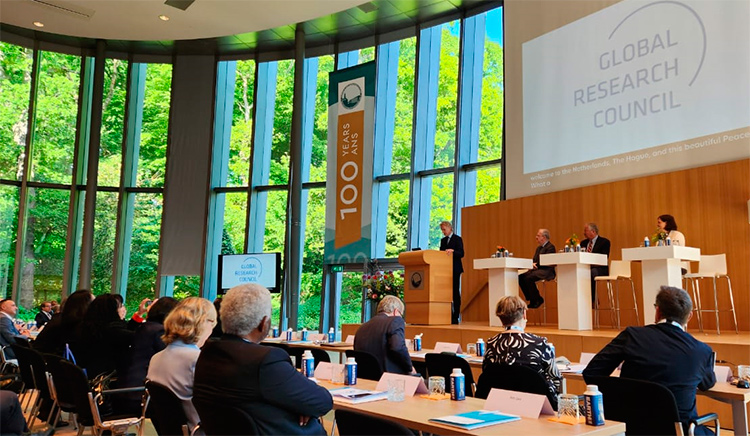
The 11th annual meeting of the Global Research Council (GRC) was held the week of May 29 at the Peace Palace in The Hague, Netherlands. The meeting was co-organized by the Netherlands Organisation for Scientific Research (NWO) and the São Paulo Research Foundation (FAPESP).
Research funding agencies from around the world signed an agreement during the meeting Statement of Principles on Recognition and Reward for Researchers. The document establishes nine principles on how funders will collaborate to develop new, contemporary ways of evaluating research and researchers. Among other recommendations, it proposes considering the contexts in which research is conducted; the field of study and the specific characteristics of each researcher's knowledge production; and research trajectories. Furthermore, it emphasizes recognizing the diversity of research activities, innovation, and outcomes. Responsible research practices and approaches should be guided by the promotion of equity, diversity, and inclusion.
“We have a lot of influence on the culture and behavior of researchers and research organizations. That’s why establishing a set of principles on how to reward and recognize researchers is absolutely fundamental to what we do,” said Prue Williams, New Zealand’s Minister for Business, Innovation and Jobs, who chaired the “Recognizing and Rewarding Researchers” session on Wednesday, May 31.
The main presentation of the session was given by Dr. Laura Rovelli, member of the Executive Council of DORA (Declaration on Research Evaluation) and coordinator of the Latin American Forum on Scientific Evaluation (FOLEC)- CLACSO.
According to Rovelli, there are currently some challenges to research evaluation due to the various transformations taking place in society, some of which are related to urgent and critical problems. One of these is the pursuit of sustainability in the face of global climate change.
"It is necessary to strengthen the role of science as a common good, in order to achieve citizen engagement in scientific activity. On the other hand, to protect access to the benefits of science, which can bring well-being to individuals and societies, aligning the quality of research with integrity and social impact is also a challenge," he stressed.
In that regard, the researcher warned that various international declarations and manifestos, such as the pioneering San Francisco Declaration on Research Assessment (DORA) at the regional level, the regional initiative FOLEC-CLACSO of reform of research evaluation and its Declaration of PrinciplesThey have been very mobilizing in the government agendas of Science, Technology and Innovation and academic-university, although with different scopes and nuances depending on the country and the institutions.
After a brief overview of some national-level evaluation reform initiatives, Rovelli highlighted that a diversity of approaches and policy instruments for change are being deployed in Latin America and the Caribbean, situated in complex environments and interacting with different procedures to improve the quality of research through evaluative reforms. Therefore, it is necessary to expand spaces for dialogue and participation with the communities involved and to add transformation laboratories to coordinate, harmonize and enhance new experiences and share diverse lessons learned.
Finally, the participants of the 11th GRC Annual Meeting ratified the charter of principles and its nine points aimed at advancing new ways of evaluating research and researchers. GRC charters and communications are available at: https://globalresearchcouncil.org/grc-publications/.

