
CLACSO at FILUNI – The University Students' Fair at UNAM in Mexico
On Wednesday, September 2, InfoCLACSO will be live on the YouTube channel and the Facebook and LinkedIn profiles.
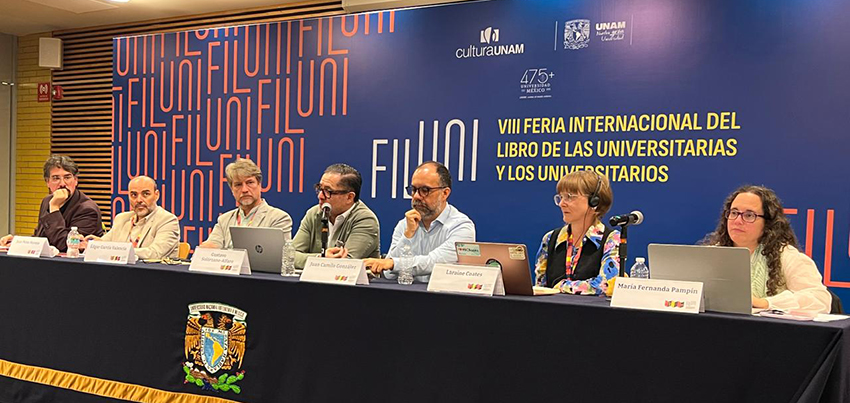
-From the University Book Fair (FILUNI) at UNAM in Mexico:
Pablo VommaroExecutive Director of CLACSO and Fernanda Pampín, Director of Publications at CLACSO
María Isabel Cabrera García, President of the Union of Spanish University Publishers
Albert Moncusí FerréVice-Rector for Culture, Sports and Social Link of the University of Valencia
Catalina López-SagásteguiDirector of dataMares, Director of the Marine Research Program at the Institute of the Americas. Marine biologist from the Autonomous University of Baja California Sur and Master of Science in Marine Biodiversity and Conservation from the Scripps Institution of Oceanography.
Lía Castillo Meneses, President of the Association of University Presses of Latin America and the Caribbean (EULAC)
Arianna Becerril García, Executive Director of Redalyc, the Network of Scientific Journals of Latin America and the Caribbean, Spain and Portugal
Martha Patricia Zarza Delgado, rector of the Autonomous University of the State of Mexico
Consuelo Natalia Fiorentini Cañedo, rector of the Autonomous University of the State of Quintana Roo, Mexico.
The program on Wednesday, September 2nd, covers one of the axes of the Platforms for Social Dialogue that CLACSO is promoting for the coming years: “Social right to education, public policies and pedagogical alternatives”.
She drives: Gustavo LemaDirector of Communication and Information at CLACSO
Directed and edited by: Guido Fontán
Production: Eric Domergue and Noelia Croci
Design and programming: Sebastián Higa, Christian Iturricha and Renata Maestrovicente
Open to the addresses of the Executive Secretariat and the members of the Steering Committee of CLACSO to disseminate activities and topics specific to each country, this communication channel is also a space to analyze and deepen the Platforms for Social Dialogue (PDS) that CLACSO promotes for the coming years, to interview researchers, and for everything that makes up the life and production of the Latin American Council of Social Sciences.

