
Cities in socio-economic and health crises in times of technological transformation: the case of Argentina
Carlos Fidel [1]
Context
Latin America is the most unequal region on the planet: on the one hand, a very small portion of the population concentrates most of the wealth, and on the other, vast segments of its inhabitants are structurally poor or have recently fallen into poverty. It exhibits a complex situation of multiple social contradictions, marked by considerable differences in educational levels, widespread malnutrition, severe state violence, and environments polluted and degraded by the commercial exploitation of resources.
Latin American cities reflect this situation in a fragmented and segregated social space, shaping urban areas that articulate various forms of unequal social relations coexisting within the same urban space. The different parts of the city become increasingly differentiated and distanced from one another due to the unregulated operation of real estate capital, which, linked to the financial sector, operates in the real estate market, dictating land uses, prices, and the built environment.
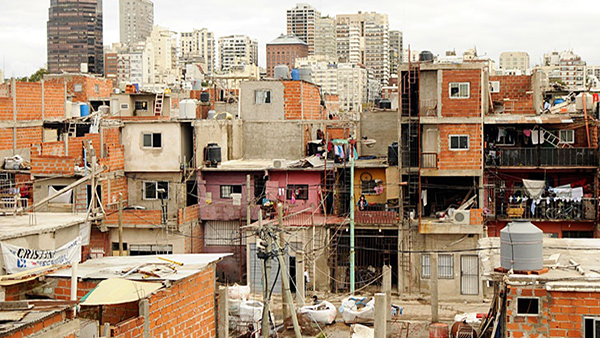
The aforementioned situation is particularly prevalent in cities where so-called "neoliberal urban management" is implemented. These areas are crisscrossed by large zones inhabited by people neglected by government protection and action. Consequently, these zones lack adequate public services and infrastructure, facing significant barriers to accessing potable water, energy supply, and health and education centers. Furthermore, residents live in substandard housing and, in many cases, are crammed into unsuitable and unsanitary spaces.
Therefore, a significant portion of urban residents live in unsanitary conditions and reproduce in situations of material and cultural marginalization. The emergence of the COVID-19 pandemic starkly revealed and exacerbated existing urban inequalities.
Argentina was not and is not an exception to this situation; over the years it has built a rigid urban social map deeply marked by differences in access to collective and individual, material and virtual goods and services.
The management of the national government in the period 2015 to 2019 adopted a neo-conservative model, carrying out an adjustment with "social containment", with the goal of consolidating a prolonged hegemony of the financial capital fraction, supported by external debt, articulated to the predominance of the most concentrated agro-export sector.
The main results were the generation of a recessionary socioeconomic map, highlighting the following aspects:
- Deindustrialization of important activities.
- Primary sectorization of the economy.
- Increased poverty.
- Increased social inequality.
- Increased precariousness and unemployment.
- Extension of deficiencies and financialization of urban habitat and housing.
- Mortgage loans are inaccessible to lower income segments.
- Decline in the material conditions of housing and habitat.
- Unwise external borrowing and rampant capital flight.
Searches on an anti-recessionary path
In recent years, a rapid global technological transformation has taken place, driven by the use of digital platforms in the production, distribution, and consumption of goods, services, data processing technologies, and communication. This trend accelerated even further last year, spurred by the near-total global shutdown of assembly lines, work processes, and the movement of people and goods.
At the end of 2019, a new government took office proposing an alternative course to financial neoliberalism. From this perspective, we express that it is necessary to revitalize an action strategy of an anti-recessionary public policy , among other axes, supported by the active and rapid implementation of a practice of INCLUSIVE AND PARTICIPATORY URBANIZATION.
This should converge on the planning of the construction and improvement of facilities, infrastructure, and housing located in the most impoverished settlements of cities, prioritizing environmental protection and using internationally accepted criteria considered the most efficient.
To achieve this, a broad policy of "urban land reserve " must be legally and expeditiously configured , made up of suitable lands that come from idle public and private properties.
It is imperative that public policy design incorporate a comprehensive approach to the improvement, construction, and financing of housing and living conditions. We propose that the design consider the following aspects:
A.- The possibility of new waves of global epidemics occurring.
B.- The new ways of reorganizing the processes of work, production and consumption that are emerging from the current “technological transformation” that we are going through.
The aforementioned issues require, taking into account the end user's perspective, a flexible review of the design, size, and use of social and individual spaces. This is especially important considering a seamless physical and virtual connection between transit areas and residences.
Ensure the installation of basic water, sewage, energy and internet connectivity services, as well as nearby and accessible health and educational centers for the residents.
Reserve open and green spaces for gardening and/or recreation, for individual and collective use.
The design and quality of homes, taking into account the user's criteria, among other things, should have a layout that considers the possibility of working, learning and entertainment "at a distance", including outdoor spaces such as patios and balconies that allow and make it attractive to spend a lot of time inside the homes.
In all cases, the residents should be located as close as possible to the job that will be the source of their monetary income.
With that orientation, urban policy has to delve into the consideration of the construction and formation of new places that we call URBAN UNITS OF WORK AND PRODUCTION (UUTP).
The UUTPs (Unidades de Unidades de Producción de la Producción - Productive Units for Productive Work) can be structured as virtual networks, located near the neighborhoods where the target population lives, or established simultaneously with and adjacent to the construction or improvement of low-income neighborhoods, with the aim of guaranteeing the population's income. These projects should prioritize the application of the latest technologies.
In order to foster the creation of new forms of productive and consumer association, the UUTP (Unified Production and Technology Units) must adapt to the existing conditions in each part of the country. The aim is to strengthen and enhance collaboration among local communities, social movements, the university system, and various productive sectors. This involves combining research efforts and adapting human and material resources to maximize the use of installed capacity in industry, particularly in currently inactive sectors.
The UUTP should be combined to align with a possible and upcoming reactivation path disseminated throughout the country, seeking innovation and/or the generation of productive processes that can substitute imports, and depending on the case, allocating production to the domestic market and/or seeking insertion into various phases established in the global market.
[1] Consulting research professor at the National University of Quilmes (UNQ). Co-coordinator of the CLACSO Working Group on Poverty and Social Policies.
If you would like to receive more information about CLACSO's training programs:
[widget id=”custom_html-57″]
to our email lists.

