
Education, face and social construction
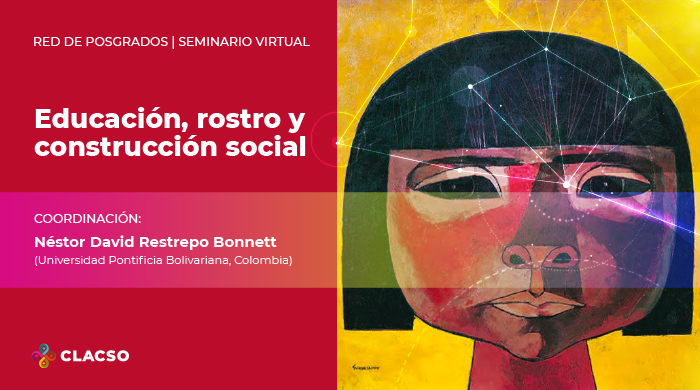
Seminar 2053
Coordination : Néstor David Restrepo Bonnett (Pontifical Bolivarian University, Colombia)
Teaching team: Néstor David Restrepo Bonnett, Carlos Arboleda Mora, Luis Alberto Castrillón, Byron León Osorio, Hernán Darío Gil (Pontifical Bolivarian University, Colombia)
Start date : 17/09/2020 | Registration : 20/05/2020 to 16/09/2020
Workload: 12 weeks – 90 hours.
Both anthropology and ethics must respond to the challenge of social deconstruction and construction. Social systems are configured through the dimensions of culture, politics, and economics. But it is essential to analyze contemporary rationalities that propose to respond to the challenges of the 21st century. This is especially true in the reinterpretation of a revealed and exposed otherness that calls for an anthropology and ethics of giving as a response to human vulnerability and the challenge of building citizenships of the face.
Three analytical characteristics should guide this investigative aim of the course:
- The relationship between anthropology, culture, and human transcendence: (Diversity, difference, and inclusion). It is within the dynamic of relationships proposed today by the culture known as interculturality that the processes of inclusion, dialogue, and recognition of the integrity of the life of each social subject are energized.
- The phenomena of social vulnerability, as an integrative analysis of social conflict and its ethical-political challenges. (Social vulnerability, social conflict (history and phenomenon). To reflect on human vulnerabilities as a human event to provoke the reconstruction of humanity as a dynamic and constant task, since the challenge is that we are all responsible for everything, and that generates ingenuity from the flesh.
- The city, citizenship, and social coexistence as factors of inclusion, acceptance, and diversity. (Citizenship, public policies, memory, conflict, and culture). The political tool for understanding social life is citizenship, and in this reflection, we are confronted with certain silences that have instrumentalized the discourse and civic attitude of the social individual.
Promoting a methodology based on multidimensional, interdisciplinary, and integrative construction. Epistemology must abandon its static nature to become dynamic, posing the challenge of not merely conceptualizing reality, but rather systematizing problems and their multidimensional contexts, and proposing holistic and comprehensive solutions with imagination and meaningful knowledge.
- The relationship between anthropology, culture, and human transcendence
- The flourishing of the city - from rural to urban
- Political citizenship and territorial development
- Social conflict, violence, and history
- Social movements
- Social exclusion - Social protest and resistance
- Social vulnerability and public policies
- Justice, equity and development
- ethics of care
- Education: Witness, memory, and hope
- Otherness, difference and alterity: the language of the face
- Anthropology of donation: from human data to the event of humanity.
- Agamben, Giorgio. (1996). The Coming Community. Valencia: Pre-textos.
- Aldai, Koldo. (2010). Interview with Leonel Narváez: “Forgiveness constitutes the basis of a new culture that humanity is called to embrace.”
- Alvarado García, Alejandra. "The ethics of care." Aquichan Magazine 4, no.
- Ánjel, Guillermo José and Gustavo Arango. (2008). Citizenship Condition: A Conversation about the City We Inhabit. Medellín: Pontifical Bolivarian University.
- Arendt, H. (2006). Men in Dark Times. Madrid: Gedisa.
- Arendt, H. (2007) Responsibility and Judgment. Barcelona: Editorial Paidós.
- Arendt, Hannah. (2005). The Human Condition. Barcelona: Paidós.
- BARCENA, Fernando, MELICH, Joan Carles. (2000) Education as an ethical event, Naturalness, narration and hospitality. Barcelona: Paidós.
- Boff, Leonardo. "The caring ethos."
- Castañeda, T., & Alba, F. (2014). “Everything must be rethought in light of barbarism” Interview with Manuel Reyes Mate. Journal of Social Studies, (50): 179-186.
- Chretién, JL. The Call and the Response. Madrid: Caparros, 1997.
- Cortina, Adela. Ethics of Cordial Reason. Educating for Citizenship in the 21st Century. Oviedo: Nobel, 2007.
- Del Barco, Jose Luis. (2011). From chaos to Beethoven blindfolded. Medellin: Pontifical Bolivarian University.
- Garcia Baró, Miguel. (2000). Towards a philosophical interpretation of horror. In Isegoria. Madrid, No. 23, (Dec. 2000) p. 173-186.
- Levinas, E. (1999). Totality and Infinity. Essay on Exteriority. Salamanca: Sígueme.
- Lévinas, Emmanuel. (1983). Philosophy, justice and love. Interview conducted by Raúl Fornet-Betancourt and Alfredo Gómez-Muller on October 3 and 8, 1982.
- Marion, JL (1993). Prolegomena to charity. Madrid: Caparros.
- Marion, JL (2005). The erotic phenomenon. Buenos Aires: El Cuenco de Plata.
- Melich, JC (2001). The absence of testimony. Ethics and pedagogy in Holocaust narratives. Barcelona: Anthropos.
- Nussbaum, Martha. «Victims and Agents. What Greek tragedy can teach us about sympathy and responsibility. Boston Review. 1998.
- Valcárcel, A. (2010). Memory and forgiveness. Barcelona: Herder.
- Valcárcel, A. (2011). Memory and forgiveness. Part 1. Program: Without distances. Space: Philosophy. Date of broadcast: 1-IV-2011. Madrid: UNED.
- Villa, L. (2016). In the face of absolute damage, resistance: a reading from Vladimir Jankélévitch. Eidos, (25): 129-156.
If you have a link with a CLACSO Associated Center:
- Paying in one payment: USD 95 (includes issuance and shipping costs of the digital certificate).
- Paying in one payment: USD 140 (includes issuance and shipping costs of the digital certificate).
- Paying in one payment BEFORE 25/08/2020: USD 150 (includes issuance and shipping costs of the digital certificate).
- Paying in one payment: USD 190 (includes issuance and shipping costs of the digital certificate).
The basic requirements for taking a seminar are:
- Availability of at least 4 hours per week to dedicate to the seminar course.
- Internet access.
- Reasonable handling of communication and computer tools.
- Language proficiency in the language in which the course will be taught. The official languages are Spanish and Portuguese.
If you have a link with a CLACSO Associated Center:
- Paying in one payment: USD 95 (includes issuance and shipping costs of the digital certificate).
- Paying in one payment: USD 140 (includes issuance and shipping costs of the digital certificate).
- Paying in one payment BEFORE 25/08/2020: USD 150 (includes issuance and shipping costs of the digital certificate).
- Paying in one payment: USD 190 (includes issuance and shipping costs of the digital certificate).

