
Social Sciences and the 2030 Agenda for Sustainable Development
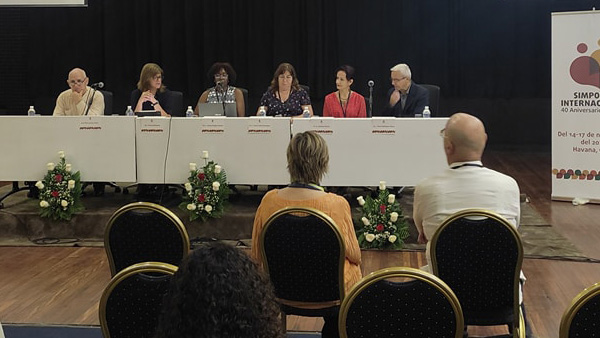

The Center for Psychological and Sociological Research (CIPS), a CLACSO Member Center belonging to the Agency of Social Sciences and Humanities of the Ministry of Science, Technology and Environment of the Republic of Cuba, organized the International Symposium 40th Anniversary of CIPS, in Havana, from November 14 to 17, with the central theme “Social Sciences and the 2030 Agenda for Sustainable Development: Challenges in Contexts of Global Crisis".

The Executive Director of CLACSO, Karina Batthyány, participated in the inaugural session along with the director of the institution Ileana de las Mercedes Hodge Limonta, and María Isabel Domínguez, a member of the CLACSO CD, among other personalities. On that occasion, Karina Batthyány He thanked CIPS for the recognition given to the Latin American Council of Social Sciences for the common path traveled for so many years and then gave a presentation about the challenges of the social sciences in the contemporary context.

Globally, various international scientific institutions and organizations have identified significant ongoing transformations in research and innovation processes in response to the pressing challenges posed by current crisis scenarios, in interdependent areas such as the economic, social, political, health, cultural and environmental, among others.
This is linked to the urgent need to address the seventeen Sustainable Development Goals (SDGs) set forth in the United Nations' 2030 Agenda. The SDGs are comprised of one hundred and sixty-nine targets that interconnect complex issues related to sustainable development, such as social inclusion, environmental protection, and economic growth. Some of the key priorities on the international research agenda focus on improving the management of scientific systems for social sustainability, strengthening research integrity, the role and responsibilities in disseminating research findings, and advocating for public engagement with science and its social impact.
An international context marked by asymmetries and polarities requires imminent changes that the social sciences must convene and help generate. The CIPS 40th Anniversary International Symposium proposes to share scientific approaches and tools that allow us to rethink current and future society from a systemic, multi-actor, intersectional, and integrative perspective. Its objectives are:
To exchange experiences and knowledge about conceptual frameworks and working methodologies related to the central theme of the event and its thematic axes.
To promote the construction and consolidation of cooperation networks between institutions, organizations and centers related to social research.
To propose transformative actions derived from the scientific debate in the different proposed thematic areas.


The Symposium is a hybrid event and combines lectures, panels, workshops, seminars, poster presentations, books and audiovisual materials, as well as pre-event courses, among other activities.
They adhere

Themes and topics
1. Public policies, inclusion and social equity. Social participation and citizenship education.
2. Social diversity and identities: groups, families, genders, generations and territories. Migrations.
3. Religion, Culture and Society.
4. Work and employment, knowledge economy, corporate social responsibility. Empowerment and organizational change.
5. Local and community development. Community self-management and multi-stakeholder relations. The social and solidarity economy. Community work and empowerment of local actors.
6. Environment and sustainable development. The role of the social sciences.
7. Communication and technologies. Use of social networks.
8. Experiences of social transformation. Design and evaluation of methodologies. Innovation oriented towards solving social problems. Learning in diverse social contexts and skills development.
Simultaneous events

VIII International Meeting of Children and Youth in Latin America and the Caribbean 15 and 16 November
The Meeting provides a forum for exchanging national and international social thought on issues related to childhood, adolescence, and youth. Held regularly since 2006, its main purpose is to foster a space for reflection, learning, and the collective construction of knowledge, not only in Cuba but also throughout Latin America, based on the contributions of social studies on the subject.
The Executive Director of CLACSO, Karina BatthyányHe presented at the opening session and will attend the second session of the meeting, which will take place on November 16 from 9:00 a.m. to 12:00 p.m. He participates on CLACSO Working Group on Childhood and Youth.

The themes cover youth diversity and its cultural, political, and economic dimensions; youth subjectivity; the gender approach in the analysis of childhood, adolescence, and youth; intergenerational relationships; the socialization processes of these groups; participation; the processes of social integration and disintegration; public policies toward children, adolescents, and youth; as well as transformative experiences in working with and for children, adolescents, and youth.
Coordinator: María Isabel Domínguez García


Meeting of CLACSO Cuba Member Centers


XI Workshop on Social Studies of Work
Since 2016, a series of workshops have been systematically organized by the Cuban Network for Social Studies of Labor, which is institutionally based at CIPS. Its main purpose is to disseminate and generate knowledge on labor and work-related issues, both nationally and within the contemporary Latin American and Caribbean region. Therefore, it serves as a space for dialogue and academic exchange, sharing studies, practical experiences, and evaluating public policy documents, with an emphasis on those related to employment, wages, vocational training, and social security.
The central themes of the meeting focus on the concept of work in its broadest sense: paid and unpaid work, employment, informality, labor relations, work culture, and labor market configurations; all of which can be connected to cross-cutting elements related to gender, skin color, territory, and other factors. An international expert in the field of work and labor relations in the Latin American and Caribbean region will participate.
Members of the Social Studies Network on Work, policy operators from the Ministry of Labor and Social Security, as well as those who register for the "Work and Employment" theme of the Symposium, are invited to participate.
Coordinator: Mirlena Rojas Piedrahita

International Workshop “Actors of the Social and Solidarity Economy”
The Network of Social and Solidarity Economy and Corporate Social Responsibility (ESORSE) invites researchers, professors, cooperative members, entrepreneurs, and decision-makers to discuss the ecosystem of actors in the Social and Solidarity Economy from different latitudes, based on the presentation of experiences and good practices in this regard, its challenges and opportunities in contemporary society.
They coordinated: Jusmary Gómez Arencibia y Rafael Betancourt Abio

International Event on Afro-descendants and Counter-hegemonies
This event, sponsored by the Nelson Mandela Chair of Afro-descendant Studies and the CLACSO Working Group “Afro-descendants and Counter-hegemonic Proposals,” has the following general objectives: to analyze current approaches and central themes in the field of Afro-descendant studies and to develop proposals based on the post-pandemic anti-racist agenda, beyond the Decade for People of African Descent.
The axes of analysis are:
Afro-epistemologies. Current debates and challenges. Black feminisms
The evaluation of the International Decade for People of African Descent
The post-pandemic anti-racist agenda
The challenges of Ethnoeducation
Emerging leadership.
The main forms of participation include conferences, workshops, panels, and working groups. The event will also feature a meeting between Afrocentric projects, working groups, and initiatives.
Coordinator: Rosa Campoalegre Septien


If you would like to receive more information about CLACSO's training programs:
[widget id=”custom_html-57″]
to our email lists.

