
Science, Technology and Innovation for National Sovereignty
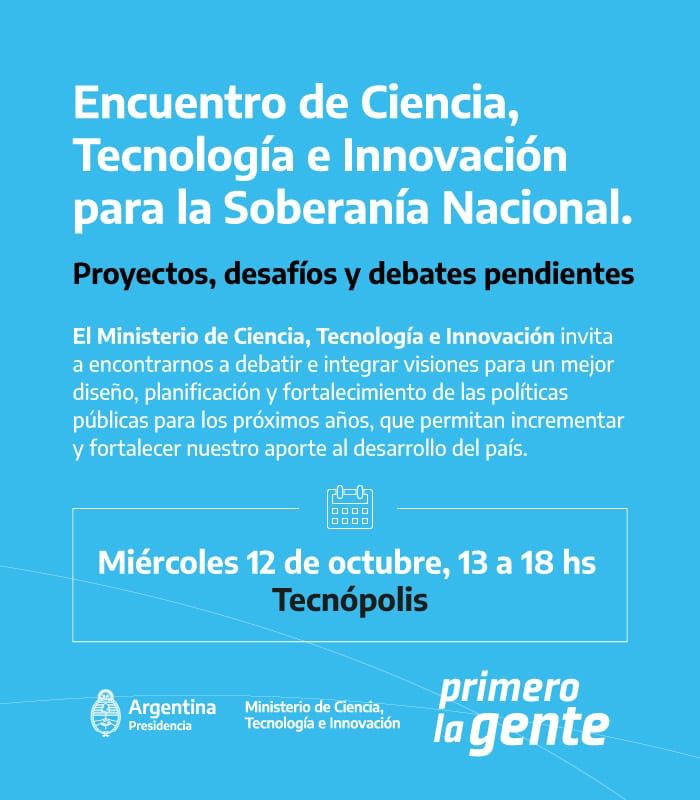
The "Meeting on Science, Technology and Innovation for National Sovereignty: Projects, challenges and pending debatesThe event will take place on Wednesday, October 12, from 1:00 PM to 6:00 PM Argentina time (UTC-3) at the Tecnópolis grounds (Av. Gral. Paz and B1603, Villa Martelli, Buenos Aires). Various CLACSO Working Groups will participate.
The Ministry of Science, Technology and Innovation of Argentina invites you to debate and integrate visions for a better design, planning and strengthening of public policies for the coming years, which will allow us to increase and strengthen our contribution to the development of the country.
The meeting seeks to create a space to listen to and receive ideas, proposals and needs from all those who make up the Argentine scientific-technological and university system in every part of the country.
The organizers say:
The reality of our scientific and technological system is marked by the major crises imposed by the current geopolitical landscape: the climate crisis, the consequences of the pandemic, the war in Europe, and the adverse global economic situation resulting from this context. All of these present enormous challenges for the world, for our country, and for the region.
In Argentina, this crisis is exacerbated by the indiscriminate borrowing during the previous administration. Furthermore, the proliferation of hate speech and its most abhorrent expression in the attempted assassination of the Vice President of the Nation complete a scenario where it is essential to re-evaluate the terms of sustainable development with social inclusion for a democratic, just, sovereign, and peaceful Argentina.
Between 2003 and 2015, the National Science and Technology System reached an unprecedented scale in Argentine history, starting from a state of critical dismantling. Subsequently, after four years of policies detrimental to the sector, it resumed its path of expansion in 2019 amidst a challenging national and global context. Faced with the challenges that reality presents for Argentina, the science and technology sector and the policies promoted by the State must rise to the challenge of the present. To this end, it must address the relevant discussions in order to provide a response commensurate with the needs of our time.
Undoubtedly, how we address current challenges will shape the future of our country's development and the science, technology, and innovation sector for decades to come. Therefore, it is essential to increase dialogue, collaboration, reflection, and cooperation among the various stakeholders in the sector, with a particular focus on younger generations.
We invite those of us who are part of the scientific-technological and university system to think about and participate in the “Science, Technology and Innovation Meeting for National Sovereignty: projects, challenges and pending debates” which seeks to be a new instance that puts those of us who do science and technology, and the national State, committed to the transformations that our country needs.
Commissions by topic:
1. GROWTH AND STRENGTHENING OF THE SCIENCE AND TECHNOLOGY SYSTEM, WITH AN EFFECTIVE FEDERALIZATION STRATEGY
Given the new Science and Technology Funding Law, passed in 2021, we must discuss the growth and expansion of the national science and technology system and universities. Historically, approximately 80% of investment in science and technology has been concentrated in the Buenos Aires Metropolitan Area (AMBA).
It is necessary to develop an investment strategy and implement public policies aimed at strengthening and federalizing the Science and Technology system, with the objective of providing favorable frameworks for scientific and technological development throughout the national territory, strengthening research at the provincial and local levels, as well as creating new jobs in places where strategic vacancies are identified.
2. THE FUTURE OF YOUNG SCIENTISTS IN THE SCIENCE AND TECHNOLOGY SYSTEM OF THE COMING DECADES
The scientific system as we know it faces the challenge of continuous improvement, so that it can respond to a changing and dynamic world, taking into account the needs of the region. Young people represent a great opportunity for this, as they constitute the current workforce of research and development, and will be the next generations to lead the fields of science and technology.
It is essential to invite young scientists to be protagonists in the discussion of the present and future of the system they comprise, in order to involve ourselves in the planning of strategies for the evolution of institutions.
3. TRANSFORM AND INNOVATE SCIENTIFIC INSTITUTIONS TO STRENGTHEN THEIR ROLE IN THE 21ST CENTURY FOR A GREATER IMPACT ON DEVELOPMENT AND POLITICAL SOVEREIGNTY.
Our scientific system was, in a sense, established in the mid-20th century and comprises a wide variety of institutions. In some cases, these institutions still operate with dynamics and procedures developed in other contexts, reflecting the needs of the nation and the national and international scientific framework. Therefore, we face the challenge of developing strategies to update our institutions and bring them into line with the needs and demands of the 21st century.
What institutional innovations are required for our institutions to adapt to the challenges that Argentina will face in 2022 and for the next 30 years?
4. CROSS-CUTTING POLICIES TO REDUCE GAPS RELATED TO GENDER INEQUALITIES AND DIVERSITY IN THE SCIENCE AND TECHNOLOGY SYSTEM
It is essential that all levels of the science and technology system reflect on and work toward analyzing and diagnosing the situation of women and gender-diverse individuals in science and technology. Therefore, incorporating an intersectional gender perspective into science policies, to address the structural conditions of inequality, discrimination, and violence within science and technology, is a fundamental priority in the Ministry of Science, Technology and Innovation's policy.
5. POLICIES FOR RESEARCH, LINKAGE AND TRANSFER OF UNIVERSITIES AND SCIENTIFIC AND TECHNOLOGICAL ORGANISMS
Universities and science and technology organizations must understand research and training as effective tools for the transformation and development of communities and territories. To this end, it is essential to develop and strengthen research, outreach, and knowledge transfer functions within the framework of structural policies that allow knowledge to be aligned with the needs of the public and private sectors, as well as society as a whole. Furthermore, they are key players in maintaining ongoing dialogue with institutions and organizations in the region and at the international level.
If you would like to receive more information about CLACSO's training programs:
[widget id=”custom_html-57″]
to our email lists.

