
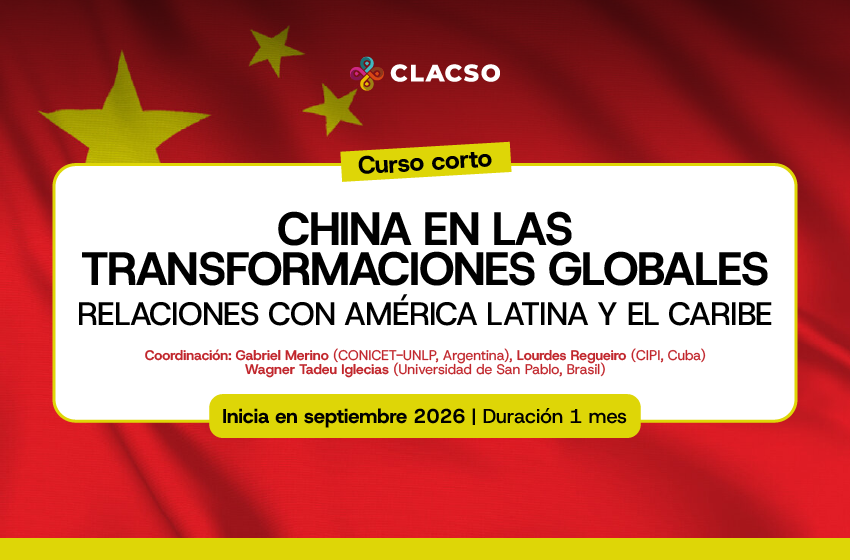
China in global transformations. Relations with Latin America and the Caribbean
EXECUTIVE
Gabriel Merino (CONICET – UNLP, Argentina), Lourdes Regueiro (CIPI, Cuba) and Wagner Tadeu Iglesias (University of São Paulo, Brazil)
PROFESSORS
Gabriel Merino (CONICET – UNLP, Argentina) | Maria Francesca Staiano (CONICET – UNLP, Argentina) | Javier Vadell (PUC Minas, Brazil) | Carlos Eduardo Martins (USP, Brazil) | Wagner Tadeu Iglesias (University of São Paulo, Brazil) | Lourdes Regueiro (CIPI, Cuba)
Home: 21 / 09 / 2026 | Registration: 02/07/2026 al 20/09/2026
Modality: Virtual with live classes and exclusive materials
Workload: 50 hours long.
Duration: 1 month
This course offers a comprehensive analysis and a forum for discussion on China's reemergence and its impact on Latin America and the Caribbean, addressing the political, economic, legal, and geopolitical dimensions of this strategic relationship. Through an exploration that ranges from the inner workings of the Chinese system to the concrete dynamics of regional cooperation, the program aims to equip participants with critical tools to understand one of the most transformative processes of the 21st century and its implications for the Global South.
The rise of the People's Republic of China to the center of the global stage is undoubtedly one of the most significant historical processes of the 21st century. Far from being limited to its economic dimensions, China's re-emergence implies a profound reconfiguration of the international order that challenges inherited analytical categories and raises fundamental questions for the entire Global South. Within this context, Latin America and the Caribbean emerge as a region particularly sensitive to this process, both because of the increasing density of its ties with the Asian giant and because of its strategic position in the transition to a multipolar world.
This program proposes a comprehensive and systematic approach to this relationship, articulating dimensions that are usually treated in a fragmented way. The exploration begins with an examination of China's political and economic system, delving into the internal logics that underpin its development model and its unique relationship between state and market. This first axis is essential for understanding the material and institutional foundations of China's global expansion.
From there, the course moves on to the analysis of globalization with Chinese characteristics, a concept that synthesizes Beijing's commitment to redefining the terms of global economic integration through initiatives such as the Belt and Road Initiative, and which implies an alternative vision of development and international cooperation.
The third theme addresses the ongoing systemic transition, situating Latin America and the Caribbean within the tension between China and the United States. This class examines the geopolitical implications of the shift in the world's center of gravity toward the Asia-Pacific region and the region's room for maneuver in a scenario of increasing competition between powers.
The economic component receives specific treatment through an analysis of economic relations between China and Latin America and the Caribbean, examining trade flows, investment patterns, financial cooperation, and the structural asymmetries that characterize this relationship. The program is complemented by two asynchronous classes that delve into cross-cutting aspects of the relationship. The first focuses on China's economic, technological, and international development, with an emphasis on its differential impact on Latin American and Caribbean subregions. The second examines the rule of law in China and the legal and philosophical framework that guides its development, as well as its perspective on Chinese foreign policy and its proposed world order, summarized in the idea of a Community with a Shared Future for Mankind.
Overall, the course offers participants a rigorous theoretical and empirical framework for interpreting one of the most decisive processes of our time. It is not merely a data collection exercise, but rather a critical understanding exercise that aims to equip students with analytical tools to navigate the complexity of a changing world and to consider the place of Latin America and the Caribbean within it.
SYNCHRONOUS CLASSES
- Class 1 - The re-emergence of a giant: the political and economic system in China - Gabriel Merino
- Class 2 - Globalization with Chinese characteristics - Javier Vadell
- Class 3 - Systemic Transition: Latin America and the Caribbean between China and the US - Carlos Eduardo Martins
- Class 4 - Economic Relations between China and Latin America and the Caribbean - Wagner Iglecias
ASYNCHRONOUS CLASSES
- China: economic and technological development and internationalization. Its relationship with Latin America and the Caribbean and its subregions. Lourdes Regueiro
- China: Rule of Law and Community of Shared Destiny - Francesca Stainao
- Gabriel Merino (CONICET - UNLP, Argentina),
- Maria Francesca Staiano (CONICET - UNLP, Argentina)
- Javier Vadell (PUC Minas, Brazil)
- Carlos Eduardo Martins (USP, Brazil)
- Wagner Iglecias (PUEAAO - UNAM, Mexico)
- Lourdes Regueiro (CIPI, Cuba)
The course will be delivered online, combining synchronous and asynchronous sessions. Over the course of a month, a total of six classes will be taught, which will then be available as recordings for asynchronous viewing.
Live classes will be held on the following days Tuesdays from 18 to 20 pm (ARG) through the Zoom platform, which will allow direct interaction between participants. In addition, students will have access to exclusive materials, available in the virtual classroom, that will complement the content covered in each session.
The final assessment will consist of an individual online questionnaire, which will be a necessary condition for passing the course.
| Early registration (until 10/08) | General registration (11/08 to 14/09) | Registration without discount (14/09 to 20/09) | |
| Full or Associate Member Center | $100 | USD 150 | $200 |
| No link | $150 | USD 225 | $300 |
Queries: [email protected]

