
Chile: Kuxan's Reasons
Crisis, Covid-19 and Mapuche political imprisonment. The case of Lov Elikura[1]
Natasha Olivera, Julio Parra and Edgars Martínez Navarrete[2]
The COVID-19 pandemic suspended the most significant political juncture in Chile since the end of the dictatorship. Beginning on October 18, 2019, millions of people took to the streets and territories of this Latin American neoliberal oasis, seeking to change a constitutional order that has perpetuated the interests of imperialism in the southern country. The “Chilean miracle,” as Friedman called the economic liberalization reforms adopted during the military regime, quickly sanctified social inequality as a divine norm and the ruling classes as its priests. Thus, the pandemic crisis currently ravaging the world overlapped with the crisis of the Chilean model, revealing its true driving force: the complete commodification of social life.
In both scenarios, the logic of crisis management operated under the same punitive and impoverishing pattern: in the first, with great suffering for the working class, leaving thousands injured, 32 dead at the hands of police or military, and more than 2.500 political prisoners. And in the second, by leaving large masses of workers unprotected, bailing out private companies with public funds, and once again deploying numerous military troops to enforce a useless nighttime curfew. Thus, the process of intertwining these crises is being used to implement measures of social and political control, to create precarious working conditions, and to enact a set of laws that benefit the elites and prop up financial capital.

The October Rebellion. Demonstrators in the streets of Concepción (Chile) confronting repressive forces. Photograph by Pablo Hidalgo.
While this new pandemic context proved to be a lifeline for Sebastián Piñera's government, which, after the October uprising, remained in power with only 6% approval and under scrutiny from international human rights organizations, in recent weeks hunger and a lack of economic opportunities have forced the working class to find alternative ways to feed themselves. This has led to the emergence of initiatives such as community kitchens, and in response, protests of indignation have resurfaced. It seems that if this complex situation continues, popular rebellion will once again take to the streets of Chile, pandemic or no pandemic.
However, this overlapping of crises does not affect the entire country equally. As always, it is the working class and Indigenous communities that bear the brunt of these blows, exposing the historical accumulation of inequalities to which they have been subjected. This is why, in various areas of Wallmapu[3]The Mapuche communities and communities immediately took measures in response to the pandemic: among other things, food support networks were activated and, faced with the government's lack of response, community hygiene cordons were established to restrict the transit of tourists and the transport of some goods through the territories.
From the perspective of resistance movements, the pandemic also revealed certain important distinctions between the Mapuche and Chilean movements that had become blurred with the October uprising. Highlighting these distinctions would help us understand the inherent strength of these two paths of struggle against a shared enemy. Thus, it would be impossible to establish that both groups, after the rebellion, strictly speaking shared the same strategies. Although they engaged in joint resistance practices at certain times, which potentially express what we might call a plurinational rebellion, these manifestations failed to transcend the immediate and symbolic realm: the massive presence of the wenufoye (Mapuche flag) in the marches, the destruction of various colonial statues in Chile's main cities, and the unstable legitimization of political violence by the "front line" were concrete expressions of a common affiliation that did not, and has not, forge into an alliance for emancipation.
Thus, while some Mapuche leaders strategically recognized that their liberation as a people depended on the liberation of oppressed sectors of Chilean society, the Mapuche autonomist movement forged its own distinct tactics within the October uprising and also within the pandemic crisis. In our view, beyond programmatic considerations, this stems from a differentiated understanding of the historical narratives of domination and emancipation, which, while not antagonistic, have significant nuances. An example of this is how the Mapuche people, unlike the Chilean people, understand and analyze the current pandemic within the context of their history of subjugation and resistance, rather than as a spasmodic event.
Beyond Covid-19: the pandemic seen from the Mapuche rakizuam perspective
For decades, the Mapuche people have denounced the harmful effects of the neoliberal capitalist model. This is not only on a material level, where the consequences for their lands are alarming, but also regarding the various spiritual, cultural, and political structures that underpin their way of life and which the colonial logic of capitalism has historically suppressed. These onslaughts have caused multiple transformations in the territory and in the forms of human interaction that develop within it, forcing local populations to disrupt production cycles and confront droughts, plagues, diseases, and other adversities stemming from the expansion of forestry, energy, and mining models in Wallmapu. Furthermore, in order to protect the interests of capital, much of the territory in conflict is militarized, forcing communities to contend with systematic raids, checkpoints, and a series of recurring forms of harassment. Therefore, it is not surprising that from the Mapuche cosmogony they refer to the current pandemic from the memory of dispossession and violence, which goes back to other evils that arrived long ago that still affect their itrofil mongen (life in its fullness).

Members of the Chilean police special forces guard the entrance to a forestry estate in the southern part of Arauco province. Photograph by Julio Parra.
From the Mapuche rakizuam (Mapuche thought), therefore, it is impossible to see the current pandemic as a purely biological phenomenon, detaching it from other factors that have harmed and sickened all beings coexisting on the mapu (land) for a long time.[4]According to José Quidel (2020), a Mapuche intellectual, kuxan (disease) is a “a living entity that has diverse origins and that at some point manages to penetrate some of the dimensions of the che (person); it can be in his püjü (spirit), in his rakizuam (thought), in ragi chegen (the social) or in his kalül (biological body) and from there it is nourished, strengthened.” Over time, if left untreated, this kuxan takes hold of the social structure it has entered, causing damage and disruptions that can become irreparable. This is why many communities understand and explain their individual and community problems by considering the social instabilities that a kuxan can create.
Under this conception, which challenges the hegemonic biomedical paradigm, the Mapuche people understand Covid-19 as a kuxan (a mythical creature) whose multidimensional nature is rooted in the harmful outcome of a series of processes carried out by various capitalist and colonial systems on the bodies, territories, resources, and spiritualities of both Mapuche and non-Mapuche people over a long period. In other words, the emergence of this disease, which has exposed the limitations of the neoliberal management of life, is not the product of a specific or isolated “event,” but rather of the harmful contemporary condensation through which the system of domination over Wallmapu (the Mapuche territory) has historically developed.
Therefore, from this historical and interdependent perspective, derived from the Mapuche rakizuam, we could argue that the rise of Mapuche territorial recoveries in recent years is due to the need to seek alternative ways of life in the face of these multiple crises that undermined their possibilities of community reproduction, now threatened again by Covid-19.
The historical reasons for the kuxan: the case of Lov Elikura
In the early hours of January 29, more than a hundred police officers violently raided 5 homes in the Elicura Valley, Lavkenche territory of Wallmapu[5]Amidst beatings, struggles, and multiple violations against their families, Matías Leviqueo, Eliseo Reiman, Guillermo Camus, Esteban Huichacura, Carlos Huichacura, and Manuel Huichacura were taken into custody. All four were charged with the alleged involvement in the death of a local resident and were remanded in custody that same afternoon.
At the arraignment hearing, it was established that the only evidence against the community members consisted of statements given by protected witnesses, which, in addition to being contradictory, failed to establish any evidence linking the accused to the alleged crime. Ignoring these legal gaps, the Elicura community members were transferred to the Lebu prison in the Arauco Province, thus beginning their political imprisonment, which continues to this day through the current pandemic crisis.
Unfortunately, this kind of criminalization is nothing new in Lavkenmapu. Faced with the rise of land reclamations in recent years, the State, forestry companies, and large landowners in the region have used various coercive mechanisms to protect the Mapuche lands they usurped and the economic interests they established on them, taking advantage of the inequalities and vulnerabilities they themselves created through community division, family impoverishment, and the scarcity of exploitative employment opportunities. However, given the current unfolding of various processes of community antagonism in the area that have managed to overwhelm these mechanisms, the predominant tactic employed by those in power has been the criminalization of these experiences through fabricated charges or flawed legal cases. In a way, this set of practices has allowed the conditions through which the kuxan (a Mapuche mentality) flows in the territory to be reproduced.
The political prisoners of Elicura are a consequence of this history. Particularly those members of Lov Elikura, a Lavkenche resistance movement that two years ago reclaimed the former Las Vertientes estate, which until then had been in the hands of the large landowners of the area, the Rivas family. This family clan settled along with other groups of colonists at the end of the 19th century on the shores of Lake Lanalhue, a sacred body of water in the Mapuche cosmogony, and since then many of its descendants have been responsible for and complicit in a series of acts of dispossession in the Elicura Valley, racially subjugating its population and systematically commodifying its natural resources.
Beginning in the last century, with varying degrees of conflict, the process of land concentration among the Lavkenche people was tremendously unequal. While there were substantial advances for the communities during the agrarian reform cycles, these were severely interrupted by the coup d'état, an event exploited by many wealthy families in the area—including the Rivas family—to expand their territorial holdings by acquiring properties and plots through illegal means.[6] or at ridiculously low prices. Through the agrarian counter-reform in the Elikura Valley, the portions of land that were not already in the hands of large landowners were further fragmented by the State in two main ways: on the one hand, the areas located in forested zones were acquired by forestry entrepreneurs through dubious auctions, which allowed them a rapid expansion of pine and eucalyptus monoculture supported, moreover, by generous state subsidies.[7]And, on the other hand, the largest hectares of fertile valley were given to Chilean landowners, confining Mapuche families to small plots where it was impossible for them to carry out their subsistence activities; crippling their productive dynamics, harassing their cultural practices, and forcing them to live in dependence on the landowners. Don Miguel Leviqueo Catrileo, a resident of Elikura, expressed the following about this situation:We Mapuche have always lived on small plots of land while the rich built their houses on high ground, on huge parcels of land; from there they looked at us as we planted the little we needed to live.” (Personal communication, March 11, 2019).
These processes aimed at dismantling the Lavkenche communities continued in other forms after the end of the dictatorship. The Rivas family, as “owners” of the Valley, lined their pockets at the expense of the forestry business and formed alliances with large timber companies, jointly expanding the monoculture plantations that by then already surrounded the Elikura Valley.[8]Despite the political gains that the Mapuche movement managed to establish during the neoliberal period and certain legal openings that allowed its presence in restricted democratic spaces, the multicultural logic of capitalism in the transition perpetuated dispossession throughout Wallmapu.
In this context, the Lavkenche families of the Valley continued to live in profound conditions of inequality, which were further exacerbated by the arrival of various transnational corporations at the beginning of this century. First, some smaller aggregate extraction companies encroached upon the Calebu and Elicura rivers, the main waterways of the territory that feed Lake Lanalhue, causing irreparable damage to them (Olivera, 2017).[9]Subsequently, starting in 2016, with the approval to build the “Gustavito” hydroelectric plant by the Spanish energy corporation Hidrowatt, which in turn belongs to the Impulso business group, plans to build two more hydroelectric plants in the Valley by this economic conglomerate became evident. Faced with this situation, which was beginning to arouse suspicion and outrage, Lonko Miguel Leviqueo quickly indicated that these projects “They do us no good, they only bring destruction“(ibid.)
It is possible to identify that such threats quickly became common enemies for a deeply fragmented and disunited local population, a product of the multiple forms of violence and racism to which it had long been subjected. The imminent arrival of hydroelectric dams in the territory signified a collective confrontation with present and past injustices, a shared indignation that was captured in the words of Pamela Rayman, werken of Lov Elikura, when she stated thatWe are already plagued with forests, with Hidrowatt it won't be the same.”Thus, during that year, the “Movement in Defense of the Rivers of the Elicura Valley” was born, an organization made up of Mapuche and non-Mapuche people that carried out a series of actions to halt the installation of these megaprojects, reaching its peak in July 2016 with the occupation of Highway P-60-R, which connects Cañete and Contulmo, two of the main urban centers in the area. Although this movement sowed the first seeds of collective antagonism in the Valley after many years of dormancy, the strain of the legal battle, the inherent frictions of any organization, and some complacency in the face of certain advances in the struggle, ultimately led to its dissolution.

Members of the Movement in Defense of the Rivers of the Elicura Valley block Highway P-60, which connects Contulmo and Cañete. Photograph by Carla Leviqueo Raiman.
But the resistance in the Elicura Valley did not end with the movement. The Elikurache youth[10]Born and raised among pine forests and large landowners, they were not content with these small victories and, affirming their right to self-determination, decided to move definitively forward with the territorial and cultural reconstitution of the Valley, the only possible path to tear away the history of subjugation that weighed on their shoulders. Thus, on January 21, 2019, the people entered to reclaim the Las Vertientes estate, which until then belonged to an heir of the Rivas family, giving birth to the Lov Elikura community and establishing themselves as an experience of resistance that has represented a concrete obstacle to the advance of dispossession in the Lavkenmapu (Mapuche territory).
Since then, Chilean structures of domination have deployed various mechanisms of repression against this Lov, attempting to dismantle the activities that sustain its community network and through which awareness is raised among those who do not yet dare to confront them. The raid that occurred at the end of January and the subsequent political imprisonment of the Elikura community members must be seen as yet another action in this strategy of persecution and harassment.
Mapuche political imprisonment in times of pandemic crisis
These are times of struggle, but also of resistance. We must support each other as brothers and sisters in every territory and raise our voices against threats of any kind. We must abandon passivity and take action, and this strike is precisely that: a step toward mobilization. It is preferable to die fighting than on our knees before an oppressive system that relentlessly subjugates us through the fear of a virus.
Machi Celestino Córdova, on hunger strike in the Temuco prison
On February 11th of this year, various Lov (Mapuche communities) and resistance groups from Lavkenmapu and other territories gathered outside Lebu prison to support the political prisoners of Elikura, who had already been imprisoned for ten days. A statement was released to the public.[11]They thanked the authorities and their brothers and sisters who accompanied them that day in the performance of a nguillanmawün, a Mapuche ceremony aimed at giving them newen (strength) and asking for justice in the process that keeps them deprived of their freedom.
In addition, they reiterated their support for all Mapuche and non-Mapuche political prisoners held in various prisons throughout Chile. To date, 28 weichave (fighters) are in pretrial detention or serving sentences for various offenses, forced to endure the pandemic in the harsh hygienic conditions of confinement. This situation, besides violating their human rights, contravenes the principles of Mapuche medicine, which establish a close connection between the Mapuche spirit and the various activities carried out on their land. Furthermore, given the intensification of state punitivism, gray areas have proliferated within prisons, which are exploited by prison guards to perpetrate various forms of racist violence against the Mapuche population.

Mapuche community members hold a rally (malon wiño) in front of the Lebu prison in support of political prisoners from Elicura. Photograph by Julio Parra.
Faced with these clear disadvantages experienced by Mapuche political prisoners before the Chilean justice system, many of them took the drastic decision on Monday, May 4th, to begin or resume a hunger strike as a means of pressuring the executive and judicial systems. Specifically, Sergio Levinao, Víctor Llanquileo, Sinecio Huenchullan, Freddy Marileo, Juan Queipul, Juan Calbucoy, Danilo Nahuelpi, and Reinaldo Penchulef, all imprisoned in the Angol prison, and Machi Celestino Córdova, in the Temuco prison, with this harmful action, demanded that the government adhere to ILO Convention 169 and the United Nations Declaration on the Rights of Indigenous Peoples, which stipulate the option of modifying precautionary measures in these crisis contexts. They also demanded the return of their usurped ancestral territory, the withdrawal of transnational corporations responsible for the imbalance in Mapuche life, and the demilitarization of Wallmapu. Finally, they issued a call to mobilize all expressions of resistance that fight daily for the national liberation of their people.
However, in a derisory and indifferent manner to the demands of Mapuche political prisoners, the Chilean judicial system granted a change of pretrial detention to the police officer responsible for the death of weichave Camilo Catrillanca in November 2018, allowing him to await trial under house arrest due to the threat that Covid-19 posed to his life. Contrary to this trend, the justice system has systematically denied changes to the pretrial detention measures of Mapuche defendants resulting from the territorial conflict in Wallmapu.
The criminalization of Mapuche political prisoners during the pandemic, the racist nature of the justice system, and the government's indifference to the demands of those on hunger strike have led to a progressive increase in resistance actions in the Arauco and Malleco regions, the epicenter of the territorial conflict between the state, forestry companies, and large landowners, and the Mapuche communities and lov (communities) in resistance. This has resulted in a continuation of land reclamations and the diverse forms of protest promoted by the Mapuche movement at the local level.
While political imprisonment in Chile affects all sectors of the community and grassroots who have chosen to fight for a different society, the racist and colonial bias with which the judicial system operates, driven by the economic and political interests of the State, particularly and specifically harms the Mapuche people. Thus, imprisonment and political persecution constitute mechanisms of subjugation against experiences like the Lov Elikura, which have built, step by step, emancipatory alternatives to life in the face of the true scourges that plague the world: capitalism, colonialism, and patriarchy.

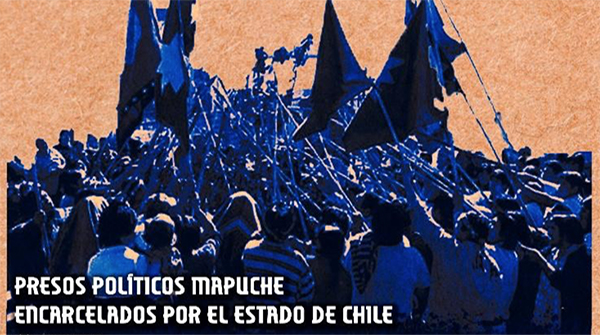
Register of Mapuche political prisoners held in different prisons in Chile until June 2020. Poster created by Felipe Bustamante (Chile).
[1] Kuxan means illness in Mapudungun. We will explain this later. A lov is the historical organizational form of the Mapuche people. Basically, it consists of family alliances established in a specific territory, led by their cultural authorities: lonko, machi, etc.
[2] Members of Aukin, a Mapuche media outlet. Edgars Martínez Navarrete is also a doctoral candidate in Social Anthropology at CIESAS – CDMX.
[3] El Wallmapu This refers to the Mapuche territory in its entirety, which, generally speaking, is composed of Puelmapu (the territory east of the Andes Mountains, now Argentina) and Gulumapu (the territory west of the mountain range, now Chile). The latter, in turn, is divided into Lavkenmapu (towards the coast), Huillimapu (towards the south), Pikunmapu (towards the center), and Pehuenmapu (towards the mountains). In this case, "lavkenche" refers in Mapudungun to the people who inhabit Lavkenmapu.
[4] According to Quidel (2020), the Mapuche people identified omens of this difficult context in signs such as eclipses, the flowering of the quila plant, and other phenomena that, in his words, heralded “bad situations, hunger, disease, and harm.” For example, for him, the “death of the sun” or the great eclipse that occurred some time ago represented the predominance of darkness over light and, with it, the beginning of a new cycle for all life on Earth. Covid-19 may be part of this cycle. His article can be found at [link to article]. https://www.comunidadhistoriamapuche.cl/fey-ga-akuy-ti-ahtu-entonces-el-dia-llego-una-lectura-de-la-pandemia-desde-un-mapuche-rakizuam/
[5] Under the Chilean territorial organization, this area would be located in the Province of Arauco, VIII region of Chile.
[6] On this topic, review the book “¡Xipamün pu ülka! The forest usurpation of Lavkenmapu and the current recovery process”, written by different communities and Lov in Lavkenche resistance.
[7] In October 1974, Decree Law 701 was issued to subsidize and secure the forestry model in Chile. This decree has been systematically renewed by successive governments.
[8] For example, Forestal Mininco owns the San Ernesto Estate, which comprises a total area of 2.871 hectares.
[9] The most comprehensive work on this process was written by Natasha Olivera in 2017. She is a member of the Mapuche media outlet Aukin, a leading source of counter-information in Lavkenmapu. It can be accessed at: https://www.mapuexpress.org/2017/12/20/las-centrales-hidroelectricas-que-amenazan-los-rios-del-valle-de-elicura/
[10] This is the name given to the Lavkenche population of this territory, with “che” meaning “person” or “people” in Mapudungun.
[11] The statement, published by Aukin, says:Through this letter, we wish to publicly express our gratitude to the Lonkos Miguel Leviqueo (Elicura), José Lepicheo (Huentelolen), Marcelino Paineo (Antiquina), and Francisco Linco (Lleu Lleu), who joined us today, Tuesday, at the Lebu prison to celebrate a massive Nguillanmawün inside this penitentiary, where we have been held since January 29th. We also extend our thanks to all the women, brothers, sisters, brothers, sisters, and children from the Lov in Resistance of Cayucupil, Pichillenquehue, Quiliwe, Elicura, Peleco, Huentelolen, Huape, Pocuno, Lleu Lleu, Antiquina, Curapaillaco, Kolkuma, and other territories who came to offer us their strength and support.. "
If you would like to receive more information about CLACSO's training programs:
[widget id=”custom_html-57″]
to our email lists.

