
Chile debates its new Constitution
Isabel Piper: “Hope lies in the streets, in social mobilizations and in feminist organizations”
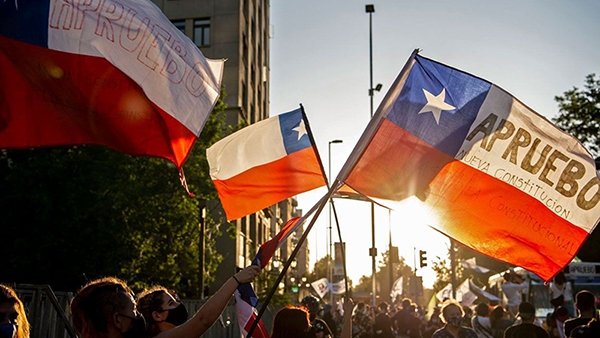
Chile is in the final stretch of the debate on a new Constitution that will forever shelve the one imposed by Augusto Pinochet's dictatorship in 1980. On Sunday, September 4, Chileans will go to the polls to vote on the text drafted by the Constituent Assembly, which met for more than a year, incorporating historically postponed issues, such as "the definition of the plurinational state, the defense of rights, and a feminist perspective," said Isabel Piper, a social psychologist, professor, and researcher in the psychology department of the University of Chile, and former member of the CLACSO Steering Committee, during her participation in InfoCLACSO on Wednesday, August 24.
In her column on the same program, CLACSO Executive Director Karina Batthyány argued that “this Constitution addresses some of the debts Chile, as a country, owed to a vast segment of the population, including Indigenous peoples, women, LGBTQ+ individuals, and youth. It recognizes the idea of the Chilean State as a plurinational state and incorporates social rights, including the right to care, but not exclusively. Ultimately, it is a Constitution that proposes a paradigm shift in the Chilean State in terms of its development model, collective identity, coexistence, and democracy, because that is what it ultimately addresses. And let's not forget that the current Constitution in Chile is Pinochet's Constitution. Therefore, CLACSO will continue to contribute to this campaign for the Constitution in Chile with debates, discussions, and materials. We will also use the Chilean Constitution as another example of the manipulation of fake news, because some of the ads that have circulated—if they can even be called that—are truly [unclear]. "It's fake news from beginning to end."
5 key points to understand the importance of the new Constitution
Column by Karina Batthyány in InfoCLACSO – August 31, 2022

The Constitution as a new social pact
Parity, environment, plurinationality and democracy
Panel “ The Constitution as a new social pact – Parity, environment, plurinationality and democracy ”. Organized by CLACSO and Democracia Viva.
Chile's new Constitution: perspectives from political ecologies
Conversation of August 18, 2022. Organized by the CLACSO Working Group “Political Ecology(ies) from the South/Abya-Yala” and moderated by Felipe Milanez (Federal University of Bahia, Brazil), the following participated:
-Paola Bolados: Autonomous University of Chile (Chile)
-Beatriz Bustos: University of Chile (Chile)
-Francisca Fernández Droguett: Movement for Water and Territories-MAT (Chile)
Marianela Denegri Coria: "A new fundamental charter is the possibility of changing the history of Chile"
Marianela Denegri Coria, Director of the Scientific-Technological Center in Social Sciences and Humanities in Chile and a newly appointed member of the CLACSO Steering Committee, was interviewed on July 6th for InfoCLACSO. She stated that “in Chile, social rights must be reclaimed as fundamental rights, not as commodities,” warning of “a veritable dirty war being waged by powerful economic groups that oppose Chile’s new Constitution.” “It’s difficult to establish a transparent agenda free from fake news in the face of the hegemonic media,” she summarized.
The constituent power of the Chilean revolt
This book, the first in CLACSO's new library, En Movimiento (In Motion), presents an assessment of the social movement that, overnight, transformed Chile's image in Latin America. On October 18, 2019, the strength of the link between neoliberalism and democracy, whose defenders had striven to present the world with so many examples of economic progress and political stability, collapsed.
DOWNLOAD THE BOOK

Education in the new constitution and the crystallization of social demands: New challenges for advancing dignity
Given the emerging scenario of constitutional change, undoubtedly a historic dilemma for the future of social struggles in Chile, we consider it necessary to address how the proposal tackles educational issues, and therefore, how the State responds to the historical demands expressed by educational movements in recent decades.
By Fabian Cabaluz and David Miranda
CLACSO Working Group "Popular Education and Critical Pedagogies"
Nelly Richard: Social revolt and new constitution
Chile: New Constitution and the possibility of reforming the health system

Camilo Bass* and David Debrott Sanchez **
After more than 45 years, with Chilean society walking the path of neoliberalism, on Friday, October 18, 2019, the Chilean people rose up, the most immediate cause being a public transportation fare increase, to say enough is enough to the prevailing inequality and exclusion. As a consequence of the social uprising, the Chilean political class launched an operation to both close down and salvage the established power structure through a Constitutional Convention that would channel, via institutional means, a process of impeachment that would lead to the fall of President Piñera and his government, which had become a violator of human rights.
* Chilean public health expert and researcher with the CLACSO Working Group on International Health and Health Sovereignty. ** Chilean economist. This text expresses the position of the CLACSO Working Group on International Health and Health Sovereignty.
If you would like to receive more information about CLACSO's training programs:
[widget id=”custom_html-57″]
to our email lists.

