
Chile: 5 keys to understanding the importance of the new Constitution
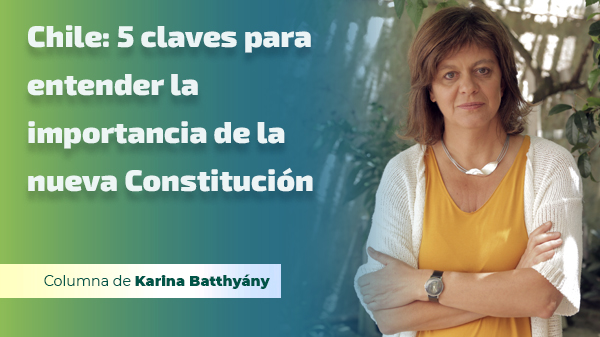
(Transcription of Karina Batthyány's Column)
(In InfoCLACSO – August 31, 2022)
Prior to this Sunday's plebiscite in Chile, I propose we discuss the topic of a new Constitution that is being submitted to the opinion of Chileans, and revisit some of the arguments we have been promoting from CLACSO on this issue.
I find it particularly important in a central axis that, from CLACSO, we work on, discuss, contribute to and debate, which has to do with democracies, with the consolidation of democratic systems in our countries, and indeed putting a New Constitution to popular opinion is a fundamental act of democratic systems.
Furthermore, because in Chile the issue of the Constitution is being discussed under the idea of a new social pact, which is proposed in the text that will be submitted to popular opinion this Sunday, it refers centrally to issues that make up democracy, such as parity, to strategic issues for Chile and the region such as the environmental issue, the consideration of plurinationalities, gender and diversities.
At CLACSO, we specifically support this debate by advocating for the approval of this constitutional text, because we believe it truly offers the possibility of building a more just and equitable society in Chile. And this new Constitution, which expresses this new social (and also environmental) pact or contract, has inclusive and plurinational characteristics and sets out a horizon of social justice.
Before delving into the logic of highlighting certain points of the new Chilean Constitution, I'd like to emphasize a few issues. This discussion about a new social pact, which raises so many interesting and necessary questions, is taking place in a world of fake news, of disinformation, of discourses that attempt to portray supposedly aberrant things in order to frighten a segment of the population. Some are focusing the discussion on the real issues, while others are using bogeymen or phantoms to obscure and shut down the discussion…
Absolutely. As we've seen at other times in Latin American history, this is happening now in Chile. That's why we at InfoCLACSO want to contribute by highlighting the points we consider most important in this new Constitution, especially regarding the proposed new social pact or contract that will allow Chile a future of greater social justice. And, as a modest contribution, we are undoubtedly countering this trend of fake news and deliberate lies that we are observing in some media outlets.
So, one of the first points I want to highlight is this idea of gender parity in democracy. It's the first time (not only in Chile, but in the world) that an equal number of men and women have drafted a constitutional text. In other words, parity was inherent in the very drafting of this text that is being submitted for consideration. This principle of parity is also reflected in the new Constitution, which defines Chile as a gender parity democracy. That is to say, it's not by chance; this idea of gender parity in democracy is explicitly stated, meaning that women and men occupy at least 50% of all state bodies and that concrete measures are taken to achieve this substantive equality and parity. It's included in the text. And that seems to me a very important first point, which, of course, is relevant to the current debate on democracies in Latin America.
It's one of the major unresolved issues in all democracies, where we still hear outdated, appalling, and retrograde rhetoric regarding the logic of parity, despite knowing full well the difficulties many women face in accessing political participation. I was thinking: when a female leader with political involvement expresses certain views and a man uses the same terms, the woman is generally subjected to offensive arguments, and that's upsetting, related to her characteristics, from physical to intellectual. Generally, this type of criticism doesn't arise when it comes to men…
-Absolutely. And there isn't just a series of reflections. We have the book we presented in Mexico #CLACSO2022 titled “It Was Always About Us” by Manuela D'Ávila, which precisely addresses this issue: violence in the exercise of politics, in this case in Brazil, but of course it also exists in all Latin American countries.
Furthermore, returning to the topic of parity, let's consider the reality in our countries, where we talk about quota policies, but not full parity. In the new Chilean Constitution, which is being considered this Sunday, this is stated unequivocally: it was drafted collectively, with equal representation, and the proposal is that Chilean democracy be based on parity for all branches of government.
The second point I want to highlight is the plurinational and intercultural state, to overcome this historical omission of Indigenous peoples and native peoples. The current Constitution (Augusto Pinochet's) makes no mention of Indigenous peoples or native peoples. This new draft defines Chile as a plurinational and intercultural state, recognizing eleven peoples and nations, and also opening the door to others that may be recognized as established by law.
What has been said goes beyond mere recognition; it also mandates the establishment of regional indigenous autonomies with political autonomy, specifying that their exercise does not permit secession or infringe upon the unique and indivisible nature of the Chilean State, and that the powers of these autonomies will be defined by law. Precisely to counter fake news, this in no way implies dividing Chile into eleven countries, but rather the integration and recognition of these autonomies within the framework of a plurinational and intercultural state. This is also a very important point, as it rectifies a historical omission by the Chilean State.
-And that it has definitely been used in many cases, always in general terms, by the most conservative governments to generate all kinds of repressive tools against the demands of these native communities.
There's a third point that I think is important, which is ensuring the conditions for involuntary termination of pregnancy, childbirth, and voluntary and protected motherhood. We need to change from the current law that "protects" the life of the unborn (as it's stated) to one that guarantees all these conditions. This means recognizing the free, autonomous, and non-discriminatory exercise of sexual and reproductive rights understood in their entirety. And the State must ensure the conditions for this to happen. Therefore, the State must guarantee the conditions for pregnancy, childbirth, motherhood, and also for involuntary termination of pregnancy. And to counter fake news, this doesn't mean that pregnancy will be terminated at any time, in any way, but rather that, as in other countries that already have these laws (Argentina, for example), it is duly regulated and governed by the legislators in each country.
-The issue of abortion remains a major point of contention in Latin America, and currently in Chile, but it undoubtedly has repercussions elsewhere. It has already influenced legislation in Argentina and throughout Latin America. We hope this discussion will have an impact, and it's very important that it's even being opened up. Are there any other constitutional points you'd like to highlight?
Yes. I believe the next point is very important. It refers to pensions, health, and social care. I would place it under the heading (as mentioned in the Constitution) of the social and democratic rule of law. The 80 Constitution, which is currently in force in Chile, affirms the State's role as a non-state actor whenever the private sector can provide these services; that is, a subsidiary state, a state only for those who, for whatever reason, cannot access the private sector. And now it is stated unequivocally that it is the State's duty to address such basic elements as education, housing, health, pensions, and employment. This truly represents a shift in the political paradigm and model in Chile, and it relates to the welfare state, to the construction of a system of well-being and social protection. Furthermore, it is clearly a direct response to the demands of the Chilean social uprising.
In this sense, the right to care is also included in this chapter, in line with what has been done in Uruguay and other countries in the region. The right to care is presented in three dimensions: the right to care, the right to be cared for, and the right to self-care. This theme is part of the new generation of rights; it is a key right that, along with economic and cultural rights, marks a significant difference on the path—if we were to move to Colombia, to the "Living Well" and "Good Living" or "Dignified Life" of Ecuador, which were also at the heart of the demands of the 2019 social uprising. Thus, the discussion surrounding the sustainability of life emerges as a guiding principle for a new social organization. Therefore, the caring state as a guiding principle for new public services appears to be one of the interesting themes of this Chilean Constitution, which also incorporates the consideration of its pluralistic, plurinational, and multicultural character, and which therefore also implies recognizing the different forms of care provided by the various communities and indigenous peoples.
Then we have another point, which is the issue of water, which is now considered inalienable. That is, water is established as a public good and as an inalienable right, and the human right to water is clearly established, taking priority over other uses. A national water agency for sustainable use is also created. We must also consider that this is happening in Chile, a country with water access problems, which, like other regions, is currently experiencing a megadrought, with many municipalities under a water emergency—in short, a very particular situation.
And related to water, there's another point concerning the environment: the idea that nature also has rights and that it's the duty of the State and society to protect and respect those rights. To that end, this constitutional text also establishes the need to promote environmental and scientific education through ongoing training and learning processes. It also establishes that whoever damages the environment has the duty to repair it. So, it seems to me that these points regarding water and the environment are also very clearly established in the text and are recognized as rights.
-Absolutely, Karina. There are five key points that help us understand the scope of the new Constitution, which is obviously framed within a major power struggle. Because all the issues raised—but especially the last few—are framed within the guiding principles of neoliberalism that have been deeply ingrained in recent years, becoming almost a framework for how to handle certain matters. And I clearly understand that the power struggle there is enormous, because talking about public services for the people instead of private companies profiting from them, talking about water as a public good and not water resources in private hands, is very disruptive to the way things were going. And this clearly puts conservative sectors in a crisis, above all.
Absolutely. And that's why I said that this text represents a break with the current paradigm and also clearly expresses a new political and development model for Chile. Furthermore, it establishes the principles for building a social state, which, among other things, means displacing the market as the guiding and regulating force in all aspects of our lives. It means removing the market from that position and giving the state the place it should have in the social organization and in the individual and collective well-being of our societies.
If you would like to receive more information about CLACSO's training programs:
[widget id=”custom_html-57″]
to our email lists.

