
Central America at a crossroads: geopolitics, democracy and regional integration
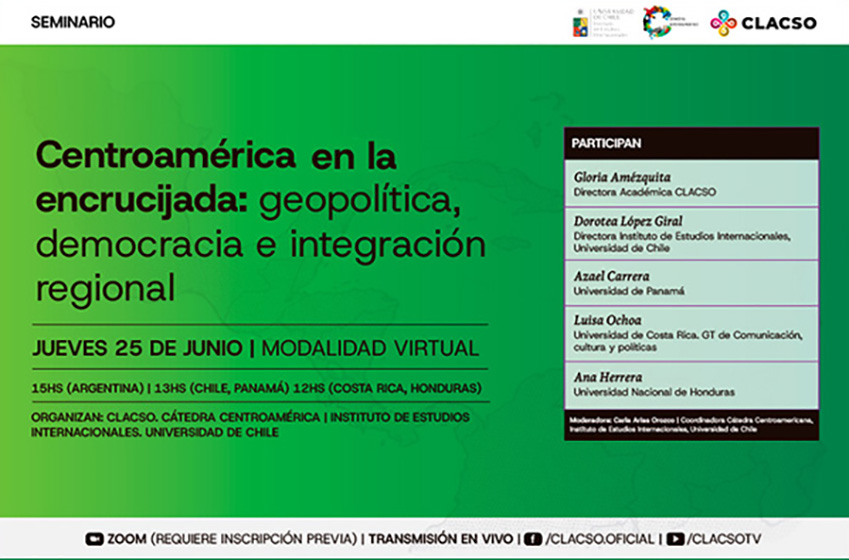
On Thursday, June 25, CLACSO and the Central America Chair of the Institute of International Studies of the University of Chile organized the virtual seminar “ Central America at the crossroads: geopolitics, democracy and regional integration ”.
Participated:
Gloria Amézquita – Academic Director CLACSO
Dorothea López Giral – Director of the Institute of International Studies, University of Chile
Azael Carrera – University of Panama
Luisa Ochoa – University of Costa Rica. Working Group on Communication, Culture and Politics
Ana herrera – National University of Honduras
Moderated by: Carla Arias Orozco – Coordinator of the Central American Chair, Institute of International Studies, University of Chile
Central America is experiencing a moment of singular complexity, characterized by the confluence of structural fragility, geopolitical reconfiguration, and sustained pressures on its democratic institutions. The subregion, historically conditioned by its geographic location and by asymmetrical relations of political and economic dependence on the United States, now faces overlapping and mutually reinforcing critical processes, the understanding of which requires an approach that articulates diverse scales of analysis.
This seminar begins with the premise that approaches focused exclusively on domestic politics underestimate the weight of external conditions, while large-scale geopolitical analyses tend to homogenize a subregion whose internal heterogeneity is one of its most relevant characteristics. Addressing the cases of Honduras, Costa Rica, and Panama simultaneously responds precisely to the need to articulate both dimensions: identifying common structural determinants while also accounting for distinct national trajectories.
Overlaid on this structural scenario is a geopolitical factor of growing importance. The Trump administration has intensified the "backyard" rhetoric, exerting direct pressure on Central American governments regarding migration, security, and alignment with Chinese influence. For the Northern Triangle countries, historically the object of US strategic interest, this pressure is not new in its nature, but rather in its form: it combines migration conditions, tariff threats, and explicit signals of distrust toward governments that have attempted to diversify their external ties. The decisions these states make in the coming years—regarding foreign investment, relations with Beijing, and institutional reforms—will depend as much on their internal needs as on their ability to negotiate in a progressively polarized hemispheric environment.
The Northern Triangle—and Honduras as a case study for the seminar—clearly illustrates the limitations of peripheral development in the isthmus. While differences exist among the countries that comprise it, their open, dependent, and structurally weak economies combine high levels of debt, unemployment, and social exclusion, and in some cases, the persistent presence of drug trafficking and organized violence—phenomena that erode both state institutions and social cohesion. Their economic policy decisions are conditioned by the urgent need to generate employment and improve the conditions of historically marginalized populations, in contexts where the margins for internal action are narrow and efforts to reverse the situation remain isolated. Given this scenario, strengthening regional integration is presented as an alternative that could broaden these margins and contribute, gradually, to reducing the structural dependency that has historically limited the autonomy of these states. Honduras is a revealing case of how institutional weakness, the penetration of drug trafficking into politics, and structural dependence on the United States combine to produce a state that operates, in practice, as a space of dispute between national and international actors with their own agendas.
Costa Rica offers a different perspective. A historical benchmark for democratic stability in the region, its current process of political fragmentation, fiscal deterioration, and erosion of institutional trust constitutes a warning sign that transcends its borders and raises questions about the sustainability of models that were assumed to be consolidated. Panama, for its part, occupies a unique position in the international system: the interoceanic canal makes the country a hub of Sino-American competition, with geopolitical implications that exceed its national scale and affect the entire subregion.
The Institute of International Studies of the University of Chile, through the Central America Chair and in collaboration with CLACSO, proposes this seminar within the framework of its commitment to the production and dissemination of knowledge about Latin America from a critical and plural perspective, which dialogues with the realities of the global south and contributes to the consolidation of epistemic communities capable of interpreting the region in its own terms.
Objective: To analyze the main scenarios of political, economic and institutional transformation that Central America faces in the context of the current global geopolitical reconfiguration, based on the comparative examination of three national cases —Honduras, Costa Rica and Panama— that illustrate, from complementary angles, the tensions between structural dependence, democratic erosion and dispute for regional influence between the United States and China.
Specific objectives:
● Examine the nature and scope of US interests in Central America under the Trump 2.0 administration, and the possible implications for the region, with particular attention to the mechanisms of migratory pressure, security cooperation and political conditionality on the governments of the Northern Triangle.
● Identify the endogenous and exogenous factors that explain the weakening of the rule of law and the reconfiguration of the Costa Rican political system, historically considered a case of democratic exception in the subregion.
● Evaluate the role of the Panama Canal as the axis of the China-United States competition in the isthmus and its implications for Panamanian sovereignty and the geopolitical stability of the entire subregion.
● To contribute to the production of specialized knowledge about Central America from a critical perspective situated in the global south, within the framework of the collaboration of CLACLSO and the academic activities of the Central America Chair of the Institute of International Studies of the University of Chile.

