
José Pepe Mujica Open Chair

An open political training proposal to reflect on the challenges of democracy in Latin America and the Caribbean together with international experts.
Home: April 2026
Virtual format with bi-weekly meetings
Live one-hour classes, from April to September
Free participation with prior registration
Organized by: Fundación Siembra , Proyecto Faro Democrático and CLACSO
The José "Pepe" Mujica Chair emerged as a joint initiative between the Siembra Foundation , the Democratic Lighthouse Project , and CLACSO . It aims to be a regional benchmark for democratic reflection, critical thinking, and the collective construction of political meaning. The program seeks to connect academic knowledge with popular and political experiences, strengthening the reflective capacity of diverse social actors in Uruguay and Latin America.
This space is inspired by the figure of Mujica, not only as a global political reference, but as a social educator who embodies a human and austere ethic of understanding power.
The chair is based on a situated and sensitive epistemology, centered on dignity, social justice, and everyday life. In a context of local and regional democratic risks, it aims to question and shed light on the ongoing search for emancipatory solutions.
- Humanistic Reflection: To promote a deep debate on the challenges of democracy in Latin America from a political and humanist perspective.
- Dialogue of Knowledge: To articulate academic critical thinking with popular sensibility and practical political experience.
- Subject Formation: To contribute to the training of new leaders and social actors with a cross-cutting gender and generational perspective.
- Knowledge Production: Develop an academic essay contest that systematizes the reflections that arose in the course.
The program is organized around the following thematic areas:
- Global dynamicsAnalysis of the international and regional scenario.
- Right-wing politics and democraciesChallenges of current democratic systems.
- Feminisms and subjectivity: Gender perspective in political construction.
- Popular sectorss: Representation and social organization.
- Ecology and indigenous peoplesEnvironmental justice and ancestral knowledge.
- ReligionThe role of faith in social and political ethics.
- Democracy and participationLimits and renewal of governance.
- Solidarity economiesEconomic alternatives oriented towards the common good.
- Regional integrationCulture of peace and South-South dialogue.
- Roberto López Salazar (El Salvador) - April 22. Focus: South-South Dialogue and conflict resolution.
A sociologist with postgraduate studies in Latin American philosophy, he is a tenured professor in the Faculty of Social Sciences and Humanities at the Central American University José Simeón Cañas, with over two decades of experience in teaching and research. He currently serves as director of the UCA's Human Rights Institute (IDHUCA) and is a member of the Steering Committee of the Latin American Council of Social Sciences, representing Central America. His main areas of expertise include democracy and citizen participation, territorial development and migration dynamics, as well as human rights, violence prevention, and public policy.
- Carolina Jiménez (Colombia) - May 6. Theme: International dialogue and culture of peace
Political scientist and PhD in Latin American Studies, former Vice-Rector (June 2024-February 2026) of the National University of Colombia. Associate professor and researcher in the Department of Political Science.
Among his lines of research are: Geopolitics, geographies of power, social struggles, peace, Latin American political thought and political processes in Latin America and the Caribbean.
- Juan Grabois (Argentina) - May 21. Focus: Popular sectors
Lawyer, writer, and social justice activist. Leader of Patria Grande and Argentina Humana. Founder of the Movement of Excluded Workers. Currently serves as a national deputy within the Fuerza Patria bloc.
- René Ramirez (Ecuador) - May 27. Theme: Common good and community.
Economist, PhD in sociology of inequality, University of Coimbra, Portugal. Professor at the National University of the Arts, University of Buenos Aires, Argentina, and visiting researcher at the "Matters of Activity" Cluster, Humboldt University, Germany.
- Amparo Marroquín (El Salvador) - June 3. Theme: Culture and politics.
Professor in the Department of Communication and Culture at the Central American University José Simeón Cañas (UCA) since 1997. She has specialized in cultural studies (narratives of memory, migration, and violence in El Salvador) and communication studies from a Latin American perspective (narratives of political communication and media literacy). She has been a visiting professor at various universities in the region.
- Steven Forti (Italy) - June 17. Axis: Right-wing and Democracies.
He holds a doctorate in History and is a tenured professor at the Autonomous University of Barcelona. He specializes in the study of fascism, populism, nationalism, and the far right in contemporary times, with a particular emphasis on comparative and transnational history. His latest books are "Far Right 2.0" (Siglo XXI, 2025) and "Democracies in Extinction" (Akal, 2024).
- Luciana Peker (Argentina) - July 9. Theme: Feminisms: the popular, politics and time.
Luciana Peker is a renowned Argentine journalist and writer specializing in gender and human rights, with over two decades of experience as a leading figure in Latin American feminism. Her global impact was confirmed in 2024 when CNN included her among the 30 most important defenders of women's and LGBTQ+ rights worldwide. She has also been recognized by Amnesty International for her work in the feminist struggle. She is the author of the books *For a Feminism of Pleasure*, *The Daughters' Revolution*, and *Sexteame: Love and Sex in the Era of Desiring Women*.
- Frei Betto (Brazil) - July 22. Axis: Religion and the role of faith in social and political ethics.
Dominican friar, liberation theologian and Brazilian writer, internationally recognized for his social commitment.
He was a special advisor to Lula da Silva's first government, where he coordinated the "Zero Hunger" program, and is the author of more than sixty books on spirituality, politics, and pedagogy.
His work stands out for bridging the gap between Christian thought and political activism, always focusing on the defense of human rights and justice for the working class. His online bookstore is www.freibetto.org
- Denise Merklen (Uruguay/France) - August 5. Theme: Democracy and participation.
Sociologist, professor and researcher at the Sorbonne in Paris. He is the director of the Institut des Hautes Études de l'Amérique Latine.
A specialist in forms of popular politics, he has conducted research in Argentina, China, France, Haiti, Senegal, and Uruguay. He is the author of numerous books, including: The Indispensables: Sociology of Militant Worlds (2025), Behind the Poverty Line: Life in the Poor Neighborhoods of Montevideo (2023), The Dictatorship, from France (2022), Libraries in Flames (2016), José Mujica's Uruguay (2014), and Poor Citizens (2005).
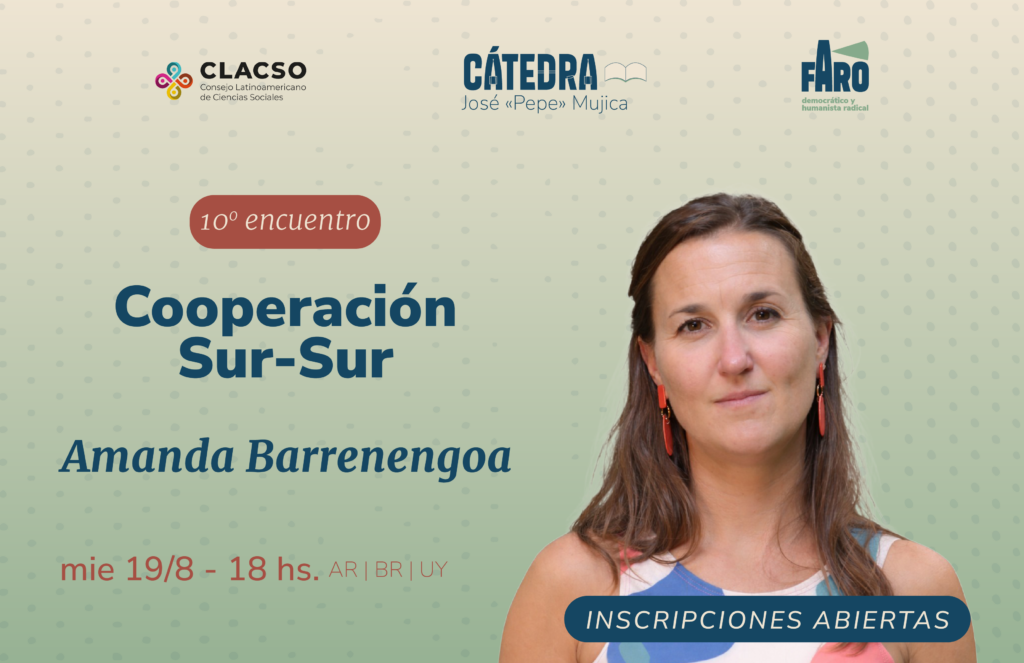
- Amanda Barrenengoa (Argentina) - August 19. Theme: South-South Cooperation.
A Doctor of Social Sciences, she is a researcher at CONICET and a professor at the National University of La Plata (UNLP), Argentina. Her academic work specializes in regional integration processes in South America, with a particular focus on the multi-scalar approach to Brazilian foreign policy. Currently, her research centers on the relationship between China and Latin America, analyzing recent transformations of the regional map and the development of physical infrastructure.
- Juan Gabriel Tokatlian (Argentina) - September 2. Theme: Global Dynamics.
One of the most influential voices in the study of foreign policy in the region. He holds a PhD in International Relations from Johns Hopkins SAIS and co-founded the Center for International Studies at the University of the Andes in Colombia, where he lived for nearly two decades. His research focuses on global power dynamics, the relationship between Latin America and the United States, and the theoretical development of his discipline.
First meeting | April 22, 2026: South-South Dialogue and conflict resolution with Roberto López (El Salvador)
Second meeting | May 06, 2026: Regional integration and culture of peace with Carolina Jiménez (Colombia)
Third meeting | May 21, 2026: Popular sectors, community and hope with Juan Grabois (Argentina)
Fourth meeting | May 28, 2026: Common good and community with René Ramírez (Ecuador)
Fifth meeting | June 03, 2026: Politics and culture with Amparo Marroquín (El Salvador)
Sixth meeting | June 17, 2026: Right-wing politics and democracies with Steven Forti
Seventh meeting | July 09, 2026: Feminist collective ethics: the popular, politics and time with Luciana Peker
Eighth meeting | July 22, 2026: Religion, spirituality and politics with Frei Betto
Ninth meeting | August 05, 2026: Democracy and participation with Denis Merklen
Tenth meeting | August 19, 2026: South-South Cooperation with Amanda Barrenengoa
Inquiries: [mail protected]

