Open Lecture: The Right to Education and Work in Recovered Companies and Social Organizations in Latin America
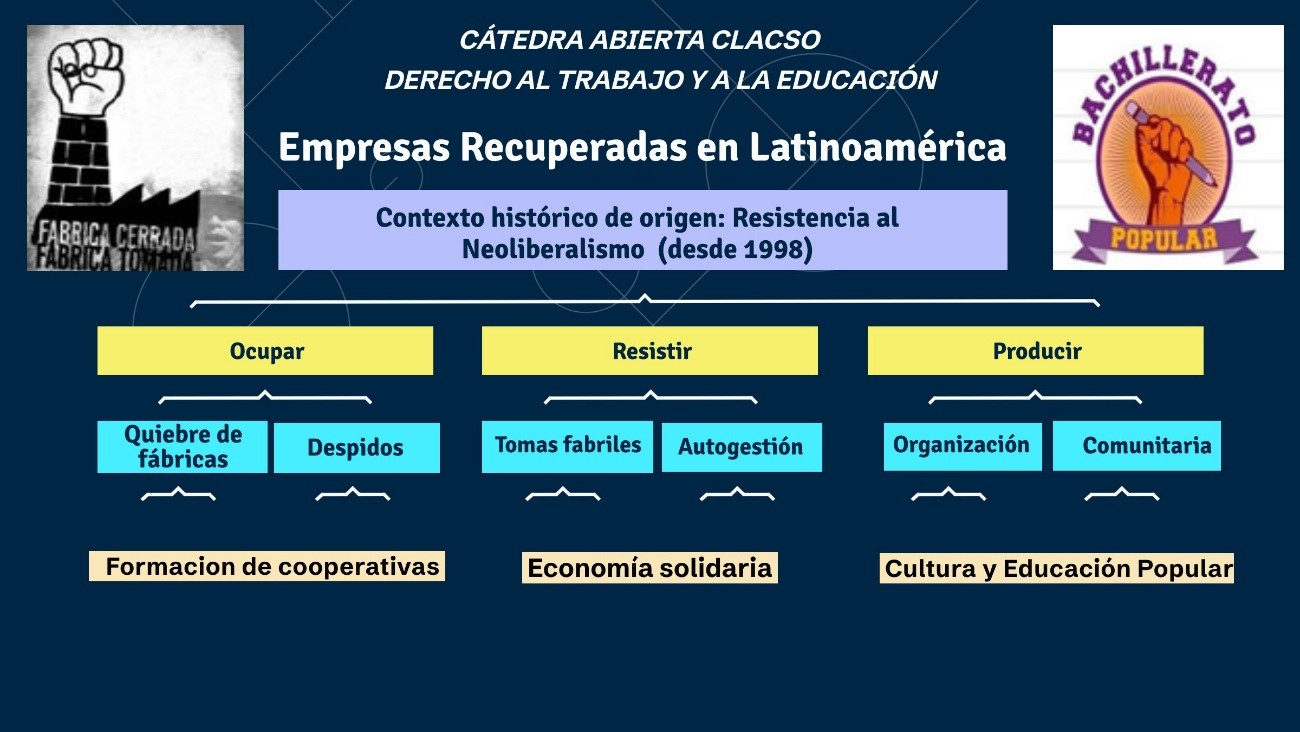
This open lecture It presents and analyzes different historical processes, key concepts, and collective actions related to the right to work and education carried out by the National Movement of Recovered Companies of Argentina (MNER-A) and their proposals for integration with Latin American experiences. Worker-recuperated enterprises represent one of the most dynamic expressions of the social movement in the region and are largely comprised of an amalgamation of cooperatives from the world of work, in conjunction with teaching and research groups from public universities. In Argentina alone, they constitute more than 400 worker-managed factories, with significant examples in Brazil, Uruguay, and Mexico, among other countries. Since their origins in 1998, they have championed work as a fundamental right, under the slogan "occupy, produce, resist," in addition to building an alternative culture and education. Therefore, the demand for the right to education through the creation of community-run high schools for young and adult workers has become one of their greatest demands and achievements in this area.
The mutual articulation between Latin American experiences is reflected in important gatherings of worker-recuperated enterprises (2005 and 2009), as well as in the articulations and mutual influences carried out with numerous social and labor organizations in the region, strengthening and sharing influences that endure to this day. The Freirean and Falsbordian perspectives of popular education and participatory action research, respectively, became frameworks for the articulations carried out by worker-recuperated enterprises together with groups of teachers and researchers. Their objective, according to the factory representatives, is “to collectively build actions in order to organize and fight for the right to public and popular education, as well as to become protagonists in the training of workers from cooperative, solidarity-based, and emancipatory positions” (MNER, 2005).
Session 1: Worker-recuperated enterprises, the right to education and work in Latin America
They coordinate and participate in:
- Marina Ampudia (RIOSAL-MNER-UBA, Argentina),
- Erica Bellini (MNER-RIOSAL-UNR, Argentina);
- Flavio Chedid (Interdisciplinary Nucleus for Social Development (NIDO), Brazil);
- Eduardo Murua (MNER, Argentina)
In this first session, we will develop key ideas related to the “Right to education and work in social organizations in Latin America: worker-recuperated enterprises.” To do so, we will examine studies on “historical contexts, key concepts, and alternative experiences to neoliberal capitalism.” We will highlight ideas relevant to this process, such as “self-management, assemblies and social control by workers, and popular education” (Svampa, 2010).
To conclude this first presentation, we consider it necessary to identify the regional projection of these experiences by identifying the Latin American influences and articulations, especially reflected in regional meetings, such as the “1st meeting of Latin American recovered companies (2005)”; the “2nd meeting of Latin American recovered companies (2009)”, and finally, the current panorama of these social movements (2025).
To reflect
What is the historical context of worker-recuperated enterprises in Latin America? What differences can be observed between cooperative models and other forms of worker management? How and why did some companies propose guaranteeing the right to education for their communities? What role did worker self-management and control play in this cooperative and productive process?
Suggested bibliography
- Chedid Henriques, Flavio et al (2013). Companies recovered by non-Brazilian workersMultifoco Publishing: https://www.academia.edu/35276212/Empresas_recuperadas_por_trabalhadores_no_Brasil
- Santos Araujo, Fernanda et al (2019). Dialectics of self-management in companies recovered by workers in Brazil, Ed. Lutas anticapital, Marília –SP. https://base.socioeco.org/docs/2019_araujo_dialeticaautogestaoert_12mar_final.pdf
- Bustos, Gisela (2021). Occupy, resist and produce rights. Ed. Ciccus: https://www.ciccus.org.ar/wp-content/uploads/2022/02/Empresas-Recuperadas-de-Argentinas-Libro-digital.pdf
- Ampudia, Marina and Elisalde, Roberto (2020)“Workers and youth and adult education in Argentina. Popular pedagogical strategies in the world of work.” In Inés Pérez Wilke, Marina Ampudia; Alfonso Torres Carrillo and Diego Cabezas (eds.) The popular production of knowledge. Latin American Keys. Riosal Editions,: https://biblioteca-repositorio.clacso.edu.ar/bitstream/CLACSO/169773/1/La-produccion-popular-del-saber.pdf
Music : Fernando Dunan
2 session: Worker-recuperated businesses and community-run high schools. Latin American influences
They coordinate:
- Laura Fiorillo (UBA-MNER-RIOSAL);
- Mike Ceriani de Oliveira Gomes (UNESP-Brazil-RIOSAL)
- Roberto Elisalde (UBA-MNER-RIOSAL).
Participants:
- Banesa Estigarribia (EITEC Popular High School, Argentina);
- Marcelo López (EITEC, Argentina, a recovered company);
- Facundo Bramuel (Mastercheese, Argentina, a recovered company);
- Ellen Felicio dos Santos (UNESP, Brazil)
In this second meeting, we will analyze the strategies that gave rise to the creation of public-popular schools within Latin American social movements since the late 20th century, especially after 2000 in worker-recuperated enterprises. We understand that this process was marked by a conceptual and experiential redefinition of popular education, based on the experience of Paulo Freire and his team at the São Paulo State Education Secretariat (PT) (1989-91) and on the creation, in much of the region, of educational institutions (schools, high schools, intercultural universities) that challenged and/or articulated with the public sector. The regional influence of the Landless Workers' Movement (MST) and the development of numerous popular schools were also key in this context.
In this session, we will also hear significant and valuable testimonies. On the one hand, from professors and researchers at UNESP-Brazil, speaking about the value and regional influence of the MST's educational field; and on the other hand, testimonies and experiences from teachers in community-run high schools and workers from worker-recuperated enterprises in Argentina.
To reflect
How did the connection between social movements/worker-recuperated enterprises and popular schools develop in Latin America? Why are popular high schools considered by their participants to be public-popular schools? How and why were they influenced by the educational experiences of the MST in Brazil?
Suggested bibliography
- Ampudia, Marina and Elisalde, Roberto (2015). “Popular High Schools in Argentina: pedagogical movement, social cartography and popular education”, Polifonías MagazineNational University of Luján, Year IV, No. 7: https://ri.unlu.edu.ar/xmlui/bitstream/handle/rediunlu/2232/7%20-%20Ampudia.pdf?sequence=1&isAllowed=y
- Moñino, Ignacio (2022). “The popular high school movement and its interpellation in the EDJA: achievements, current situation and perspectives”, in Meeting of Knowledge Magazine, No. 10, Published by Ediciones de la FFyL (UBA): http://revistas.filo.uba.ar/index.php/encuentrodesaberes/article/viewFile/3925/2620
- Dal Ri, Neusa Maria and Giraldez Vieitez, Candido (2010). “Democratic management in public schools: an educational experience of MST” Portuguese Education Magazine, vol. 23, no. 1, pp. 55-80 Universidade do Minho Braga, Portugal: https://www.redalyc.org/pdf/374/37417089004.pdf
- Video EITEC recovered metallurgical company and popular high school (2023): https://youtu.be/vuHh_Tt9qi4?si=CtJ0htaVXeOuHywH
Music : Fernando Dunan
Session 3 – Social Space, Social Cartography, Participatory Research and Popular Education: The Colombian Experience
They coordinate and participate in:
- Marina Ampudia (RIOSAL-MNER-UBA Argentina)
- Milagros Molina (RIOSAL-UNCUYO, Argentina)
- Zulma Toro (Fals Borda School - RIOSAL, Colombia)
In this third meeting, we presented a conceptual and practical framework that was and continues to be a relevant part of building popular education experiences in worker-recuperated enterprises. We explored social space, territorialities, social cartography, and popular education in the construction of schools for young people and adults (EDJA), while also addressing topics such as the use of cartographic tools as a process for producing and circulating collective knowledge, grounded in the active participation of social movements in collective mapping. The school and the factory are viewed as spaces of resistance and the construction of new territorialities, where popular education and participatory research are present as fields of praxis. Research is understood as a political practice, especially participatory action research, a field championed in Colombia by Orlando Fals Borda.
To reflect
How are social mapping and popular education linked in the creation of community-run high schools for young people and adults? How can a worker-recuperated factory become a "living classroom"? How are territorialities constructed in self-management processes?
Suggested bibliography
- Torres Carrillo, Alfonso (2022). Contribution of Freire's thought to participatory methodologiesCLACSO TV: https://www.youtube.com/watch?v=FmjDUPbAzrw
- Mancano Fernandez, Bernardo (2005). Socio-territorial movements and socio-spatial movements: Theoretical contribution for a geographical reading of sociais movements https://biblioteca.clacso.edu.ar/clacso/osal/20110312111042/34MFernandes.pdf
- Guzmán, Nataly and Triana, Diana (2019). “Julieta Paredes, Weaving Community Feminism”Political Science Journal, v. 14, No. 28. https://dialnet.unirioja.es/descarga/articulo/7126935.pdfJulieta_Paredes_hilando_el_feminismo_comunitario
- Pautasso, María Ludmila and Pautasso, María José (2014). “Reinterpreting Cartography: Politics of Scale and Social Cartography. Collective Mapping in the Paulo Freire Popular High School for Young People and Adults.” XI Argentine Congress of Social AnthropologyRosario, 2014. https://www.aacademica.org/000-081/138
- “Orlando Fals Borda, Participatory Action Research”, Video National Pedagogical University:https://www.youtube.com/watch?v=op6qVGOGinU&t=1011s
Music : Fernando Dunan
4 session: State, right to work and right to education
They coordinate:
- Marina Ampudia (RIOSAL-MNER/Education-UBA, Argentina);
- María Angelica Guzmán Hernández (SNTE in Struggle; RIOSAL, Mexico);
- Erica Bellini (MNER/Education-RIOSAL, Argentina);
- Roberto Elisalde (RIOSAL-MNER/Education-UBA, Argentina)
Participants:
- Placido Peñarrieta (Chilavert-MNER Cooperative, Argentina);
- Martin Acri (UBA-PIMSEP-RIOSAL, Argentina);
- Nacho Moñino (Chilavert-UBA-RIOSAL Popular High School, Argentina)
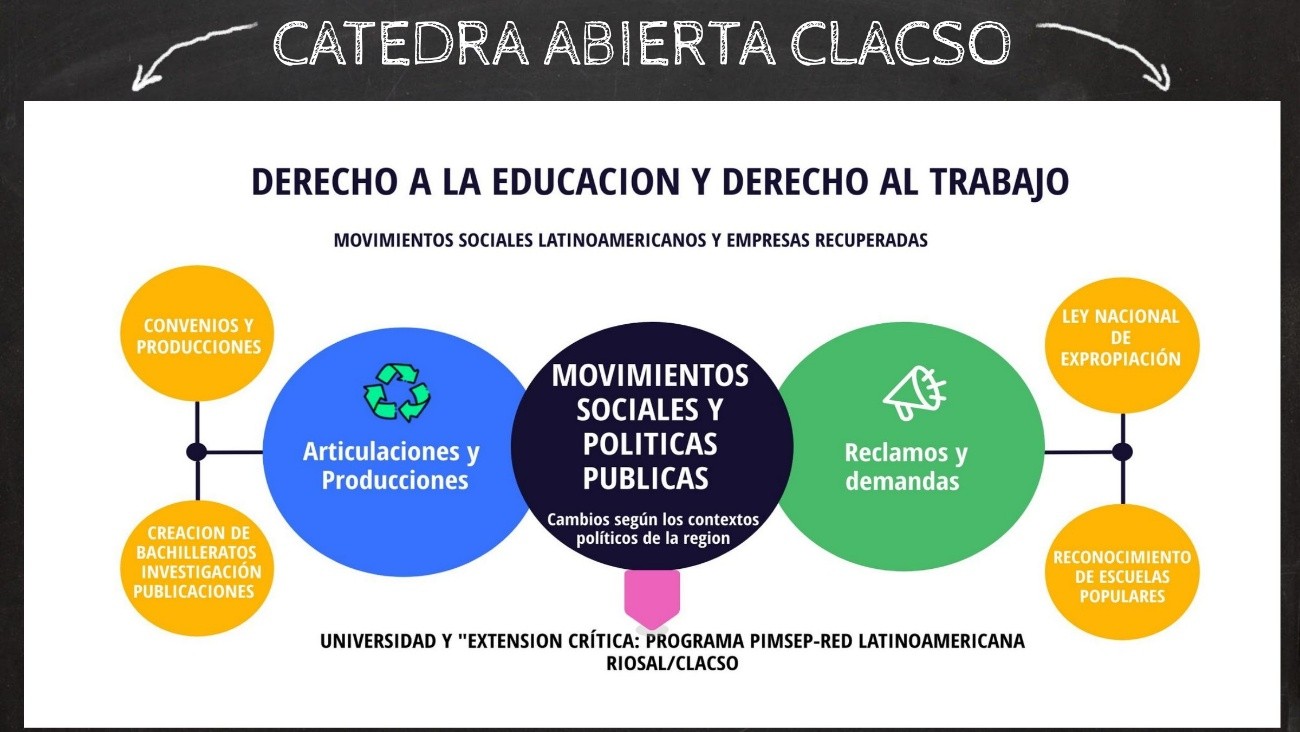
The relationship between public policy and social movements has been and continues to be a constitutive part of the historical process presented, in some cases promoting and addressing the demands of these groups, and in others, expressing unmet conflicts and grievances. Therefore, in this session, we will focus on analyzing a topic relevant to our course: the State, the right to education, worker-recuperated enterprises, social/labor organizations, and their relationship with public policy in Latin America . We will present a current overview of the debates, conflicts, and existing connections according to the different political and cultural contexts and stages of the region. Within this thematic framework, we consider it pertinent to analyze and characterize aspects that link the State to the struggle for the right to work and education, the worker-recuperated enterprises, and other influential social movements, especially in their relationships and actions with public universities, for example, within the framework of what is known as "critical Latin American outreach."
As a synthesis of the central theme of the course "The Right to Work and Education in Social Movements," we will highlight the case of community-run high schools in worker-recuperated enterprises, emphasizing the relationships between universities, factories, community schools, and the State. In this way, we will present and describe the network of connections between programs, organizations, and regional territories, focusing on the Latin American Research, Teaching, and Social Articulation Program: "Social Movements and Popular Education in Latin America" (PIMSEP), based at the University of Buenos Aires and a driving force behind the RIOSAL Network, associated with CLACSO. From this perspective, we will be able to explore, in a comprehensive way, the experience of social movements and popular education in Latin America, paying attention to the contributions and actions undertaken by worker-recuperated enterprises and their struggle for the right to popular education and the self-managed recovery of labor.
To reflect
How would you characterize the relationship between social movements and public policies? What was the case of worker-recuperated enterprises and their struggle to defend the right to work and education? What connections exist between the Argentine experience and the rest of Latin America through the RIOSAL/CLACSO Network, worker-recuperated enterprises, and social and labor organizations?
Suggested bibliography
- Humberto Tommasino (2021). “Critical, banking or grassroots extension: models of university extension based on the thought of Paulo Freire” in Meeting of Knowledge Magazine No. 10, Published by Ediciones de la FFyL-UBA. (UBA): http://revistas.filo.uba.ar/index.php/encuentrodesaberes/article/view/3927/2622
- Roberto Elisalde (2022).Paulo Freire: From the Ministry of Education to Latin American Popular Public Schools (1989-2020). Pedagogy and Knowledge Journal No. 56, National Pedagogical University, Faculty of Education, Bogotá, Colombia.
https://revistas.upn.edu.co/index.php/PYS/article/view/13086/10470 - PIMSEP: Research and Teaching Program: Social Movements and Popular Education (FFyL-UBA): https://seube.filo.uba.ar/programa-movimientos-sociales-y-educaci%C3%B3n-popular-pimsep-riosal
MusicFernando Dunan
Diffusion kit