
Capitalocene, Neo-extractivism and Cosmopolitics in Latin American Territories
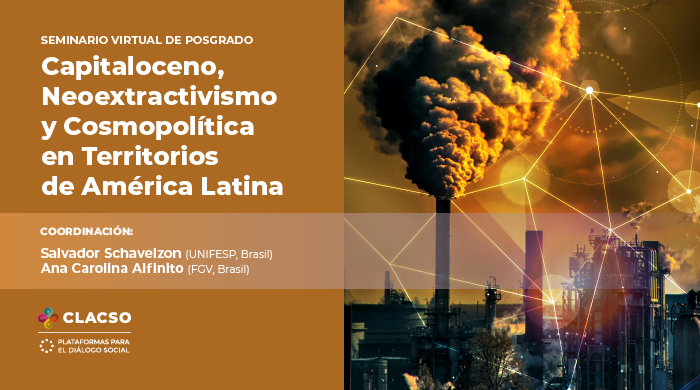
Seminar 2507
Coordination: Salvador Schavelzon (Universidade Federal de São Paulo – UNIFESP, Brazil) and Ana Carolina Alfinito (Fundação Getúlio Vargas – FGV, Brazil)
Start date : 26/03/2025 | Registration : 10/12/2024 to 25/03/2025
Workload: 10 weeks – 90 hours.
The course aims to explore the relationships between the concept of the Capitalocene and the new and profound forms of extractivism in Latin America, proposing an investigation into the political and cosmopolitical horizons of the struggles that defend territories of life against the advance of extractivism.
The program is organized into three parts: the first will be dedicated to presenting the literature and debates surrounding contemporary diagnoses such as the Anthropocene and the Capitalocene, discussing their relationship to neo-extractivism and territorial conflicts in Latin America. We will address concepts from various fields, focusing on anthropology, law, and the social sciences, including perspectives from Latin America and Marxism. The second part will focus on developing, together with students, a map of the conflicts arising from resistance against the advance of extractivism in territories, exploring their dimensions and variations, and paying attention to how these struggles intertwine the human and the more-than-human in political action and in the worlds they aim to shape. The third and final part will focus on a critical discussion of some of the paths proposed at the local, national, and global levels to address the ecological crisis of our time. The course will consist of synchronous classes, asynchronous classes, and conversations with guests.
Over the past few decades, academics, social movements, and governments have become increasingly concerned about the deterioration of living conditions on Earth, including the progressive pollution of water resources, the massive loss of biodiversity, and the destruction of territories. Since the 1990s, climate science has pointed to long-term changes in temperature and climate patterns caused by anthropogenic greenhouse gas emissions. More recently, Earth scientists argue that humankind has become a geological force, unleashing such structural changes in the Earth's constitution that the period of relative stability in which human civilizations were able to develop—the Holocene—has already been shortened by the emergence of a new geological epoch, called the Anthropocene.
While these diagnoses have generated important debates in science and society, the dominant ways of describing contemporary socio-ecological crises often ignore the plurality of collective ways of perceiving, experiencing, and navigating these crises. They ignore that there is not one crisis, but many, and that these are an inherent part of the global capitalist production system. The urgency created by the announcement of the likely climate catastrophe has even accelerated the pace and reduced the truly political—or rather, cosmopolitical—scope of these crises and the transformations they demand. It has also silenced situated voices and experiences, as well as political proposals that question the constitutive practices and premises of modernity, such as the notions of progress, civilization, and development.
This course aims to recover and discuss Latin American experiences and perspectives on current socio-ecological crises. In dialogue with international debates on climate change and the Anthropocene, we seek to explore and discuss Indigenous, feminist, peasant, and peripheral experiences and epistemologies that address the many "ends of the world" that have emerged in recent centuries, as well as the approaches that different political actors have proposed to confront the ecological challenges of our time.
In this context, it becomes especially important to discuss collective experiences and projects that emerge from territories, such as those related to autonomy and self-determination, plurinationality, and the creation of space for what Marisol de la Cadena calls the "uncommon": those ways of existing, making the world, and doing politics that escape the modern operation of conquest and separation between nature and culture. What do these experiences, epistemologies, and ways of existing have to do with global debates and agendas on the Anthropocene and climate change? How can they contribute to qualifying, expanding, and transforming these debates? We explore these questions based on concrete experiences of resistance and the decolonial ecologies of Abya Yala.
GENERAL PURPOSE
To enable students to develop critical reading skills and the ability to engage with key contemporary debates addressing the dimensions and manifestations of the socio-ecological crises that characterize our times. We seek to connect these discussions with ongoing political processes in Latin America. To this end, we will examine the foundational debates, social conflicts, and struggles where nature, the relationship between society and the environment, and development models emerge and clash with conventional definitions of liberal politics.
-
Part 1: Readings from the Anthropocene, Capitalocene, Neo-extractivism and Global Alliances and Multi-species Assemblies of Gaia-Ship.
-
Part 2: Mapping Latin American territorial conflicts.
- Part 3: Discussion of alternatives, problems of solutions within capitalism.
ALFINITO, AC, SCHAVELZON, S., & MUNDURUKU, AK (2024). The Munduruku cosmopolitical direito as a legal practice against the Anthropocene. Direito E Práxis Magazine, 15(3), 1–37. Retrieved from https://www.e-publicacoes.uerj.br/revistaceaju/article/view/83710
ANGUS, IAN Confronting the Anthropocene . São Paulo: Boitempo, 2023.
CHAKRABARTY, Dipesh. The Humanities in the Anthropocene: the Crisis for an Enduring Kantian Fable. New Literary History. 47, 2 e 3 (September 2016): 377-397.
CURY, JF, MARINHO, M FRICKMANN, CE YOUNG, L; CAIADO COUTO, M ALVARENGA JUNIOR Green new deal as a post-pandemic development strategy: lições da experiência tempo do mundo magazine | RTM | No. 26 | aug. 2021 https://portalantigo.ipea.gov.br/agencia/images/stories/PDFs/rtm/211005_rtm_26_art4.pdf
DE LA CADENA, Marisol. Indigenous cosmopolitics in the Andes: reflexões conceituais para além da “politics”. Maloca: Revista de Estudos Indígenas, Campinas, SP, v. 2, p. e019011, 2020. DOI: 10.20396/maloca.v2i.13404. Available at: https://econtents.bc.unicamp.br/inpec/index.php/maloca/article/view/13404. Access em: 9 dez. 2024
ESCOBAR, A. Encountering Development: The Making and Unmaking of the Third World. Princeton NJ: Princeton University Press, 1995.
FERDINAND, Malcom. A decolonial ecology: Thinking from the Caribbean world. São Paulo: Ubu Editora, 2022.
GUARANI, Jera. Tornar-se selvagem. PISEAGRAM, Belo Horizonte, n. 14, p. 12-19, July 2020. Available at: https://piseagrama.org/artigos/tornar-se-selvagem/
GUDYNAS, Eduardo. Compensatory State and New Extractivisms: The Ambivalences of South American Progressivism. Nueva Sociedad, Buenos Aires, n, 237, p. 128-146, January-Feb.2012.
HARAWAY, Donna. Anthropocene, capitalocene, plantationocene, Chthulucene: fazendo parentes. ClimaCom Scientific Culture - research, journalism and art, Year 3 - N. 5, April 2016, p. 139-146.
KOPENAWA, D. & ALBERT, B. La Chute du ciel. Paris: Terre Humaine / plon, 2010.
LOURES, RSP, & MOREIRA, FC (2022). The rescue of the urns: the historical mourning world against the death of its sacred places. Antropolitics - Revista Contemporânea De Antropologia , 54 (1). https://doi.org/10.22409/antropolitica2022.i1.a45853
LOWY, Michael O QUE É O ECOSSOCIALISM . São Paulo, Cortez Ed, 2014.
MACHADO ARAÓZ, Horacio. Extractivism and the roots of the “Anthropocene”. Regimes of sensitivity, climate regime and rights of nature. Revista Direito e Práxis, Rio de Janeiro, 14. (1), 2023.
MARTÍNEZ ALIER, Joan. Political ecology of extractivism and socio-environmental justice. Interdisciplina 3, no. 7 (2015): 57-73.
Beyond Green Colonialism: Global Justice and the Geopolitics of Ecosocial Transitions / Miriam Lang ... [et al.] ; edited by Miriam Lang ; Breno Bringel ; Mary Ann Manahan. - 1st ed. - Autonomous City of Buenos Aires : CLACSO, 2023.
MENDES, J. (2020). Geologia da Humanidade by Paul Crutzen. Anthropocenica. Revista De Estudos Do Antropocene E Ecocrítica, 1.
MIGNOLO, WD Colonialidade: the darkest side of modernity. Brazilian Journal of Social Sciences, v. 32, no. 94, p. e329402, 2017.
MOORE, Jason. The emergence of cheap nature. In: MOORE, J. (org), Anthropocene ou capitalocene? Nature, history and crisis of capitalism. São Paulo, Elefante, 2022.
PEREZ, ALFONS A Green New Deal for whom? Open Democracy.
PÉREZ, Mercedes Solá R-existências dos camponeses/as do que leaf é Suape: territorial justice, pós-desenvolvimento e decolonialidade pela vida. Geography Thesis. Federal University of Pará.
PORTO-GONÇALVES, CW Of knowledge and territories: diversity and emancipation from the Latin American experience. GEOgraphia, v. 8, no. 16, 4 Feb. 2010.
SAITO, Kohei Or Ecosocialism of Karl Marx . São Paulo: Boitempo, 2021.
SCHAVELZON, Salvador. Plurinationality and Living Well/Good Living: Two Concepts Seen from Post-Constitutional Bolivia and Ecuador. Argentina: Abya-Yala, 2015. http://biblioteca.clacso.edu.ar/clacso/se/20160202103454/Plurinacionalidad.pdf
SVAMPA, Maristella (2013). Commodity Consensus and Valuation Languages in Latin America. Journal. Nueva Sociedad. No. 244.
TSING, Anna L. O cogumelo no fim do mundo. On the possibility of life in the ruins of capitalism. São Paulo: n-1, 2022.
VIJAY KOLINJIVADI. Why a 'Green New Deal' must be decolonial https://www.aljazeera.com/opinions/2019/12/7/why-a-green-new-deal-must-be-decolonial
ZALASIEWICZ, Jan; WATERS, Colin; ELLIS, Erle, et al. The Anthropocene: Comparing its meaning in Geology (Chronostratigraphy) with conceptual approaches emerging in other disciplines. Earth's Future, no. 9, 2021.
|
Discount for one payment until 19/03 |
In one payment after 19/03 |
|
|
CM Plenos |
$85 |
$150 |
|
CM Associates |
$85 |
$150 |
|
No link |
$105 |
$190 |
FAQ
The basic requirements for taking a seminar are:
- Availability of at least 4 hours per week to dedicate to the seminar course.
- Internet access.
- Reasonable handling of communication and computer tools.
- Language proficiency in the language in which the course will be taught. The official languages are Spanish and Portuguese.
The seminars last 10 weeks, plus the completion of a final project. A total of 90 hours of dedication will be credited.
A course consists of twelve classes, each accompanied by required reading bibliography, supplementary bibliography, discussion forums and training activities proposed by the teaching team, partial deliveries and a final project.
The course is online and asynchronous. Some instructors may propose synchronous activities. In those cases, the time and date will be agreed upon beforehand between the teaching team and the students to ensure everyone's participation.
To pass the seminar, you must participate in at least 80% of the discussion forums and activities proposed by the teachers, have completed the scheduled partial deliveries, and pass the final work.
|
Discount for one payment until 19/03 |
In one payment after 19/03 |
|
|
CM Plenos |
$85 |
$150 |
|
CM Associates |
$85 |
$150 |
|
No link |
$105 |
$190 |
The possible payment methods are by credit card or bank transfer.
Inquiries: [email protected]

