
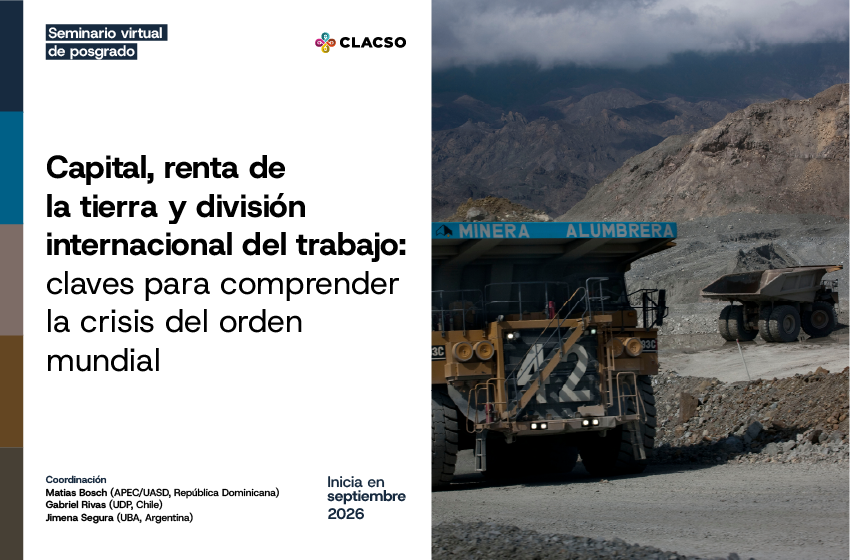
Capital, land rent and the international division of labor: keys to understanding the crisis of the world order
Seminar 2604
Coordination: Matías Bosch (APEC/UASD, Dominican Republic), Gabriel Rivas (UDP, Chile) and Jimena Segura (UBA, Argentina)
Teaching team: Javiera Rojas (UNGS/CONICET), Argentina, Gabriel Oyhantçabal (Udelar, Uruguay), Juan Kornblihtt (UNGS/CONICET, Argentina), Manuel Antonio Casique Herrera (UNQ, Argentina), Manuel Espro (UNGS/CONICET, Argentina), Emiliano Mussi (UNGS/CONICET, Argentina) and Enrique Tortós (EIDAES-UNSAM / BCIE).
Start date : 17/09/2026 | Registration : 5/06/2026 to 16/09/2026
Workload: 10 weeks – 90 hours.
In a global market undergoing political realignment in major economies, the question of Latin America and the Caribbean's place has once again become central. This seminar addresses this current issue by examining the actual course of capital accumulation, understood as a social relation with global reach. This entails avoiding two common pitfalls: approaches that fragment the problem into isolated variables—productivity, fiscal policy, international prices, or national “models”—and interpretations that disregard the analysis of concrete economic mediations and remain on a purely theoretical plane. From this perspective, the course articulates the foundations of political economy critique with a methodological reflection aimed at discussing how the process of capital accumulation can—and cannot—be empirically reconstructed. The seminar explores what it means to measure capital valorization and rent appropriation using sources such as national accounts, sectoral statistics, and comparative empirical studies, considering their scope and limitations.
Over ten weekly modules, this seminar will offer a critique of Latin American political economy through the analysis of various national cases. It is designed for graduate students, researchers, and public or social actors interested in critical analysis tools.
The relevance of this seminar lies in the fact that the contemporary restructuring of the global market—marked by geopolitical disputes, new productive and technological configurations, and tensions over strategic resources—reopens the question of Latin America and the Caribbean's place in the international division of labor. In the region, these processes manifest as transformations in the dynamics of accumulation, in the modes of surplus appropriation, and in the state interventions that govern social reproduction—interventions that are now markedly authoritarian. Within this context, it is crucial to have tools that allow us to discuss the region's "development" beyond fragmented perspectives that separate economics from politics or the national from the global.
The seminar aims to contribute to the debate on current regional affairs by developing rigorous methodological tools for analysis. Its starting point is capital as a global social relation, and its organizing hypothesis is that Latin American specificity is more clearly defined when analyzed through two fundamental mediations: the rate of profit and land rent (agricultural, oil, and mining), as well as their processes of appropriation. These two key determinants of capital accumulation will allow us to address, in an integrated manner, recurring problems in the regional debate—cycles of growth and crisis, international integration, disputes over resources, taxation, exchange rates, and wage trends.
From a methodological perspective, this proposal assumes that theoretical discussion must confront the challenges of empirical operationalization. In Latin America, much of the academic production and public debate oscillates between, on the one hand, measurements that privilege partial indicators (productivity, margins, return on investment) without questioning their conceptual assumptions, and, on the other hand, approaches that reject quantification altogether, considering it inevitably technocratic. This seminar seeks to overcome this false dilemma by critically examining what it means to measure social relations such as capital appreciation and rent appropriation using sources like national accounts, sectoral statistics, and comparative studies, considering their possibilities, limitations, and interpretive effects.
Due to its regional and comparative orientation, the course is framed within a South-South perspective: it promotes dialogue between heterogeneous national experiences and the discussion of recent research produced in and about Latin America and the Caribbean, with the aim of strengthening analytical capacities in both students and researchers, as well as in state and social agents interested in understanding the structural conditions of regional development.
GENERAL PURPOSE
To critically analyze the specificity of development in Latin America and the Caribbean by articulating theoretical foundations of capital accumulation with a methodological reflection on the problems of measuring capital valorization and land rent appropriation.
SPECIFIC OBJECTIVES
- Examine the main Latin American discussions on development, dependency and international integration, linking their contributions and limitations with the global unity of the capital accumulation process.
- Reconstructing the conceptual foundations of the rate of profit and land rent (agricultural, oil and mining) as structuring mediations to interpret the regional trajectory and its conflicts.
- To problematize the main theoretical-methodological challenges involved in the quantification of these mediations (sources, categories, assumptions and measurement decisions) based on national accounts, sectoral statistics and comparative empirical studies.
- Analyze courses of rent appropriation and associated political mediations (State, exchange rate, taxes and wages), evaluating their implications for the contemporary debate on regional development.
- Apply the theoretical-methodological framework of the seminar to the critical reading of selected cases, integrating conceptual discussion, empirical evidence and comparative problematization.
- Presentation of the seminar: Capital, land rent and development in Latin America and the Caribbean
- Value, money and fetishism as a critique of Latin American political economy.
- Capital as a social relation
- International division of labor and restructuring of capital on a global scale
- Reproduction of capital and accumulation
- Rate of profit and appreciation: competition, investment and accumulation
- Appropriation and redistribution of income: exchange rate, taxes and wages
- Case studies — Land rent and appropriation courses
- What to do? Working class, land rent and political strategy in South America
- Rojas Cifuentes, J., Kornblihtt, J., Rivas Castro, G., & Fuentes, M. (eds.) (2023). The quantification of the historical development of capital valorization in South America. Introduction.
- Iñigo Carrera, J. (2017). Land rent. Forms, sources and appropriation. Selection from chapters 9 to 13.
- Osorio, J. (2017). “Law of value, unequal exchange, land rent and dependency”. Arguments, 30(83), 219–248.
- Sunkel, Osvaldo (1970). “Development, underdevelopment, dependency, marginalization and spatial inequalities”. (Selection).
- Marini, Ruy Mauro. "Dialectics of dependency: the export economy." Society and Development 1.1 (1972): 35-51.
- Prebisch, Raúl (1949). The economic development of Latin America and some of its main problems. (Selection).
- Marx, K. (1973). Capital: A Critique of Political Economy, Volume I, Book I: The Production Process of Capital. Fondo de Cultura Económica. Chapters I, II, V, X and XIV.
- Iñigo Carrera, J. (2007). Understanding capital today, using Capital critically. Imago Mundi, Buenos Aires. Chapter II.
- Fröbel, F., Heinrichs, J. and Kreye, O. (1980). The new international division of labor. Chapters 1 and 2.
- Iñigo Carrera, Juan. (2008). Capital: Historical Reason, Revolutionary Subject and Consciousness. Imago Mundi. Chapter II.
- Marx, Karl (1885). Capital, Volume II. Section I: “Metamorphosis of Capital and its Cycle”. (Selection).
- Marx, Karl (1885). Capital, Volume II. Section II: “The Rotation of Capital”. (Selection).
- Rozdolski, Roman (1978). Genesis and structure of Marx's Capital. Chapters 21–24. (Selection).
- Marx, Karl. (1973). Capital, Volume III: The Overall Process of Capitalist Production. Fondo de Cultura Económica. (Selection of chapters I to X, XIII and XIV).
- Iñigo Carrera, J. (2008). Capital: Historical Reason, Revolutionary Subject and Consciousness. Imago Mundi. Chapter 5.
- Duménil, G., Glick, M., & Rangel, J. (1988). “Theories of the great depression: why did profitability matter?”. El Trimestre Económico, 55(219), 523–558.
- Iñigo Carrera, J. (2017). Land rent. Forms, sources and appropriation. Imago Mundi. Selection chapters 9–13.
- Caligaris, G. (2014). “Two debates on land rent and its implications for the analysis of capital accumulation in Argentina”. Reason and revolution, 27, 59–79.
- Todaro, R. (1978). “Land rent: some theoretical background”. EURE Journal, 5(15).
- Tamara Seiffer & Gabriel Rivas Castro (2017). “Social policy as a form of reproduction of the historical specificity of capital accumulation in Argentina (2003–2016)”. Estudios del Trabajo, 54, 91–117.
- Jaime Osorio (2016). “Fundamentals of super-exploitation”. Veredas. Journal of Sociological Thought, (29), 7–35.
- Juan Iñigo Carrera (2008). “Landowners, withholdings, exchange rate, specific regulations: The courses of appropriation of agricultural land rent 1882–2007”. CICP.
- Rojas Cifuentes, J., Kornblihtt, J., Rivas Castro, G., Fuentes, M. (eds.) (2023). The quantification of the historical development of capital valorization in South America. (Chapters relevant to the cases studied).
- Dachevsky, F., & Kornblihtt, J. (2017). “The Reproduction and Crisis of Capitalism in Venezuela Under Chavismo.” Latin American Perspectives, 44(1), 78–93.
- Tortós, José Enrique, et al. "Central America in the global accumulation of capital: from trade integration sustained by the appropriation of land rent to the regional fragmentation of the working class." Izquierdas 52 (2023): 1-32.
- García Linera, Álvaro. (2025). Caring for the Popular Soul. Sur Collection.
- Juan Kornblihtt; Tamara Seiffer; Emiliano Mussi (2016), “Alternatives to neoliberalism as a way of reproducing the particularity of capital in South America.”
- Dussel, Enrique. (2020). Seven essays on the philosophy of liberation: Towards a foundation of the decolonial turn. Trotta. Chapters 2 and 3.
- Rivera, Miguel, et al. (2023). "The capitalism of the fifth Kondratiev: capital accumulation, digital technology and socio-institutional processes." FCE. Chapters 1 and 6.
| Early registration (until 10/08) | General registration (11/08 to 10/09) | Registration without discount (11/09 to 16/09) | |
| Full or Associate Member Center | $100 | USD 150 | $200 |
| No link | $150 | USD 225 | $300 |
FAQ
The basic requirements for taking a seminar are:
- Availability of at least 4 hours per week to dedicate to the seminar course.
- Internet access.
- Reasonable handling of communication and computer tools.
- Language proficiency in the language in which the course will be taught. The official languages are Spanish and Portuguese.
The seminars last 10 weeks, plus the completion of a final project. A total of 90 hours of dedication will be credited.
A course consists of ten classes, each accompanied by required reading bibliography, supplementary bibliography, discussion forums and training activities proposed by the teaching team, partial deliveries and a final project.
The course is online and asynchronous. Some instructors may propose synchronous activities. In those cases, the time and date will be agreed upon beforehand between the instructors and the students to ensure everyone's participation. Attendance at synchronous sessions is not mandatory.
To pass the seminar, you must participate in at least 80% of the discussion forums and activities proposed by the teachers, have completed the scheduled partial deliveries, and pass the final work.
| Early registration (until 10/08) | General registration (11/08 to 10/09) | Registration without discount (11/09 to 16/09) | |
| Full or Associate Member Center | $100 | USD 150 | $200 |
| No link | $150 | USD 225 | $300 |
The possible payment methods are by credit card or bank transfer.
Inquiries: [email protected]

