
Climate change in SIDS in the Caribbean: impacts and community resilience
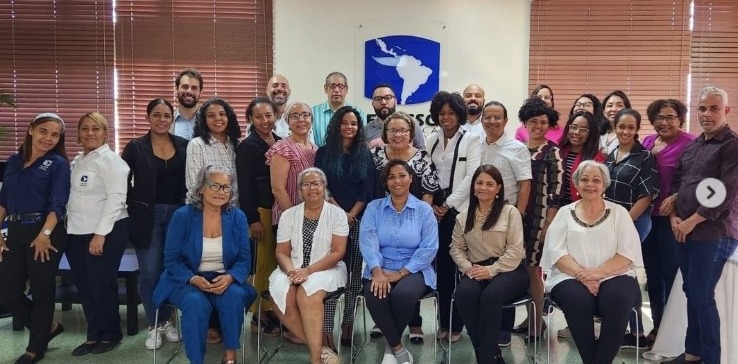
Following the organization of International Seminar: Climate Change and its Impacts on the Greater Caribbean in July 2019 and of Seminar: Climate Change in SIDS of the Caribbean. The Role of Public Policies and Local Communities in June 2022, both at the University of Havana and coordinated by the CLACSO Working Group: Crisis, Responses and Alternatives in the Greater Caribbean in conjunction with the Norman Girvan Chair of Caribbean StudiesThe Working Group proposed to hold a third seminar to expand and deepen the areas of greatest interest associated with the impacts of climate change in the insular Caribbean and strategies for addressing it, this time based in the Dominican Republic.
The Norman Girvan Chair of Caribbean Studies at the University of Havana joined this initiative, having collaborated on the two previous seminars. As the host institution, and joining on this occasion, the participation of FLACSO-Dominican Republic.
This third seminar had a regional scope that, similar to the first edition, brought together experts and participants from the Greater Caribbean region, with a focus on colleagues residing in the Dominican Republic. Specialists and participants from Cuba, Haiti, and Mexico also took part. The initial planned enrollment of 20 participants grew to nearly 30.
This activity is part of the Platform for Social Dialogue on Environment, Climate Change and Social Development.

Tuesday May 2
The panel discussion took place in the morning. Impacts of climate change in the insular Caribbean and proposals for addressing it composed of Jacqueline Laguardia Martínez (CLACSO Working Group Crisis, responses and alternatives in the Greater Caribbean/The UWI), Milagros Martínez Reinosa (Norman Girvan Chair of Caribbean Studies) and Miguel Montero (MEPyD).

The report was presented in the afternoon. Learning from Irma and Maria and a discussion was held on recovery experiences with the participation of Jorge Alfredo Carballo (CLACSO Working Group Crisis, responses and alternatives in the Greater Caribbean / FLACSO – Cuba), Nayely Germoso (FLACSO-RD) and Patricia Gómez (Ciudad Alternativa).

Wednesday May 3
A round table discussion took place this morning on Negotiations on the environment and climate change: the case of the Dominican Republic moderated by Cheila Valera (FLACSO-RD) with the presence of Ambassador Julio Ortega Tous, Executive Secretary of the Dominican-Haitian Bilateral Joint Commission.
The discussion and subsequent exchange with attendees addressed various topics focused on the bilateral relationship between the Dominican Republic and Haiti, and how both countries must coordinate their positions and actions to confront shared environmental challenges and vulnerabilities. Nature knows no borders, and the entire island of Hispaniola is subject to environmental risks.
Specifically, Ambassador Ortega Tous commented on:
- Key moments in the Dominican-Haitian relationship
- Inequalities between countries and development gaps in the western portion of the Dominican Republic that borders Haiti
- Work experience in the area of river basins and water resource management.
In the dialogue with the Ambassador, the participants addressed several initiatives that have been carried out in border areas and the experiences of IDDI, REDOM, among others.
In the afternoon, the Dominican documentary “Tumba y Quema” by José María Cabral was screened.
It deals with the practice of destroying forests and vegetation for intensive farming. The discussion
The content was directed by Gloria Amézquita (CLACSO Working Group Crisis, responses and alternatives in the Greater Caribbean /Ciudad Alternativa).
Thursday May 4
A round table discussion took place this morning on Climate change and its impacts on Dominican society: perspectives from the community and vulnerable groups moderated by Milagros Martínez, Norman Girvan Chair of Caribbean Studies and featuring panelists Ana Moyano (Risk Management Forum), Eladia Gesto (PROPAGAS Foundation) and Noemi Araujo (Samaná Ecological Group).

In the afternoon, the documentary “My Port-au-Prince,” directed by the late Cuban filmmaker Rigoberto López Pego, was screened. It explored the effects of overpopulation in the Haitian capital within a context of insufficient resources for infrastructure development, land-use planning, and a lack of opportunities for communities living on the city's outskirts. Commentary on the documentary was provided by Milagros Martínez, Norman Girvan Chair of Caribbean Studies, and Franklin Santos, Ministry of Economy, Planning and Development (MEPyD). The discussion with the participants was moderated by Jacqueline Laguardia Martínez (CLACSO Working Group on Crisis, Responses and Alternatives in the Greater Caribbean/The UWI).

Friday May 5
This morning, a roundtable discussion on “Synergies between health and climate change: impacts on the territory” was held, moderated by Ricardo Melgen, Director of Population Health at the Ministry of Public Health (Dominican Republic). Panelists included Luisa Íñiguez (FLACSO – Cuba), Jeanty Fils Exalus from the Ministry of Public Health and Population (Haiti), and Gonzalo Basile and Josvane Japa Rodríguez, both from the International Health Program at FLACSO – Dominican Republic.
In the afternoon, Pierre Candelon, UNDP Environment and Climate Action Specialist, presented the UNDP survey on perceptions of climate change and its effects in the Dominican Republic. The session was moderated by Nayely Germoso (FLACSO-RD). The study focuses on understanding Dominican perceptions of climate change and can be accessed via an online dashboard.
To view the interactive survey data, please follow this link: bit.ly/3o3uaHD

SEMINAR COORDINATION
- Jacqueline Laguardia MartínezCo-Coordinator from the CLACSO Working Group on Crisis, Responses and Alternatives in the Greater Caribbean
- Gloria E. Amezquita PuntielCo-Coordinator of the CLACSO Working Group on Crisis, Responses and Alternatives in the Greater Caribbean
- Milagros E. Martínez ReinosaExecutive Secretary of the 'Norman Girvan' Chair of Caribbean Studies at the University of Havana
- Cheila Valera AcostaDirector of the FLACSO Program – Dominican Republic
- Lourdes F. Meyreles ViciosoCoordinator of the Social Study of Disaster Risk Program, FLACSO – RD
ORGANIZATION
CLACSO Working Group Crisis, responses and alternatives in the Greater Caribbean
Norman Girvan Chair of Caribbean Studies, University of Havana, Cuba
Latin American Faculty of Social Sciences of the Dominican Republic (FLACSO – RD)
SUPPORT
Latin American Council of Social Sciences
Social Science Research Council

