
"Regional and Global South cooperation is becoming increasingly important"
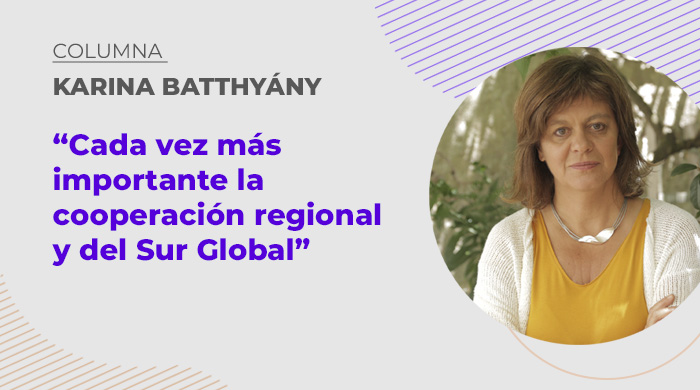
Transcript of Karina Batthyány's column
in InfoCLACSO – August 7, 2024
In June we were in Bogotá, Colombia, at the forum organized by Fundació Sentit Comú de Cataluña, “Imagining the future from the south”, where the Ministry of Cultures, Arts and Knowledge of Colombia had a relevant participation.
This initiative aimed primarily to establish a public forum that addressed the major challenges of our time regarding strengthening democracy, equal opportunities, social justice, peace, the energy transition, and coexistence in pluralistic spaces free from racism, xenophobia, classism, sexism, or any other form of discrimination. Ultimately, it sought to work in a strategic alliance based on CLACSO's founding principles, which we uphold in all our actions.
It is important to remember that this year, within the framework of the cooperation project “Cities Without Fear: Dialogues between Latin America and Barcelona,” carried out by CLACSO and the Fundació Sentit Comú of Catalonia, we have worked on a report by a prestigious team of researchers led by René Ramírez, coordinator of the Science, Technology, and Innovation Axis of the UNESCO CRES and former Minister of Higher Education of Ecuador. The report, entitled “Debates on Democracy and Equality,” aims to study the economic, social, and political dynamics occurring during this period of paradigm shift, the analysis of which is essential to understanding the direction in which the societies we inhabit are heading.
Simply listing the chapter titles is enough to understand the importance of the analysis and debate proposed. For example: “Crisis of Capitalism, Besieged Democracy, and Creative Resistance in the Long Political, Economic, and Social Cycles of Latin America and the Caribbean,” “Democracy in Dispute: Between Siege and Emancipation,” “Anti-Democratic Redistribution: Ideology as a Counter-Cycle,” “Colombia: That Latin American Blind Knot,” and, as an epilogue, “Democracy for Life, Democracy for Peace as a Vaccine Against Authoritarian Narco-Neoliberalism.”
Furthermore, the report's introduction states that one of the defining characteristics of our time is that we live in increasingly unequal societies. Inequality is once again presented as a structural and historical feature of our region. This inequality undermines social cohesion, particularly fracturing the communities it impacts most severely, with profound social, political, and economic consequences.
The report then adds that the social destruction caused by inequality generates disinterest in politics, identity fragmentation, and, especially, increased polarization that gives rise to reactionary options capable of challenging the very foundations of the democratic systems in which we live. In light of this, the report investigates how the political dispute between progressive and conservative options plays out at a time of rising authoritarian tendencies worldwide, a trend from which our Latin American and Caribbean region is not immune.
In this context, it is worth recalling that at the end of April of this year, in Brazil, we organized, together with the Federal University of Rio de Janeiro, the Forum “The New Dynamics of South-South Relations and the Challenges of Latin American Integration,” with the participation of important academics and members of civil society and social organizations, where essential topics were addressed, such as “International academic cooperation and South-South relations,” “The new world system” and the “New directions of the world economy and the global south,” “The BRICS and the new dynamics of South-South and North-South relations,” the “New global and regional financial architecture and infrastructure for integration,” “Towards a strategic agenda for Latin American integration,” “Climate crisis, energy transition and the geopolitics of natural resources,” and “Science, technology, innovation and industrialization: challenges and new frontiers.”
In the context of that forum, I raised the concern that Latin American and Caribbean integration remains an unfinished task, which is detrimental in terms of development and the strengthening of the various dimensions that contribute to collective well-being. If anything can change the landscape of integration in Our America, it is the great potential it possesses—politically, culturally, economically, and due to its strategic natural resources. And this is something recognized internationally.
Latin America and the Caribbean has a vast wealth of natural resources, including minerals, oil, gas and a unique biodiversity that positions it as a region of great strategic interest at a global level and those of us who inhabit it must be aware of this.
Our countries are increasingly interdependent, and it is impossible to imagine alternatives or solutions to the multiple crises that affect us individually. Therefore, regional cooperation, and more broadly, cooperation with the Global South, is becoming increasingly important. This means it must be addressed at different levels: at the level of states, international organizations, and also academic institutions and organizations, where CLACSO plays a leading role with its South-South program. This program is based on advancing development goals, grounded in principles of solidarity, equity, horizontal exchange among our countries, and the premise of interdependence. It also emphasizes horizontal relationships with the organizations that cooperate with, work with, and are strategic partners of our institution.
This program, which we developed at CLACSO, seeks not only to share resources and knowledge, but also to build a framework for cooperation based on equity and mutual respect, breaking with the models of vertical and asymmetrical cooperation that have prevailed in other historical periods. It is from this perspective that we build and develop cooperation with the Global South.
The foundation of these collaborations is knowledge sharing and the implementation of various programs in the fields of training, research, publications, and communication. These activities are essential for creating a shared knowledge base and strengthening local capacities, enabling countries in the Global South to address their challenges more effectively and autonomously.
We have a concrete example: our Latin American Forum on Scientific Evaluation (FOLEC), which seeks to establish evaluation criteria adapted to the realities and needs of the Global South, promoting a more inclusive, relevant, and engaged science. This forum already has the participation of countries from the Global South, the support of the African Council, the Arab Council of Social Sciences, and the Chinese Academy of Social Sciences, as well as support from India and other parts of the Global South. Collaboration with these organizations allows us to expand this network of cooperation, enriching the exchange of knowledge and experiences, and strengthening the strategic alliances that enable us to drive this joint development.
Latin America, due to its geopolitical position, strategic resources, and cultural diversity, has a crucial role to play in redefining the Global South and achieving effective regional integration. This would not only strengthen its negotiating power internationally but also promote more sustainable and inclusive development for all regions. The Latin American and Caribbean region has the potential to become a leader in global initiatives, enabling it to discuss and reflect on these shared challenges, plan concrete actions, and establish commitments that will allow us to move forward in this direction. At CLACSO, we frame this within our broader strategic project, the Platforms for Social Dialogue (PDS). These platforms, while prioritizing key issues for Latin America and the Caribbean, extend far beyond these areas, embodying a commitment to the Global South.
– I was thinking about the multifaceted importance of South-South relations, including topics like open science, the dynamics of research and scientific advancement, and the specific characteristics of that part of the world…
That's why I always place these points of reflection within the framework of our broader project, our Platforms for Social Dialogue (PDS), which focuses on knowledge as a common good, open science, and the benefits of that knowledge for everyone. That's why we so strongly advocate, from this region of the world, for progress not only in diagnoses but also in the transformation of scientific practices.
If you would like to receive more information about CLACSO's training programs:
[widget id=”custom_html-57″]
to our email lists.

