
Biden and The Great Game of the 21st Century
Pablo Pozzi [1]
Throughout the second half of the 19th century, England pursued a series of diplomatic and military measures to maintain its position as the preeminent power in the Middle East. Its main rival was Tsarist Russia, whose primary objectives were the dismantling of the Ottoman Empire and the decline of British influence in India. This struggle was likened to a grand chess game, with peoples and nations as pieces, and was called the Great Game. A key element of what was also termed the Tournament in the Shadows was that words did not match actions. In other words, it was the era of " fake news ." With the Ukrainian conflict, it would seem we are witnessing a new edition of this tournament, but this time with the United States replacing Great Britain as the central player. What is at stake is whether one of the powers will resign itself to ceasing to be one: or rather, whether Russia will cease to be one, while the United States continues its uninterrupted decline.
This is nothing new. Behind the Cold War and the fight against “atheistic and barbaric communism” lay the American effort to develop and maintain its global hegemony. The dissolution of the USSR seemed to end the game, when in reality it ushered in a second phase. Gorbachev and his successors, convinced that the confrontation with the United States was ideological, thought that the fall of the Soviet state could usher in an era of friendly relations between two capitalist powers. And while Yeltsin and his advisors strove to maintain good relations, the Americans moved steadily and quietly to extend their influence over what had been the nations in the Soviet sphere. While businessmen plundered Eastern Europe in the 1990s, the State Department, the CIA, and the National Endowment for Democracy showered dollars on all those anti-Russian politicians who wished to take refuge under the umbrella and domination of the American empire. The quid pro quo for this economic “aid” was facilitating both the penetration of American companies and the integration of these nations into the NATO Pact. Those that retained some semblance of independence, such as Yugoslavia, were dismembered by NATO forces in support of barely democratic movements like the paramilitary (and allegedly drug-trafficking) Kosovo Liberation Army. Furthermore, NATO intervened in places far removed from its original mandate, such as when it destroyed Muammar Gaddafi's Libya.
All of the above allowed the United States a decade of unquestioned hegemony, but it did not resolve its economic decline. That is, the rate of return on invested capital has been falling for more than four decades. This decline, reflected in increases in inflation, the unemployment rate, and productivity per hour worked, as well as the growth of the speculative sector at the expense of the productive sector, erupted in 2009, generating discontent among the American population and friction among sectors of the ruling class regarding future policy. For a whole sector, led by the Claremont Institute in California, the policy initiated primarily by Clinton had failed to halt the decline, much less curb China's rise. Therefore, a new foreign policy was needed, one that emphasized China as an enemy while improving relations with potential allies such as Russia. This was the perspective of the Donald Trump administration, and it explains the thaw in relations with Moscow, the dialogue with North Korea, while the American military presence in Africa and the seas of Asia increased.
The opposing faction, which dates back to the Reagan era and continued under the Democratic and Republican administrations of Bush, Clinton, and Obama, believes that both Russia and China must be confronted, increasing pressure on Russia not only to gain access to its natural resources but also to hinder access for both China and its other major rival, the European Union. This faction has strong ties to the military-industrial complex. For example, Biden's Secretary of State, Anthony Blinken, a specialist in Eastern Europe and China, was Obama's Deputy National Security Advisor and is the co-founder and owner of WestExec Advisors, a company that facilitates contract negotiations between various corporations and the Pentagon. Blinken and several other executives from WestExec and similar companies have served in every administration since 1980, except for the four years of Trump's presidency. Victoria Nuland, for instance, is the wife of Robert Kagan, a key advisor to the Bush administration and instrumental in the rise of neo-Nazis in Ukraine. Not to mention Janet Yellen, now Treasury Secretary, who was Chair of the Federal Reserve between 2014 and 2018 (in case you didn't realize, she served "with honor" under both: Obama and Trump).
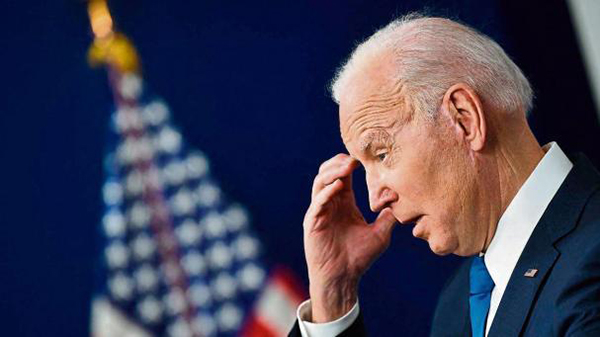
For this sector, the Trump administration was a disaster, not only because of the erratic behavior of the "Orange-Haired President," but above all because it sought to distance itself from the national and international policies that had led us from the subprime mortgage crisis to the wars in Iraq and Afghanistan. These policies impoverished millions of Americans, but also meant that the 100 richest billionaires in the United States tripled and quadrupled their fortunes in less than a decade and a half. This sector orchestrated the electoral campaign of Joe Biden, a right-wing Democrat with strong ties to the military-industrial complex and, through his son Hunter, to Ukrainian neo-fascists. His victory implied a return to pre-Trump policies, but this time in an even more extreme form.
As soon as he assumed the presidency, the new shift became evident. On the one hand, Biden appointed a whole host of experts to the State Department, all distinguished by their long-standing anti-Russian leanings. Among these new officials, there are neither progressives nor moderates. In fact, their principal foreign policy architects can all be described as “hawks.” Notably, they served in the Obama and George W. Bush administrations, and all are linked to the military-industrial complex and various proposals for military intervention around the world. In every case, their central focus is reversing the decline of American global power by confronting “Russian and Chinese expansionism” “decisively.” At the same time, there are no specialists in Latin America or Africa. They all concentrate their expertise on Russia and China. On the other hand, Biden signaled his new stance when he accused Putin of being a “murderer” and a “gangster”—not exactly terms conducive to dialogue.
Furthermore, the new government advanced its efforts to extend NATO into Eastern Europe, while reinforcing its troops and military equipment in countries like Poland. It also provided diplomatic support to the Ukrainian government to continue its efforts to "cleanse" the Russian-speaking regions of Luhansk and Donbas of Russians. Part of this involved blocking the new Russian-German gas pipeline, Nord II, and preventing the implementation of the Minsk II agreements, while the Ukrainians withdrew from the negotiations intended to end the conflict with Russia. Finally, the United States launched a media campaign accusing Russia of expansionism.
Now, another interesting aspect is the power of the media controlled by the United States. Everywhere you look, Vladimir Putin's name is always described with an adjective like "authoritarian" or "gangster." In every newspaper, Ukraine is portrayed as a poor, innocent lamb. Commentators insist that Russia is attacking because it "wants to restore the USSR's empire." Let's see, suppose Russia spent $5 billion (as the US did in Ukraine) to overthrow the Canadian prime minister. Then, the Canadian Putin supporters expelled the Americans from their soil and claimed, say, Seattle as their own (one of the largest ports in the Pacific), and they constantly fired on US border posts, all while Russia sent missiles and troops, and Putin's son got rich on the boards of Canadian companies (as Biden's son is doing in Ukraine). What would the United States do? I don't know, except that we know that when the USSR launched a couple of missiles at Cuba, the Americans imposed the blockade that still exists today, and then trained a band of mercenary thugs to invade at the Bay of Pigs. Well, but that was an exception. More or less, in 1916 they invaded Mexico to protect their oil interests and pursue Pancho Villa. And let's not even mention the Nicaraguan Contras. What's remarkable about the Ukrainian crisis isn't just the patience Putin has shown, but how the United States manipulates world opinion.
The American approach is worthy of the Great Game. On the one hand, it's about pressuring Russia as much as possible and pushing that nation to the brink (what's known as " brinkmanship "). If Russia invades Ukraine, as it has, the United States can position itself as a champion of Ukrainian sovereignty, all while applying sanctions that they hope will hinder Russian economic development. At the same time, this would be useful to them in relation to their shadow competitor: the European Union. The EU, particularly Germany, imports a third of its oil and half of its natural gas from Russia. Russian billionaires not only fuel the European tourism industry but are also some of its largest investors. Russia, like China, has developed intense trade relations with the EU in the last decade. At the same time, the United States couldn't care less about Ukrainian sovereignty and independence. That's why promises of aid arrive late and are scarce, and why American diplomacy has made enormous efforts to block any negotiated solution to the conflict that has existed since 2014. Finally, since 1916, the American tradition has been that in the face of an economic crisis, the response has been war, which entails deficit spending by the state and allows for tax revenue (not to mention that if you participate and win, you can plunder the defeated). It is no accident that the officials who implement this policy are those linked to the military-industrial complex.
The flip side is that Putin is not Yeltsin, Russia is not Yugoslavia, and 2022 is not 1994. In reality, Putin gives the impression that he has been preparing his nation for this confrontation for some time now. Not only by strengthening economic ties and reducing tensions with China, but also by finally understanding that the United States only understands force. In other words, never in their history have Americans honored an international treaty without being forced to do so; from the agreements with the Indian Nations to the postwar treaties, they have broken them all. In fact, they have invaded other nations 392 times (and I'm sure I'm underestimating).
It is clear that Russia will not emerge unscathed from this war. The most likely outcome will resemble the Georgian war a few years ago: a swift and overwhelming Russian victory, securing the autonomy/sovereignty of the claimed Russian-speaking territories while preventing a new NATO member from joining its borders. At the same time, however much Putin has improved his economic relations with the rest of the world, European sanctions will have an effect, both on Russia and on Europe. And, of course, Putin will emerge from the conflict as the aggressor, providing fodder for American propaganda.
And what about the United States? Biden is convinced his policy was the right one. But it's doubtful this will hold true in the medium term. On the one hand, Washington has proven to be "much ado about nothing." Not only because it threatened, but never actually supported, the Ukrainian neo-fascists, but also because strong tensions have surfaced among NATO's European members. Germany has already set limits on economic sanctions, and the Eastern European countries, while they have mobilized, show no interest in entering a war with a nuclear power that would be fighting on their own soil. More than one person must be thinking that NATO is a paper tiger, recalling those drawings of tigers that the Chinese used to stick at the entrances of their houses to ward off evil spirits.
The other problem the United States will face is related to its economy. At a time of inflation and declining productivity and terms of trade, Biden is imposing sanctions on a major producer of energy and agricultural resources. Global oil and soybean prices are already rising, and consequently, so is US inflation.
As so often happens, war seems like a solution for statesmen who never think about the thousands of dead. But in this case, it's not a solution to the problems of Biden and Putin either.
[1] Member of the CLACSO Working Group on the Left: Praxis and Social Transformation. A version of this article was published at https://www.eldestapeweb.com/internacionales/guerra-rusia-ucrania/biden-y-el-gran-juego-siglo-xxi-20222270530.
If you would like to receive more information about CLACSO's training programs:
[widget id=”custom_html-57″]
to our email lists.

