
Advancing the democratization of knowledge

The InfoCLACSO live stream on Wednesday, October 27, featured a prominent segment on International Open Access Week, with contributions from Karina Batthyány , Executive Secretary of CLACSO; Laura Rovelli , coordinator of the Latin American Forum for Scientific Evaluation (FOLEC) of CLACSO; Dominique Babini , advisor at CLACSO on open access policy; and Arianna Becerril García , President of AmeliCA and Executive Director of Redalyc, the Network of Scientific Journals of Latin America and the Caribbean, Spain and Portugal.
“Open and free access to scientific knowledge was, is, and will be one of the most important principles of our institution,” summarized Karina Batthyány, noting that “access to knowledge has become one of the central issues of inequality (…) Defending knowledge as a public good is also a way to combat poverty and inequality and promote democratic participation.”
Dominique Babini, in turn, asserted that “Open Access is present in all dimensions of our lives (…) We must move forward in the democratization of knowledge and listen to all voices,” affirming that “CLACSO shares and safeguards the diversity of collections in Open Access knowledge.”
According to Laura Rovelli, “evaluation policies in the commercial circuit reduce knowledge production,” which is why “Open Access needs to be included in knowledge circulation processes.” “We need all books to be available through Open Access,” she concluded.
Finally, Arianna Becerril García emphasized that “we need to debate the issue of structural equity in Open Access” and “ask ourselves and question what we are doing to strengthen Open Access.” She concluded: “In market terms, oligopoly generates a financial crisis.”
International Open Access Week, from October 25 to 31, is convened this year under the slogan "How we open knowledge matters – Building structural equity," which aligns with UNESCO's recommendation on open science, of which open access is a crucial component.
Karina Batthyány: “Access to knowledge has become one of the central issues of inequality”
During this week, CLACSO, together with many institutions and agencies with which we work dedicated to training, research and the promotion of Science and Technology, celebrates International Open Access Week.
These days CLACSO will have a very important presence, organizing, sponsoring or participating, through different references in the subject, in events of different types: seminars, colloquiums, open classes, symposia, and in the launch of books and podcasts, among other activities.
Why all this? Because open and free access to scientific knowledge was, is, and will be one of the most important principles of our institution, and that is why we are participating in the organization of Open Access Week.
We must remember that promoting open access to Latin American and Caribbean academic production is a way to democratize knowledge—this is one of CLACSO's founding objectives. And we believe that in recent years this issue has become even more important. This is because, as never before, access to knowledge has become a central issue of inequality. Therefore, this topic will be very prominent at our Conference, "The Web of Inequalities," in June of next year (2022).
We believe that defending knowledge as a public good that is distributed throughout society in an equitable, free, collaborative and non-commercial manner is also a way to combat poverty and inequality and promote or strengthen democratic participation.
In this fight to which we are committed, CLACSO has many actions underway this week, as well as ongoing actions within our strategic guidelines. For example:
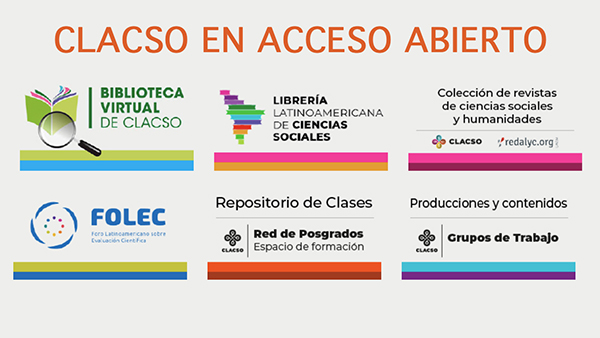
-The Latin American Social Sciences Bookstore, which offers more than 3.500 books from different collections for free download.
-The Virtual Libraries Network, which has more than 100 texts from the network of associated centers and CLACSO Working Groups.
-The joint portal with the Network of Scientific Journals of Latin America and the Caribbean (REDALYC), which offers open access to almost 300 articles from 650 social sciences and humanities journals in the region.
-And also CLACSO TV, which in these last years of pandemic and quarantines is playing a more than prominent role, with many documentaries, interviews, virtual classes and talks.
Therefore, our publications program has been one of the channels through which our researchers, intellectuals, academics and scholars can disseminate the results of their work, their reflections and research, in the different areas of knowledge.
It is worth pausing to consider the case of the Latin American Social Sciences Library: it has had more than 30 million downloads during the last year, its collection has been built, improved, and multiplied with the Member Centers, but also in agreements with other institutions, such as the Ayacucho Library of Venezuela; the National University of General Sarmiento of Argentina; or the María Sibylla Merian Center for Advanced Latin American Studies in Humanities and Social Sciences (CALAS); also co-editions with commercial publishing houses such as Siglo XXI of Mexico and Argentina, or, signed just a few days ago, Blossom Press of China, among others.
At the beginning of this column, I mentioned that we are engaged in this struggle. Why do we call it a struggle? Because CLACSO and other training and research institutions are deeply committed to promoting the democratization of knowledge. This effort takes place within a context of increasing commodification of the educational and academic systems.
We want to emphasize that this defense of open access and of the repositories of our Latin American Library of Knowledge as a public good is, ultimately, also going against this trend towards the commodification of knowledge and also of the results of research.
The data you've shared is truly striking, because it speaks to an open access policy that is bearing fruit in terms of the impact of knowledge access materials and is trying to avoid the commodification logic you mentioned. But what's happening globally regarding this issue? Are we really able to challenge these market forces when it comes to knowledge? How much longer will this struggle continue as we address these issues?
I would love to tell you that we're almost there and that we're winning this fight, but unfortunately, that's not the case. We're in the midst of a debate and a full-blown challenge to democratize knowledge and, above all, to counter these commodifying trends. Progress has been made… Latin America and the Caribbean are an example in this regard, as is the work CLACSO is doing, particularly in relation to the data I presented from the Latin American Library. But much remains to be done. We have other lines of work that we're promoting, which go hand in hand with knowledge assessment and academic evaluation, where sometimes one of the requirements is precisely publication not in open access, but in those large journal publishers that are ultimately commodifying the results of research.
Arianna Becerril: “We need to put the discussion of structural equity in Open Access up for debate”
-Why was the slogan chosen: “It matters how we open up knowledge by building structural equity”?
I am very pleased that Spark, the organization that has fostered International Open Access Week, has chosen this theme through its committee. Because it touches on a fundamental point: we are 20 years on from the Budapest Declaration, which formalized open access. While it already existed, especially in our Latin American region, it wasn't until this initiative and others—of course, there were declarations on the matter before in Latin America—that it became formalized and gained international visibility.
So, I think it's very important to discuss structural equity and really question how we open up knowledge: it's not about achieving open access at any cost or regardless of who it affects, it's not about that. And we often see this in other regions and in models of knowledge commodification. No matter how, the point is to open up knowledge and eliminate subscriptions, regardless of whether this is generating new exclusions or inequities in other parts of the knowledge generation circuits.
Therefore, I believe it is crucial to place the discussion and emphasis on structural equity within the international discourse. And not only within the international discourse, but also with decision-makers, with key entities and individuals involved in defining science policy and evaluating science. Because it is precisely at this juncture that we can move towards achieving equity, epistemic justice, and ensuring that open access becomes a tool that allows us to foster this global conversation about science, which undoubtedly is the most beneficial for scientific development, improved quality of life, and the advancement and progress of society.
-There are logics of information and knowledge confinement that are completely globalized and worldwide. So, what is your assessment regarding Open Access in 2021?
"It's a bit worrying, I'd say. I believe our Latin American region is a global leader in the model of Science as a Common Good. It's the most consolidated community that has made significant progress toward involving the academic sector and public sector governments to support scientific publishing and scientific communication in general. But unfortunately, the open access initiatives of the major publishers, who are, in a way, the main players in scientific communication in the Global North, especially in Europe and the United States, have been consolidating and, in a way, transforming open access into something that is actually shifting the costs, as we now know with the infamous APC (Application Processing Code). And what happens? Beyond the economic problem, the response from commercial publishers is always 'good,' but we give discounts to developing countries, we waive the fees. Beyond that issue, it's about asking ourselves, regarding the privatization of knowledge and scientific dissemination, what implications this has for the development of science." And in that sense, we need to examine the interests at play when this commercial model is being adopted. Something we've observed is the restrictions surrounding this type of content. While it's achieving open access—that is, it's subscription-free—there are many doubts and problems. For example, there are restrictions regarding deposit in institutional repositories. Therefore, something published openly by a commercial publisher doesn't necessarily have the same level of open access as if it were published non-commercially. Furthermore, copyright issues persist even when a computer is paid for to publish; the author still has to relinquish their rights. This casts doubt on the future of open access because the commercial publisher remains the owner, and we don't know what policies or restrictions they, as the owners of this knowledge, will impose on open access in the future. So, there's a very important issue here, one that I find very concerning regarding the open access achieved through commercial means and its associated restrictions. For example, when something is made open source commercially, that openness doesn't usually grant the right to process it, to mine data and texts, even if you pay to make it open source or subscribe to a service. So, we're also limiting the scope of new knowledge development because this openness isn't fully realized. Therefore, 20 years into Open Access, we need to ask ourselves this question and evaluate our governments and institutions: What are we doing to strengthen open access that is more focused on science as a common good?
How does the fact that researchers have to pay to publish their research and have to do so in English complicate matters? How does it complicate what is and isn't researched, for example, in Latin American and Caribbean societies? How does it influence research and publications?
It has to do with the scientific agenda and, above all, with the community we need to reach when we communicate knowledge. Ultimately, a scientific journal, an institutional repository, and a book all have one objective: to solve a problem, generate discussion within a specialist community, or generally demonstrate the social applicability of the knowledge being communicated. When publication is limited and required in another language, for example, English, it likely restricts the reach of this knowledge to the communities we should be reaching. On the other hand, there's the issue of the scientific agenda, where we know that journals, especially those published by commercial publishers, have very clear and defined agendas. To get my research published there, I might have to change or adjust the topics, the discipline, or the specialization of my research to place a scientific article in a journal of a certain quartile, which is often where research policies dictate. So yes, it is worrying that initiatives like "Plan S" are showing the results we've seen two years after their launch in Europe. There's a consolidation of transformative agreements, reaching up to 300% in some countries. In other words, it turns out that commercial publishers are gaining even more control over European scientific communication, while we, who have another way of doing things, have demonstrated that it's much healthier for scientific communication, prioritizing the interests of the community. I believe it's up to us as the Latin American community (we're on that path, and a call to action is warranted) to scale up our system, which, while already an international benchmark, has been degrading in some countries precisely because they're adopting the commercial model. We have to go further, to create an ecosystem (I wouldn't call it regional) of science as a common good, where authors from all over the world publish. Often, when we talk about the Latin American system, we think it's only for us, but that's not the case. We really need to move towards new forms of scientific evaluation through collaboration among platforms, systems, and initiatives. In that sense, our collaboration with CLACSO and Redalyc, as well as Americ and various other institutions, has been fundamental. I believe we can continue to strengthen it so that we can truly offer a counterproposal to this commercial model that, unfortunately, is absorbing a large amount of economic resources worldwide.
-Is it possible to envision profound changes that involve open access and democratization of knowledge in societies that continue to maintain logics of inequality and deepen issues of neoliberalism?
-I think so. I've been on panels with those kinds of counterparts, and there's at least something they should reflect on: it's a matter of the market and pure capitalism. If we look at it in terms of what's happening in Germany, which has opted for transformative agreements and APC payments, what's happening is the strengthening of an oligopoly. And in market terms, we all know what happens with an oligopoly, since it's going to create an inflationary crisis now regarding APCs. In fact, it hasn't even been three years and we're already seeing it… Simply to create a balance in the market, there should be strong investment in non-commercial open access, because it reduces the control and power of commercial publishers. If they are neoliberal governments or communities, it's ultimately very much associated with knowledge as a commodity or commercial product. At least for the sake of market health, non-commercial open access should be supported, strengthened, and invested in precisely to eliminate the imbalance that already exists in the commercial communications market. So, I think they're taking that argument a bit more seriously now, because that's exactly what happened 20 years ago, and that's why the Budapest Declaration came about—because they realized they were completely captured by the commercial market. And that's what's happening now, and what will happen in a few years with the PC issue. So, even for the sake of balance, the health of the capitalist system, and scientific communication, the non-commercial model has to have a place, the resources, and be able to be competitive, as it already is in Latin America.
Dominique Babini: “We must move forward with the democratization of knowledge and listen to all voices.”
Open access is present in every dimension of our lives. We witnessed it during the pandemic, from citizens seeking information online about treatments and news, to academic journals that helped them better understand what was happening. Then, hospitals transmitted data to databases to inform the international community and enable monitoring, releasing open access scientific articles that expedited vaccine rollout. Finally, we saw it in the reporting of the pandemic's economic and social impacts, as demonstrated by the CLACSO Social Observatory of the Pandemic.
Open access has truly played a vital role. Returning to this year's theme of "how we open knowledge matters" and "building structural equity."
Open access equity means that when we design the necessary infrastructures to provide open access to knowledge, we take into account the circumstances of those who are producing knowledge, those who disseminate it, and those who use that academic and scientific knowledge.
For example, when we create platforms to give visibility and access to scientific publications, we have to be careful about who manages those platforms, because it makes a big difference whether they are managed by the commercial sector or by the community itself. When infrastructure is managed, technology is defined. So, who ensures that open access to knowledge is equitable?
People without reliable internet access can still access PDFs in other formats like HTML. In other words, we need to address technical issues to ensure greater equity in access to all the publications we distribute. And then, when we decide what content and knowledge to disseminate through open access, we have to consider whose voices we're excluding, who isn't present on the platforms we're developing.
We must also strive for equitable sustainability so that everyone can participate, share their knowledge, and have access to open access resources. That's why it's so important that the management of open access platforms be in the hands of the community itself, and not outsourced to the commercial sector, to large international publishers, because they make decisions driven by their commercial needs and shareholder interests, not by the interests of the community.
-How were these 20 years of CLACSO's work with open access?
The theme of International Open Access Week is equity. When CLACSO embarked on this path 20 years ago, it did so with that model in mind, but it wasn't the prevailing trend. The international trend was open access to scientific and academic output in English published in mainstream scientific journals. We then discovered that in Latin America, knowledge is expressed in a diversity of formats, not only in scientific journal articles and books. At CLACSO, we had to decide to incorporate all these formats, and little by little, the collections grew: a process carried out in consultation with the Member Centers, a centralized, cooperative effort. The collections expanded, and most importantly, we built community. The community of publishers and libraries within the CLACSO Network became part of this transition process from the print world to the digital world, and from the digital world to open access. CLACSO shares best practices for open access policies and initiatives. And today, CLACSO's Publishing Department, together with the Library and the Communications Department, manages this diverse collection, which ranges from 3.000 books to its Member Centers' open access resources: more than 300 texts available in the CLACSO REDALYC collection (Network of Scientific Journals of Latin America and the Caribbean). All this output has allowed CLACSO to position itself to influence policies in Latin America, engaging in dialogue and carrying out important activities such as reflecting on and evaluating scientific production. Are we valuing what is produced in the region? We also need to contribute to the international debate. But to do that, we must build and support more voices in the region.
Laura Rovelli: “At FOLEC we are promoting the appreciation of open access and open science.”
Undoubtedly, evaluation policies based on incentivizing publication with an impact factor in the commercial circuit are clearly reducing, limiting, and generating greater inequalities in the production and circulation of knowledge, particularly in regions like ours in Latin America and the Caribbean, which have less representation in these knowledge circulation circuits. Therefore, in this sense, reducing the impact factor in evaluation processes, starting by eliminating all references to this indicator in research funding calls and by devaluing the career paths of researchers in the region, is undoubtedly a step in favor of equity, and one that CLACSO and FOLEC are working to make happen.
But openness and open access are also strengthened by including evaluation mechanisms that help populations that have been less represented or have a more peripheral presence in the scientific system to be better represented in the evaluation processes, as well as institutions and regions with fewer scientific capacities. These also need to be included in the processes of knowledge production and dissemination.
Therefore, from FOLEC we are encouraging the appreciation of open access and open science and a diversity of scientific productions by those who are evaluated as researchers, teachers, extension workers, in a much broader way, both in universities and in the evaluation systems of science and technology organizations.
Also linked to equity is our proposal to strengthen multilingualism. To illustrate, considering the international scientific citation index, we see that publications in Spanish between 2009 and 2015 represent only 0,42 percent of the knowledge circulating in that international index, and in Portuguese only 0,30 percent. Therefore, we see that the richness and diversity of publications from our regions are not equitably represented in this circuit, nor is the richness of our languages, of our cultural expressions, reflected there.
That's why, from an evaluation standpoint, we promote this openness to multilingualism in science communication, and I would also say a third key aspect is bibliodiversity. That is, specifically, ensuring that books—a very valuable and long-standing tradition of scientific publication and communication in the social sciences and humanities—can be valued in evaluation processes. And for that, we need these books to be open access, peer-reviewed, and readily available so that we can also generate indicators about the diversity of scientific output we have there.
Ultimately, equity is fostered by responsible evaluation with inclusive research indicators regarding gender, open access, ethics, extension as we call it in Latin America or the link with society, and by a situated use in each of the institutions of the countries of our region.
So, in a way, we aim for equity in research evaluation to strengthen access and open science.
If you would like to receive more information about CLACSO's training programs:
[widget id=”custom_html-57″]
to our email lists.

