
Authoritarianism, seductions and utopias
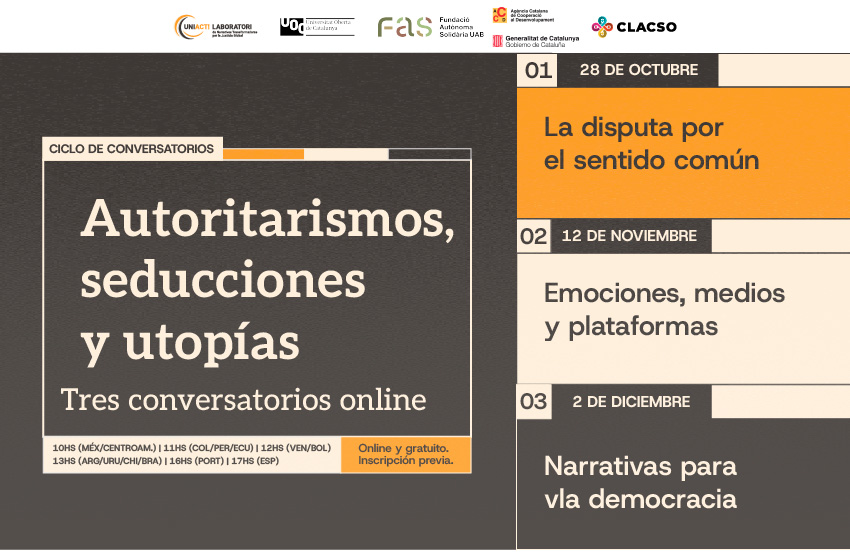
“ Authoritarianism, seductions and utopias ” is a series of three virtual talks that proposes to analyze how political narratives that are transforming public debate and common sense are currently constructed, circulated and contested.
The cycle begins with the question: how do certain narratives manage to connect with social anxieties, mobilize emotions, generate identification, and transform our understanding of concepts such as freedom, security, equality, rights, or democracy?
Over three sessions, the project seeks to address this phenomenon from different perspectives, fostering dialogue between experiences and viewpoints from Latin America, the Caribbean, Catalonia, and Europe. Each discussion proposes a journey that ranges from understanding narratives and analyzing how they circulate to explaining how we can construct transformative narratives within the framework of Global Justice.
October 28: The Dispute over Common Sense. Authoritarian Narratives and Democratic Crisis
November 12: Emotions, media, and platforms. How authoritarian narratives circulate and are legitimized.
2 de diciembre: Narrativas para la democracia. Comunicación transformadora e imaginación política
Organized by: Laboratory of Transformative Narratives for Global Justice of the Open University of Catalonia (UOC) and the Autonomous Solidarity Foundation of the Autonomous University of Barcelona (UAB), together with the Latin American Council of Social Sciences (CLACSO). Supported by: Catalan Agency for Development Cooperation (ACCD).
First discussion: “The dispute over common sense: authoritarian narratives and democratic crisis” – October 28
Contemporary democracies are experiencing a profound struggle over the definition of the common good. The rise of new right-wing movements and authoritarian projects cannot be explained solely by their electoral results: it also relies on their ability to interpret social discontent, offer seemingly simple explanations for complex problems, and redefine values such as freedom, security, resistance, equality, rights, and democracy.
This webinar proposes to analyze the social, economic, political, and cultural transformations that have fostered the expansion of these narratives and their capacity to articulate diverse demands, fears, frustrations, and aspirations. From a comparative perspective between Europe and Latin America, it will address their continuities and innovations, the political actors they engage, the antagonisms they construct, and the societal imaginaries they propose.
The activity proposes to analyze the rise of authoritarian narratives in contemporary democracies, exploring the cultural, political and emotional frameworks that support their ability to redefine common sense and legitimize exclusionary projects.
They expose:
-Maria Julia Giménez, Post-Graduation Program in Social Sciences, Universidade Federal Rural do Rio de Janeiro.
Yanet Martínez Toledo, Institute of Economic Research, University of Costa Rica.
steven forti, Autonomous University of Barcelona.
Elvin Calcano, Complutense University of Madrid.
Moderator: Amparo Marroquín , Central American University of El Salvador.
Schedule: Mexico and Central America: 10:00 a.m. / Colombia, Peru and Ecuador: 11:00 a.m. / Venezuela and Bolivia: 12:00 p.m. / Argentina, Uruguay, Chile and Brazil: 13:00 p.m. / Portugal: 15:00 p.m. / Spain: 16:00 p.m.
Format: virtual.
This activity will be broadcast on CLACSO platforms
Upcoming meetings of the cycle
November 11: Emotions, media and platforms: how authoritarian narratives circulate and are legitimized
The capacity of authoritarian narratives to transform public debate depends not only on what they say, but also on how they circulate, who amplifies them, and what emotions they manage to activate. Digital platforms, media outlets, virtual communities, influencers, and political actors form hybrid ecosystems in which discourses are reproduced, adapted, and legitimized at great speed.
This webinar will analyze the relationships between platform architecture, the attention economy, algorithmic logic, polarization, disinformation, and affective mobilization. Rather than understanding audiences as passive recipients, the aim is to explore how certain narratives manage to construct identification, belonging, and communities of meaning. Dialogue between experiences from Latin America and Catalonia will allow for the identification of shared dynamics and local specificities, as well as a discussion of the possibilities and limitations of responses based solely on fact-checking.
2 de diciembre: Narrativas para la democracia: comunicación transformadora e imaginación política
Faced with the rise of authoritarian and exclusionary discourses, the defense of democracy cannot be limited to refuting disinformation, denouncing hate speech, or reacting to frameworks imposed by other actors. Challenging the prevailing common sense also requires constructing narratives capable of broadening the horizon of what is possible, forging connections, and translating principles such as global justice, human rights, equality, and sustainability into socially meaningful experiences and language.
This webinar proposes shifting the question from how to respond to authoritarian narratives to how to construct our own democratic narratives. Drawing on experiences developed in Catalonia and Latin America, it will explore transformative communication strategies, cultural practices, and forms of political imagination capable of bypassing adversarial frameworks, activating democratic sentiments, and making alternative futures visible. The objective is to identify lessons learned, methodologies, and experiences that can contribute to communication for global justice, oriented not only toward resistance but also toward imagining, connecting, and transforming.