
Neoliberal authoritarianism or democratizing democracy?
The dispute over the future in Latin America
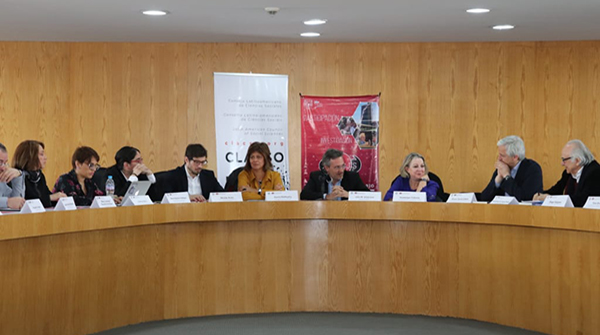
At the facilities of the National Autonomous University of Mexico, on February 7 and 8, the Conversation “Neoliberal Authoritarianism or Democratizing Democracy?: The Dispute for the Future in Latin America” is taking place, with the presence of prominent academics from Latin America and the Caribbean.

Organized jointly by CLACSO and the University Program of Studies on Democracy, Justice and Society (PUEDJS-UNAM), the organizers argue that “Latin America is in dispute. Indeed, while there was a challenge to neoliberalism with the arrival of progressive governments in the region, it is also true that there was an onslaught of conservative strategies where—whether through coups d'état, political betrayals of their people, or electoral processes tainted by new forms of media intrusion and manipulation in politics—governments came to institutionalized power that once again led the region down the path of accumulation for the few and dispossession for the vast majority… In Mexico and Argentina, Manuel López Obrador and Alberto Fernández demonstrate that a second wave of progressive governments may once again sweep across the region… Within the framework of this second wave that is palpable in the air and felt in the social pulse of our countries, the need to debate and develop new narratives is clear.” and ideas that allow us to challenge the neoliberal common sense that has taken such deep root.”
The opening of the Conversation will be attended by John M. Ackerman, Director of PUEDJS-UNAM, Karina Batthyány, Executive Secretary of CLACSO, Guadalupe Valencia, Coordinator of Humanities-UNAM and Nicolás Arata, Director of Training and Editorial Production of CLACSO.

The first presentation, by the Portuguese sociologist Boaventura de Sousa Santos, Director of the Centre for Social Studies at the University of Coimbra, deals with the “Construction of demodiversity, articulation of social movements-political movements and unity of the left.”
Attendees
a) Foreign Guests
Álvaro García Linera – First Vice President of the Plurinational State of Bolivia
Boaventura de Sousa Santos – Director of the Center for Social Studies, University of Coimbra-Portugal
Guy Alberto Vernáez Hernández – Executive Secretary of the Federal Council of Government of Venezuela
Gabriela Alejandra Rivadeneira Burbano – Former President of the National Assembly of Ecuador
Jochen Kemner – Manager, CALAS
Karina Batthyány – Executive Secretary, CLACSO
Marcio Pochmann – State University of Campinas-Brazil
María José Pizarro – Congresswoman, House of Representatives of Colombia
Nicolás Arata – CLACSO-Argentina
Ricardo Foster – University of Buenos Aires. Advisor to the President of the Republic of Argentina
Ricardo Armando Patiño – Former Foreign Minister of Ecuador
Rosa Mirian Elisalde – First Vice President of UPEC and Vice President of FELAP (Cuba)
Santiago Hernández – National University of Lanus, Argentina
María Soledad Buendía Herdoiza – Former Assemblywoman of Ecuador
b) Mexican Academics
María Elena Álvarez Buylla – Director General of the National Council of Science and Technology (CONACYT)
Irma Eréndira Sandoval – Secretary of Public Administration – Mexico
Guadalupe Valencia García – Coordinator of Humanities at UNAM
Raúl Delgado Wise – Director of the Academic Unit of Development Studies, Autonomous University of Zacatecas
Margarita Favela Gavia – Researcher at the Center for Interdisciplinary Research in Sciences and Humanities, UNAM
Sergio Zermeño y García-Granados – Researcher at the Institute of Social Research, UNAM
Héctor Díaz Polanco – Center for Research and Higher Studies in Social Anthropology, (CIESAS)
Ana Esther Ceceña Martorella – Researcher at the Institute of Economic Research, UNAM
Elvira Concheiro Bórquez – Researcher at the Center for Interdisciplinary Research in Sciences and Humanities, UNAM
Enrique Dussel – Faculty of Philosophy and Letters, UNAM
Carlos Mendoza – Director of Channel 6 de Julio
Lucio Oliver Costilla – Researcher at the Center for Latin American Studies, UNAM
Luis Gómez Sánchez – Center for Theoretical and Multidisciplinary Studies in Social Sciences, UNAM
Jorge Linares Salgado – Director of the Faculty of Philosophy and Letters, UNAM
José Gandarilla Salgado – Center for Interdisciplinary Research in Sciences and Humanities, UNAM
Jorge Witker Velázquez – Institute of Legal Research, UNAM
Gerardo de la Fuente Lora – Faculty of Philosophy and Letters, UNAM
Sarah Corona Berkin – Director of CALAS, University of Guadalajara
Alain Basai Rodríguez – Representatives of the CLACSO member centers in Mexico
Darío Salinas Figueredo – Representatives of the CLACSO member centers in Mexico
c) Academics from the University Program of Studies on Democracy, Justice and Society (PUEDJS) of the UNAM
John Ackerman – Director of PUEDJS
Adrián Escamilla – Academic Secretary of PUEDJS
Miguel Ángel Ramírez – Research Coordinator at PUEDJS
Paola Ricaurte – Researcher at Tecnológico de Monterrey and Coordinator of the PUEDJS-CONACYT Digital Laboratory
René Ramírez Gallegos – Researcher at PUEDJS and Co-Coordinator of the CONACYT Political Cultures Project.
Walter Arellano – Coordinator of Teaching and Training PUEDJS
Ann Lee – Researcher PUEDJS-CONACYT
Eduardo Fernando Paz – Researcher PUEDJS-CONACYT
Eloy Caloca Lafont – Researcher PUEDJS-CONACYT
Gabriela Gallardo – Researcher PUEDJS-CONACYT
Israel Jurado – Researcher PUEDJS-CONACYT
Navarro Isidro – Researcher PUEDJS-CONACYT
Erika Pérez Domínguez – Researcher PUEDJS-CONACYT
Julián Morales – Postdoctoral Student PUEDJS
If you would like to receive more information about CLACSO's training programs:
[widget id=”custom_html-57″]
to our email lists.

