
Autonomies, cinema and re-existences: praxis-theory, genealogies and aesthetics in the decolonization of methodologies
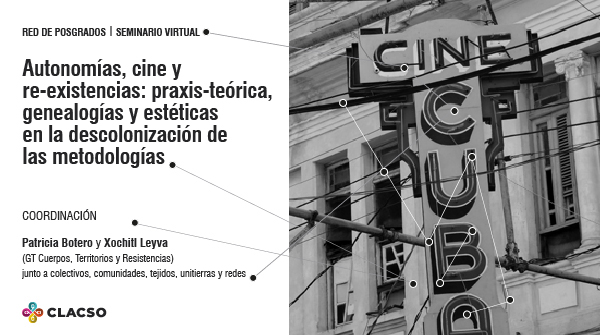
Seminar 2035
Coordination : Patricia Botero-Gómez and Xochitl Leyva Solano (GT Bodies, Territories and Resistances) in collaboration with collectives of professors and researchers with an emphasis on Latin American film criticism, curators and community filmmakers participating in the GT meetings in collaborative research processes and from the following collective actions that exist and of which we are an organic part: The Indigenous Videographers Project of the Southern Border (PVIFS), The Autonomies, Cinema and Re-existences Group, The Transnational Network Other Knowledges (RETOS); The Independent Studies Center Color Tierra and The Fabric of Collectives-University of the Earth, in Manizales-Caldas and southwestern Colombia.
Start date : 03/09/2020 | Registration : 20/04/2020 to 02/09/2020
Workload: 12 weeks – 90 hours.
This seminar seeks to decolonize the perspective by reconfiguring collective imaginaries, consciousnesses and unconscious minds through the study of Latin American cinema and the construction of documentary proposals linked to research processes based on collective actions, resistances and re-existences.
The purpose of this seminar is to share experiences of figuration and reconfiguration of audiovisual narratives from the perspective of critical psychoanalysis, post-Marxism and decolonial theoretical practices.
One of the most subtle forms of recolonization consists of information and counter-information wars and the ways in which they are linked to dominant media capitalism, which mask the reality of dispossession under the premise of enchantment, and subtle forms of racism, patriarchy, and recolonization of imaginaries. In this sense, the analysis and production of short and feature-length documentary films constitutes a tool of information and transformation that warrants a critique of criticism, by making us see, hear, feel, live, and be from the enunciative position of people, peoples, and communities in re-existence.
Consequently, one of the experiences of making visible autonomous worlds and realities and of transformation emphatically starts from the new audiovisual and digital frameworks which constitute an unavoidable field of knowledge for the social sciences to make visible, audible, feelable-thinkable and transformable the socio-territorial realities that relate the life of the peoples, the subjectivities and communities in resistances that exercise steps of uncooptable autonomies and that circulate in knowledge, practices, philosophies and theories written as inscribed.
Visual aesthetics and poetics, testimony, and narrative account for the multiple meanings of being polyglot, that is, activating multiple languages and complementary forms of expression, different from the logocentric exclusivity inherent in the very paradox that characterizes the cinematic fable. Cinema can approach reality as a problem and more freely experiment with the variable interplay between action and life” (Rancière, 29). In this way, the image that both silences and speaks, the word that generates images and enigmas, new proposals and approaches on stage make it possible to retell a reality from the point of view of those directly involved, their struggles, chance encounters, dramas, and proposals for pluriversal worlds and realities.
Versions of reality circulate based on testimonies reread from the reality of the present, the past, and the creation of new devices of hope to decolonize possible futures. In this way, research trilogies carried out with communities, actors of flesh and blood, create new hopes and alternatives to decolonize times, to refute versions that tell the present, the past, and the future in order to reinvent them in each immediate context, from the simplicity of the story of everyday life.
The boomerang effect produced in the present, predicted by risk theorists since the end of the 20th century, allows us to recount the collapse, but not merely the awareness of the catastrophe, but the alternatives for transformation that are thematized as alternatives to globalization, degrowth, food autonomies, self-governments, struggles raised by the outbreaks of social movements and peoples in re-existence in Abya Yala.
- Cinema, Autonomies and Re-existences: Bets on a Decolonial Genealogy from Cinema and Critical Psychoanalysis
- Agro-Eco-Visual Autonomies and Dignified Life.
- Cinema, autonomy and ancestrality from the Luuçx Leçxkwe program
- Memories of Fire, ancestry as a narrative force
- Cinema and resistance against racism and femicides: Weaving the Afro Abya Yala diaspora
- Challenges, tensions and possibilities in the construction of representations from a feminist, anti-racist, intersectional and intercultural perspective.
- Agro-eco-spiritual struggles, autonomies and digital territorialities and Latin American cinema.
- Childhoods and migrations
- Creation of an autonomous scene for critical and alternative independent cinema. Experiences in film analysis and diversity.
- Imagination to power, audiovisual mobilization in Latin American students through film, audiovisual as resistance and transgression.
- BOTERO, Patricia. “Political and critical psychology from a decolonial perspective and autonomous resistances. Steps, voices and socio-territorial theories in movements.” In Álvaro Díaz
- GÓMEZ and Omar BRAVO. Political Psychology and Peace Processes in Colombia. Cali, Colombian Association of Psychology Faculties and Icesi University Press, 2019, pp. 49-84
- BOTERO, P. and MORA, A. “Communities in resistance and re-existence: a contribution to popular communication processes.” In: Germán Muñoz (Ed.). Re-visiting Popular Communication: Essays to understand it as a strategic scenario of social resistance and political re-existence. Bogotá, Uniminuto, 2018, pp. 135-192
- CERTEAU, Michel de. History and Psychoanalysis. Between Science and Fiction. Mexico City, Universidad Iberoamericana, 2007.
- DELEUZE, Gilles. Conversations. Valencia, Pre-textos. 1995-2006.
- DELEUZE, Gilles. Essays Critical and clinical. Minneapolis, University of Minnesota. 1997.
- FAJARDO, Andrea. Sarayaku and ICTs: A struggle for territorial self-determination. Master's Thesis. Quito, FLACSO, 2016.
- HOLLOWAY, John. “Critical thinking in the face of the capitalist hydra.” In La Jornada, May 15, 2015.
- KÖHLER, Axel and Xochitl LEYVA (eds.). Indigenous Video in Motion and Resistance. Buenos Aires and San Cristóbal de Las Casas, CLACSO, Cesmeca-UNICACH, Cooperativa Editorial RETOS,
- Maldonado Editions, 2020.
- LEÓN, O. (coord.). “Democratizing the word. Converging movements in communication.” Latin America in Motion, Lima, ALAI. 2013
- LEYVA, Xochitl and Axel KÖHLER. “Brushstrokes from Chiapas on the State, Indigenous Video, Insurgencies and Counterinsurgency.” In Santiago Bastos and María Teresa Sierra (eds.). State and Indigenous Peoples in Mexico. The Dispute over Justice and Rights. Mexico City, CIESAS, 2017. pp. 296-320.
- LEYVA, Xochitl and Rosalba ICAZA (coord.). In Times of Death: Bodies, Rebellions, Resistances. Buenos Aires, San Cristóbal de Las Casas, The Hague. CLACSO, Cooperativa Editorial Retos, ISS/EUR, 2019, Volume IV.
- OZU, Yasujiro. The Poetics of the Everyday. Writings on Cinema. Spain, Gallo Nero, 2017.
Fabric of Collectives, Movements and Peoples and compilers BOTERO, Patricia; ALVES, Rita; LEYVA, Xochitl and ITATÍ PALERMO, Alicia. Generations in motion and generational movements. Villamaría, Caldas-Colombia, Sao Paulo-Brazil, Buenos Aires, San Cristóbal de las Casas, CLACSO, Color Tierra, Cooperativa Editorial Retos, 2019. Volume V. - JAQUES, Rancière. The Cinematic Fable. Buenos Aires, El cuenco de Plata, 2001-2018.
If you have a link with a CLACSO Associated Center:
- Paying in one payment: USD 95 (includes issuance and shipping costs of the digital certificate).
- Paying in one payment: USD 140 (includes issuance and shipping costs of the digital certificate).
- Paying in one payment BEFORE 25/08/2020: USD 150 (includes issuance and shipping costs of the digital certificate).
- Paying in one payment: USD 190 (includes issuance and shipping costs of the digital certificate).
FAQ
The basic requirements for taking a seminar are:
- Availability of at least 4 hours per week to dedicate to the seminar course.
- Internet access.
- Reasonable handling of communication and computer tools.
- Language proficiency in the language in which the course will be taught. The official languages are Spanish and Portuguese.
If you have a link with a CLACSO Associated Center:
- Paying in one payment: USD 95 (includes issuance and shipping costs of the digital certificate).
- Paying in one payment: USD 140 (includes issuance and shipping costs of the digital certificate).
- Paying in one payment BEFORE 25/08/2020: USD 150 (includes issuance and shipping costs of the digital certificate).
- Paying in one payment: USD 190 (includes issuance and shipping costs of the digital certificate).

