
“Women’s physical autonomy to advance equity and equality”
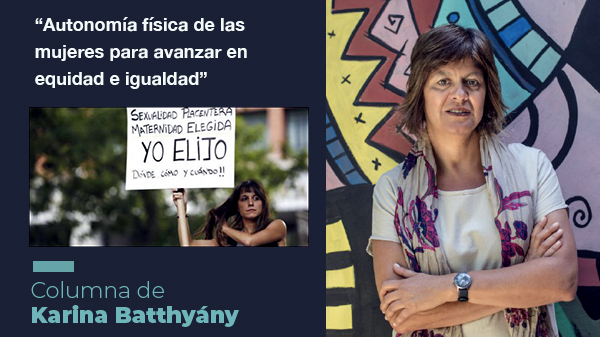
(Transcription of Karina Batthyány's Column)
in InfoCLACSO – 24 March 2021)
-We're starting today's program by focusing on March 24th, a truly special day in Argentina, but I also understand its regional significance due to the Latin American dictatorships. Before you begin your segment, I was wondering if you could share your thoughts on this day and tell us a bit about what March 24th meant in Argentina and in Latin America and the Caribbean.
-Of course. We cannot begin without acknowledging that today is March 24th and that it is fitting to engage in an exercise of remembrance as part of the ongoing struggle for Human Rights, Truth, and Justice throughout Latin America and the Caribbean. Indeed, the coup d'état of March 24, 1976, in Argentina brought to a close a cycle of civilian-military interventions in South America that had previously overthrown constitutional governments in Paraguay, Brazil, Bolivia, Chile, and here in Uruguay, in order to impose policies of terror and advance clearly neoliberal economic projects.
From CLACSO, as champions of historical memory, as one of the essential elements for shaping the future, we want to be present when condemning these classic coups of the last century, but also the more recent ones disguised, in some cases, as parliamentary coups, as was the case in Paraguay, Honduras, Brazil, and Bolivia. We want to keep the banners of Memory, Truth, Justice, and Never Again flying high. March 24, 1976, as we have said, marked the beginning of the worst years of terror in the modern history of Argentina, with hundreds of torture camps, 30,000 disappeared detainees, thousands murdered, political prisoners, and exiles: a carefully planned methodology to crush popular struggles, workers' and students' struggles, and to impose an economic policy of destroying the productive apparatus, dismantling the State, and forging new ties of dependency with global financial centers. Of course, this comes at the cost of impoverishing large segments of the population and neglecting common goods such as science, health, education, among others.
So, 45 years after the 76 coup in Argentina, CLACSO once again recognizes those who, during the dictatorship and since the return to democracy in December 83, have never wavered in their struggle and demands. I think of the Mothers and Grandmothers of Plaza de Mayo, but not only them. And of course, these people guide us in our search for more just, freer, and more egalitarian societies. Let us also remember, along this path, the work of the Argentine Forensic Anthropology Team, which earned the Juan Gelman Latin American Prize from our Council and the National University of Quilmes. This prize consisted of the documentary "Traces of Death and Anthropology" and the book "Science for Truth," in addition to having spearheaded the campaign to nominate this Team, along with the University of Quilmes, for the 2020 Nobel Peace Prize. All of this is what this March 24th represents.
-Karina, thank you for this account and for sharing CLACSO's and your own position regarding what happened on March 24th. I was thinking about the book dedicated to the Argentine Forensic Anthropology Team, produced in conjunction with the National University of Quilmes. It's available in Open Access in the CLACSO library, and I understand it's a reference book, as is the documentary. I understand, Karina, that you had other topics to discuss because we're approaching the end of what we've called Women's Month, a month that was packed with virtual activities, presentations, grants, calls for proposals—it was truly a very active month. I was wondering, as a way of concluding these many days of reflection, but not closing the debate or the topics you've been addressing , where would you like to focus your thoughts today?
-Exactly. We have two Wednesdays left: this one and next, that is, March 24th and 31st. So, I propose we continue exploring gender inequalities from this perspective of autonomy. Last Wednesday we talked about economic autonomy; today we're going to focus on physical autonomy. Physical autonomy, which at least brings us to two major issues—more, but I'll highlight two—: first, the issue of gender-based violence, and second, sexual and reproductive rights. So, focusing on physical autonomy, after many years of struggle to make one of these problems visible—violence against women in the different spheres of our lives—this issue finally occupies a very important place on the public agenda of all the countries of Latin America and the Caribbean. In recent years, a series of initiatives have been implemented that reflect the commitment that has been assumed from different areas to prevent, to punish and also to eradicate violence against women at the level of different contexts, in different geographical spaces, such as regional, national and local spaces.
However, as we know and have already discussed here at InfoCLACSO, this remains a very important and urgent issue on the agenda of Latin American feminisms. Among other things, there is a lack of data, statistics, and precise figures that would allow us to identify the characteristics of the victim and the perpetrator, the relationship between them, the environment, the motivations, the patterns of behavior, and records that also allow us to account for such important dimensions as race, ethnicity, gender identity or sexual orientation, and place of residence. In our countries, this remains an outstanding issue for making further progress in understanding and transforming this problem of gender-based violence.
We know, as we've already mentioned, that the pandemic we're facing has only exacerbated the problem. Along with other organizations, we say that this is the second pandemic Latin America and the Caribbean is experiencing: the Coronavirus pandemic, but the pandemic of gender-based violence has been ongoing for several years. Let's recall the preliminary figures I mentioned earlier regarding this issue, which show at least 4.200 femicides in Latin America and the Caribbean in 2020. That means one woman every two hours. If we compare this to the 3.800 femicides in 2019, we see a significant increase. This is an issue we must continue working on; we must continue discussing and developing different approaches to understand and transform it. The situations we are experiencing today as a result of the health crisis compel us to do so even more urgently.
The second dimension to this issue is sexual and reproductive rights. Here, we could focus on two phenomena that are important from the perspective of autonomy in terms of sexual and reproductive rights. On the one hand, access to voluntary termination of pregnancy—to legal, safe, and free abortion. And as a second dimension, the issue of teenage pregnancy and motherhood. If we begin with the first, which we have also addressed here very recently in InfoCLACSO, it's important to remember that we are the region with the highest percentage of unsafe abortions in the world, and that it is precisely the context of illegality and criminalization of abortion that exposes women to these risks—risks that are not only medical but also social, psychological, and legal. Let's also recall the slogans that have resonated throughout Latin American countries, such as in Argentina, which recently passed its Law on Voluntary Termination of Pregnancy, which is: “Sex education to decide, contraception to avoid abortion, legal abortion to avoid death.” Why? Because ultimately, this issue of abortion is about democracy, about the vision of a democratic society, where women decide about their bodies and life projects, where these decisions must be respected, and where states, in addition to respecting them, must create the conditions to guarantee the exercise of these rights.
But as I was saying, there's a second dimension to this issue, which is teenage pregnancy and motherhood, also very high in our region, even though, in general terms, the fertility rate of Latin American and Caribbean women is declining. We have an issue with teenage pregnancy and motherhood, partly due to a lack of access to information about contraceptive methods and the restricted sexual and reproductive health rights available to Latin American and Caribbean adolescents. In general, our countries observe a teenage motherhood rate above 12%, which, of course, is much more significant when we break down that population according to income and education levels, with the group of adolescents from lower-income and lower-educated backgrounds being the most affected. Therein lies a very serious issue, highlighted by ECLAC (Economic Commission for Latin America and the Caribbean) in its latest reports, linked to the unmet demand for family planning. What does this mean by family planning? What percentage of sexually active, fertile women report not wanting more children or wishing to postpone their next pregnancy and do not use any contraceptive method? Why don't they use it? For the reason we mentioned earlier: the lack of access to information on sexual and reproductive health. Just two facts to conclude this point: let's remember the reality in Haiti: it tops the list of countries with the highest unmet need for family planning at 35%, meaning that almost 4 out of every 10 women in that country do not have access to contraceptives. Guatemala also has a 20% unmet need, as does Bolivia, and Honduras has 17%. This calls us to reflect on both dimensions of physical autonomy so we can continue working to truly advance in terms of equity and equality this March, Women's History Month, but every day, as you so aptly put it at the beginning.
Karina wanted to bring up the conversation we had last Wednesday with the activists from the Dominican Republic in that tent dedicated to fighting for dignity, for access to the possibility of decriminalizing abortion in cases as serious as sexual abuse. These cases aren't even included in Dominican legislation, and they told us that even politicians, both men and women, had campaigned on promises to vote for changes to the Penal Code, and now it seems they're backtracking, pushing back the possibility of those changes. I think it's a very clear example of the vast differences that exist in Latin America and the Caribbean.
Absolutely. What we showed last week with the women who were camped out in the Dominican Republic is an excellent indicator, as are some of the data we've shared here at InfoCLACSO. Let's remember: we have countries in Latin America where the penalties for women who have abortions are greater than those for rapists or sexual abusers. That's the most dramatic example of the inequalities we're talking about this March, Women's Month. And that's why we have to keep going, we have to reiterate these issues, we have to keep pushing and putting them on the agenda, as CLACSO is doing with its research, its training programs, its Working Groups, and its communications, like here at InfoCLACSO, where we repeatedly raise these issues so that everyone remembers that, ultimately, we have to keep fighting for these women's rights.
If you would like to receive more information about CLACSO's training programs:
[widget id=”custom_html-57″]
to our email lists.

